


























Views
Downloads



Printable Percent Increase/Decrease Worksheet (Grades 5-8)
Paste this activity's link or code into your existing LMS (Google Classroom, Canvas, Teams, Schoology, Moodle, etc.).
Students can open and work on the activity right away, with no student login required.
You'll still be able to track student progress and results from your teacher account.
Students master the complexities of proportional relationships with this comprehensive practice set. This resource guides learners through calculating the relative change between values, a critical skill for middle school mathematics and financial literacy. By the end of these exercises, students will confidently identify whether a value has grown or shrunk and express that change as a precise percentage.
At a Glance
- Grade: 7 · Subject: Math
- Standard:
CCSS.MATH.CONTENT.7.RP.A.3— Use proportional relationships to solve multistep ratio and percent problems- Skill Focus: Percent increase and decrease
- Format: 5 pages · 35 problems · Answer key included · PDF
- Best For: Mastery-based practice and formative assessment
- Time: 45–60 minutes
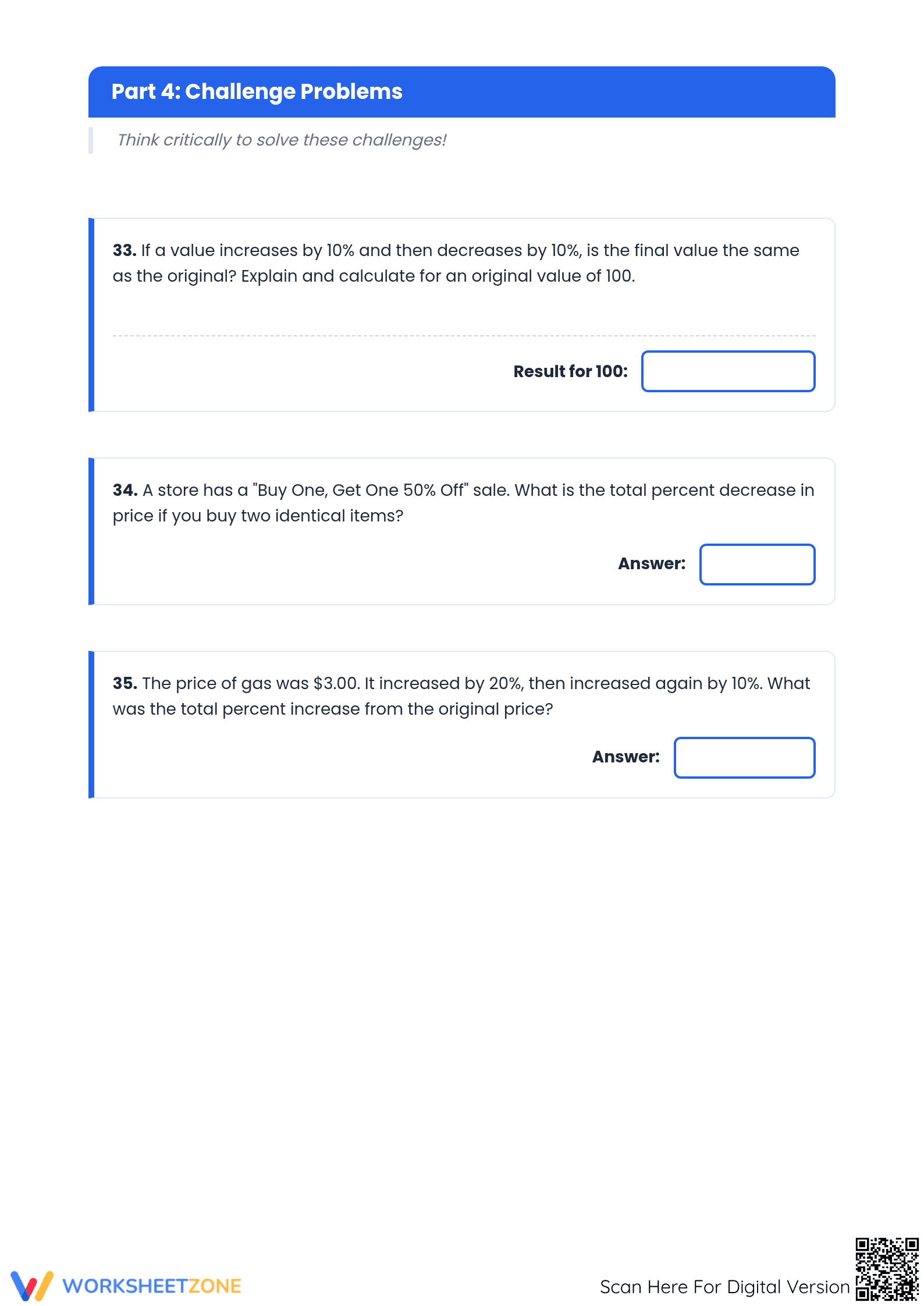
This five-page packet contains a structured sequence of 35 problems designed to build fluency and deep understanding. It includes a visual guide explaining the % change formula, twenty basic calculation drills, five real-world scenarios involving prices and populations, seven advanced multi-step applications with decimals, and three rigorous challenge problems that test conceptual limits. A full answer key ensures immediate feedback.
Skill Progression
- Guided Practice: Twenty integer-based calculation drills help students cement the core formula through high-volume repetition with manageable numbers.
- Supported Practice: Twelve contextual problems and decimal-based applications require students to translate real-world scenarios into mathematical expressions with teacher or peer support.
- Independent Practice: Three rigorous challenge tasks demand full mastery as students explain complex phenomena like compounding percentage changes and total discount rates.
This sequence follows a gradual-release model, transitioning students from procedural computation to high-level conceptual application across the five-page resource.
Standards Alignment
This resource is strictly aligned with `CCSS.MATH.CONTENT.7.RP.A.3`. Students use proportional relationships to solve multistep ratio and percent problems, specifically focusing on percent increase and decrease. This standard requires students to calculate markups, markdowns, and relative change accurately. Both standard codes can be copied directly into lesson plans, IEP goals, or district curriculum mapping tools.
How to Use It
Use this worksheet as a primary practice tool after introducing the percent change formula. It is ideal for a "I Do, We Do, You Do" lesson structure where the teacher models the first few basic problems before students work independently. Teachers should observe students during Part 2 to ensure they are correctly identifying the "old value" versus the "new value," as this is a common misconception. Expected completion time is 45 to 60 minutes.
Who It's For
This resource is designed for Grade 7 students but is highly effective for Grade 6 acceleration or Grade 8 remediation. It supports diverse learners through a visual guide and a scaffolded difficulty curve. This packet pairs naturally with a lesson on ratios or a financial literacy unit exploring sales tax and discounts.
According to the RAND AIRS 2024 report, high-quality mathematics instructional materials that incorporate a progression from procedural fluency to conceptual application are essential for closing achievement gaps in middle school. This worksheet directly addresses the procedural requirements of CCSS.MATH.CONTENT.7.RP.A.3 while challenging students with higher-order thinking tasks. By providing 35 diverse problems, including multi-step decimal applications and conceptual challenges, the resource ensures that students move beyond simple memorization toward a deeper understanding of proportional reasoning. Research indicates that when students are exposed to varied contexts for percentage change, they are better able to generalize these skills to real-world financial and scientific data. This worksheet provides that necessary variety, making it a robust addition to any standards-aligned math curriculum focused on preparing students for the rigors of algebra and data analysis.


