




























Views
Downloads


Essential Percent Increase and Decrease Worksheet | Grade 7

Paste this activity's link or code into your existing LMS (Google Classroom, Canvas, Teams, Schoology, Moodle, etc.).
Students can open and work on the activity right away, with no student login required.
You'll still be able to track student progress and results from your teacher account.
Mastering the mechanics of percentage change is a fundamental skill for middle school mathematicians. This worksheet provides students with targeted practice in calculating percent increase and decrease across twenty-one distinct problems. By progressing from basic numeric pairs to complex real-world word problems, learners develop the fluency needed to solve practical mathematical challenges with confidence.
At a Glance
- Grade: 7 · Subject: Math
- Standard:
CCSS.MATH.CONTENT.7.RP.A.3— Use proportional relationships to solve multistep ratio and percent problems like percent change- Skill Focus: Percent Increase and Decrease
- Format: 5 pages · 21 problems · Answer key included · PDF
- Best For: Middle school ratio and proportion practice
- Time: 45–60 minutes
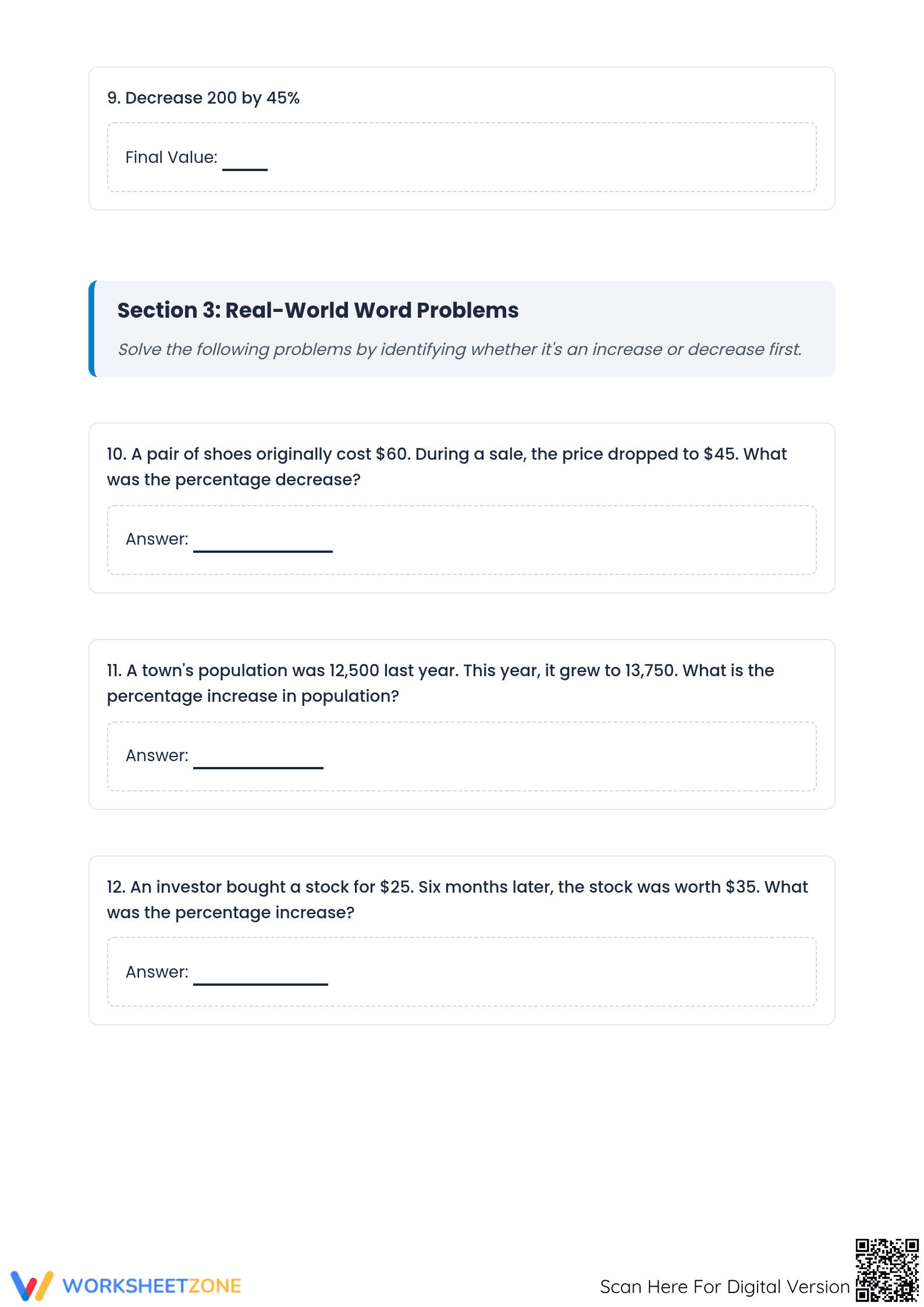
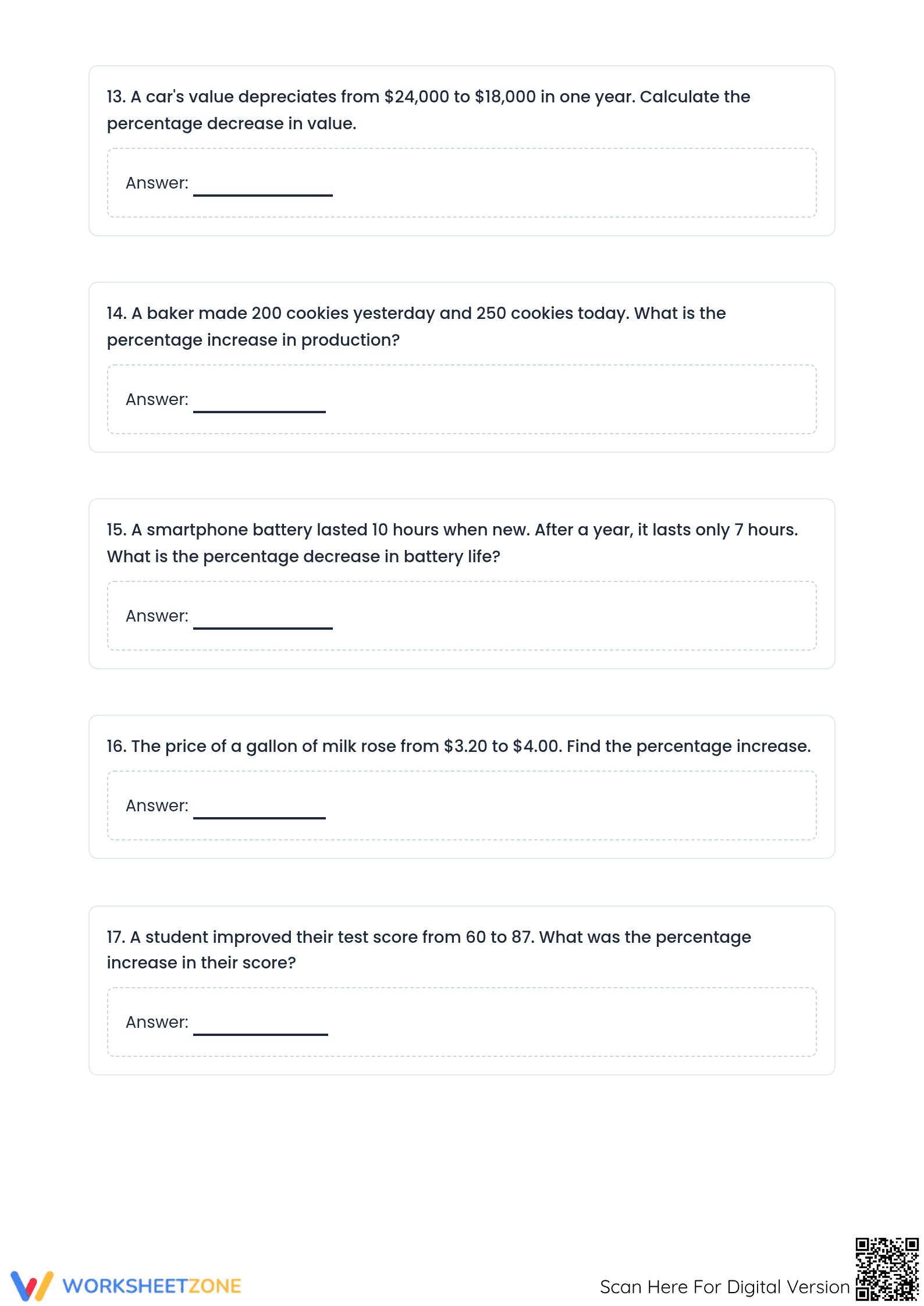
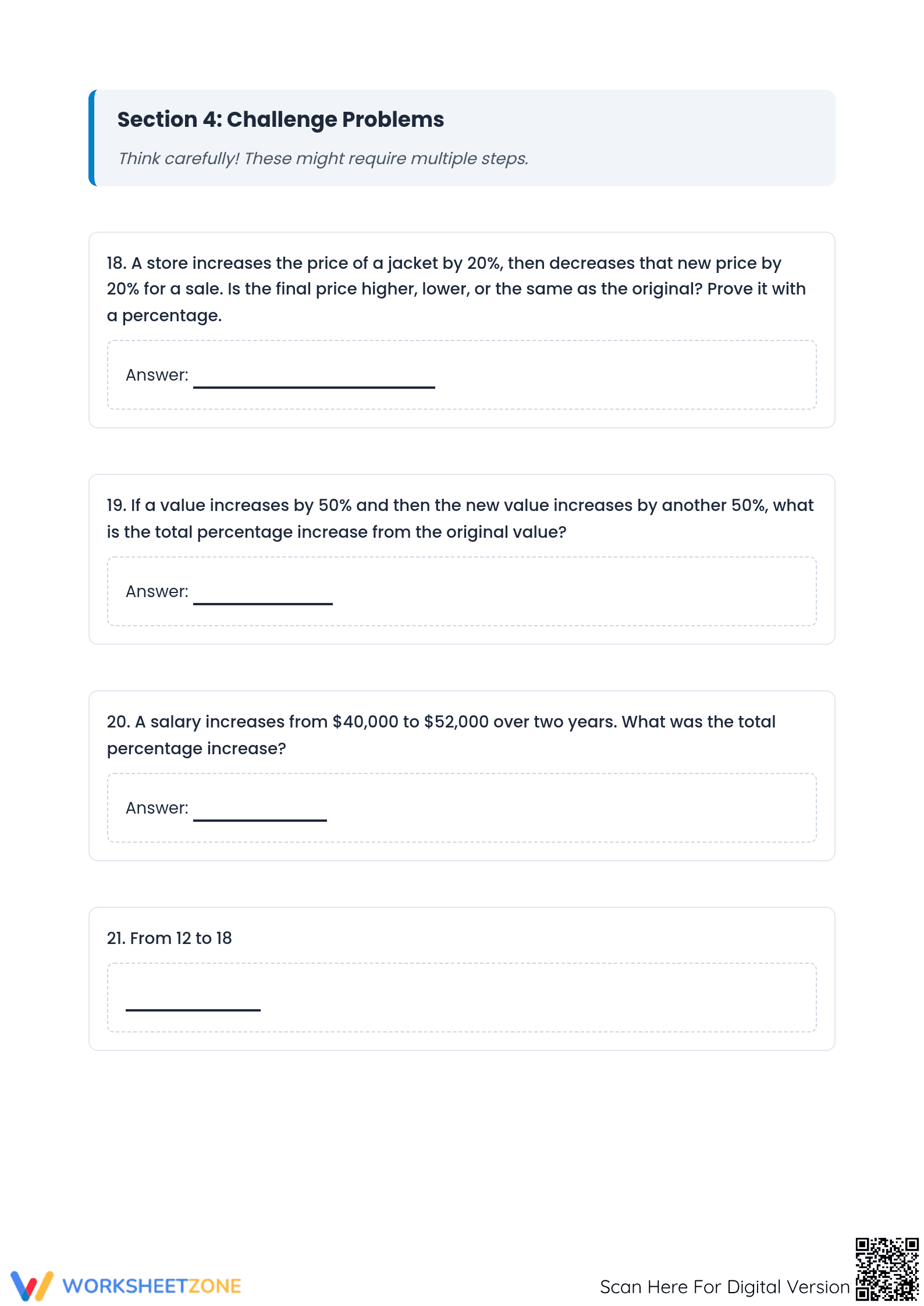
What's Inside: This five-page packet is organized into four logical sections. It begins with raw numeric calculations before moving into finding new values given a specific percentage. The third section introduces eight real-world scenarios, while the final section offers multi-step challenge problems. A complete answer key is provided to facilitate rapid grading or student self-correction.
Skill Progression
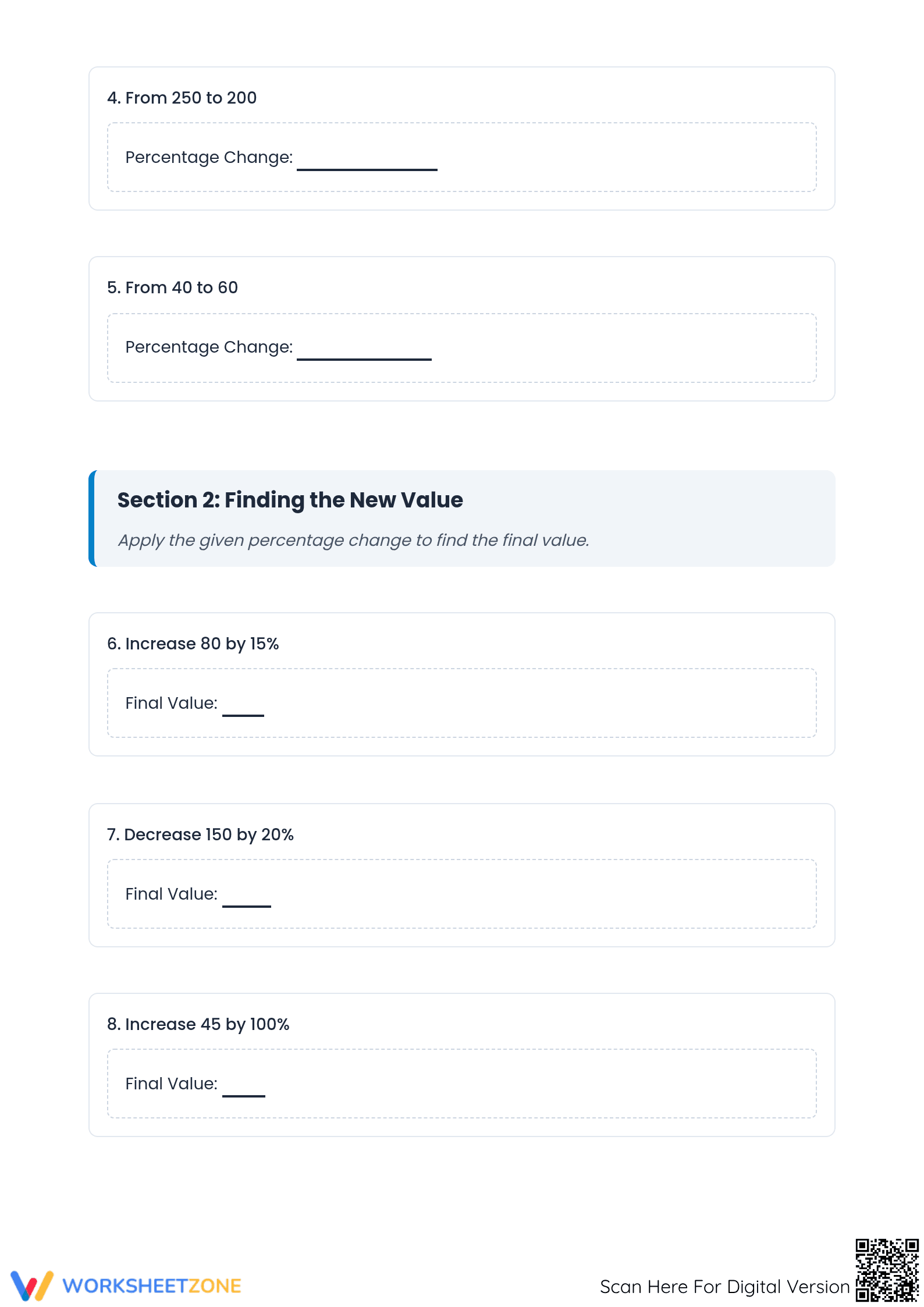
- Guided practice: The first five problems provide a structured framework, including the formula, to help students calculate percent change from simple integer pairs.
- Supported practice: Problems 6 through 9 transition students toward finding a final value after applying a percentage change to a given base number.
- Independent practice: The final sections require students to independently identify whether a scenario represents growth or decay and apply multi-step calculations.
The worksheet follows a gradual-release model, shifting from formula-assisted computation to independent application.
Standards Alignment
This resource is directly aligned to CCSS.MATH.CONTENT.7.RP.A.3, which requires students to use proportional relationships to solve multistep ratio and percent problems. The problems meet the rigor of the standards by requiring both procedural skill and conceptual application. This code can be copied directly into lesson plans, IEP goals, or district curriculum mapping tools.
How to Use It
This worksheet is ideal for independent practice. Teachers can assign the first two sections as a check for understanding after direct instruction. Alternatively, use the word problems as a formative assessment to observe how well students can translate verbal scenarios into mathematical expressions.
Who It's For
This material is designed for 7th-grade students, though it serves as a review for 8th-grade learners or enrichment for advanced 6th graders. The varied problem types allow for natural differentiation; struggling students can focus on the scaffolded calculations, while advanced learners can move to the multi-step challenges.
According to the RAND AIRS 2024 report on mathematics instructional materials, high-quality practice that integrates procedural fluency with real-world application is essential for retention of ratio concepts. This worksheet addresses that need with 21 rigorous tasks aligned to CCSS.MATH.CONTENT.7.RP.A.3. By moving from numeric pairs to scenarios involving salary increases and car depreciation, students build a mental model of how percentages operate in the economy. Research from ScienceDirect (2024) indicates that such targeted practice sets improve student performance on standardized assessments. The inclusion of challenge problems ensures that students are not merely memorizing a formula but are developing critical thinking skills required for non-routine situations. This resource provides the necessary breadth for classroom mastery.


