


























Views
Downloads

Percent Increase/Decrease | Essential Grade 7 Worksheet
Paste this activity's link or code into your existing LMS (Google Classroom, Canvas, Teams, Schoology, Moodle, etc.).
Students can open and work on the activity right away, with no student login required.
You'll still be able to track student progress and results from your teacher account.
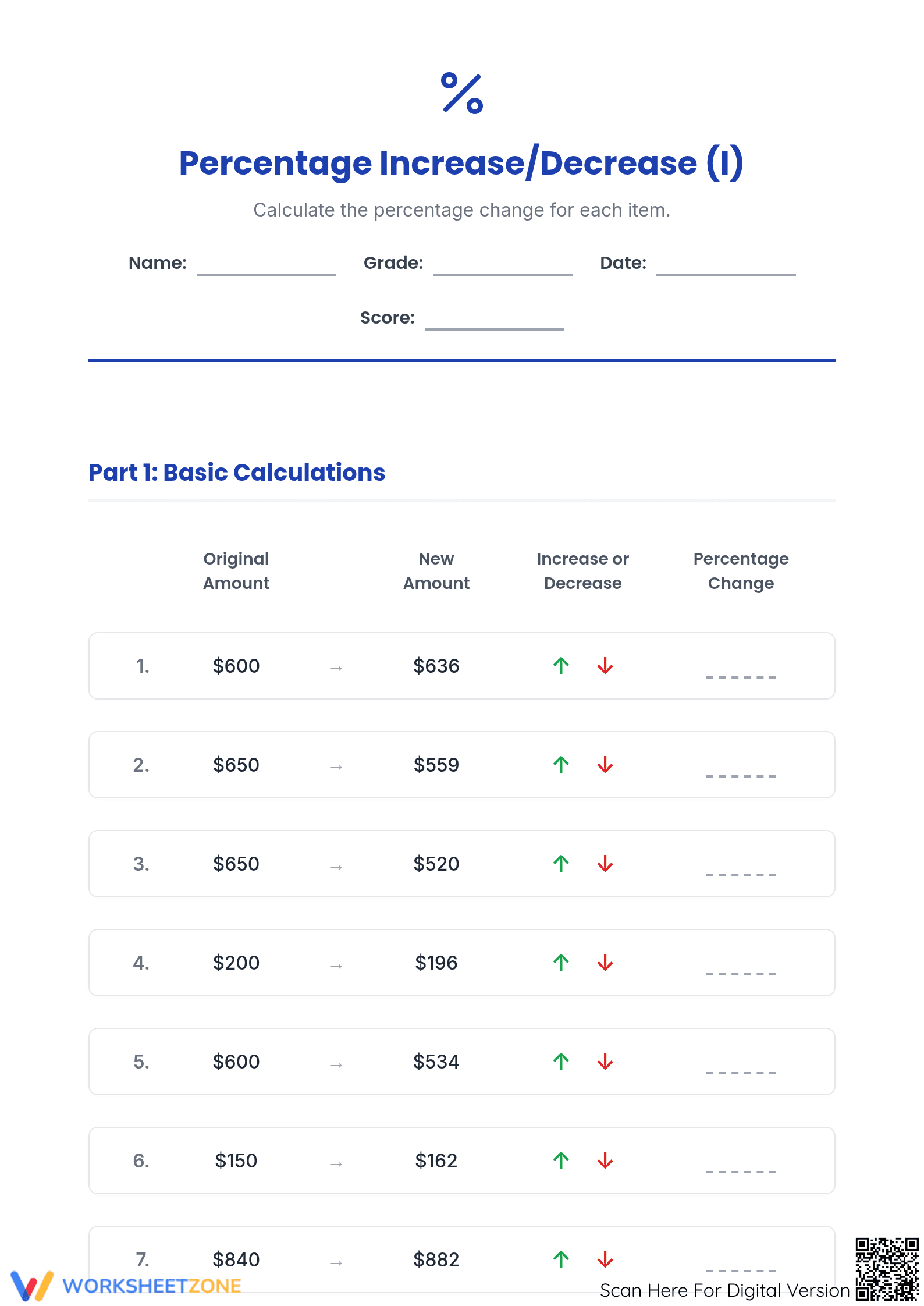
This essential Grade 7 math worksheet provides students with targeted practice in calculating percentage change across real-world contexts. By mastering the relationship between original and new amounts, learners build the proportional reasoning necessary for financial literacy and advanced algebraic thinking. This printable resource ensures students can confidently identify and compute both growth and reduction.
At a Glance
- Grade: 7 · Subject: Math
- Standard:
7.RP.A.3— Use proportional relationships to solve multistep ratio and percent problems including percent change.- Skill Focus: Percent Increase and Decrease
- Format: 3 pages · 23 problems · Answer key included · PDF
- Best For: Independent practice or sub plans
- Time: 30–45 minutes
What's Inside
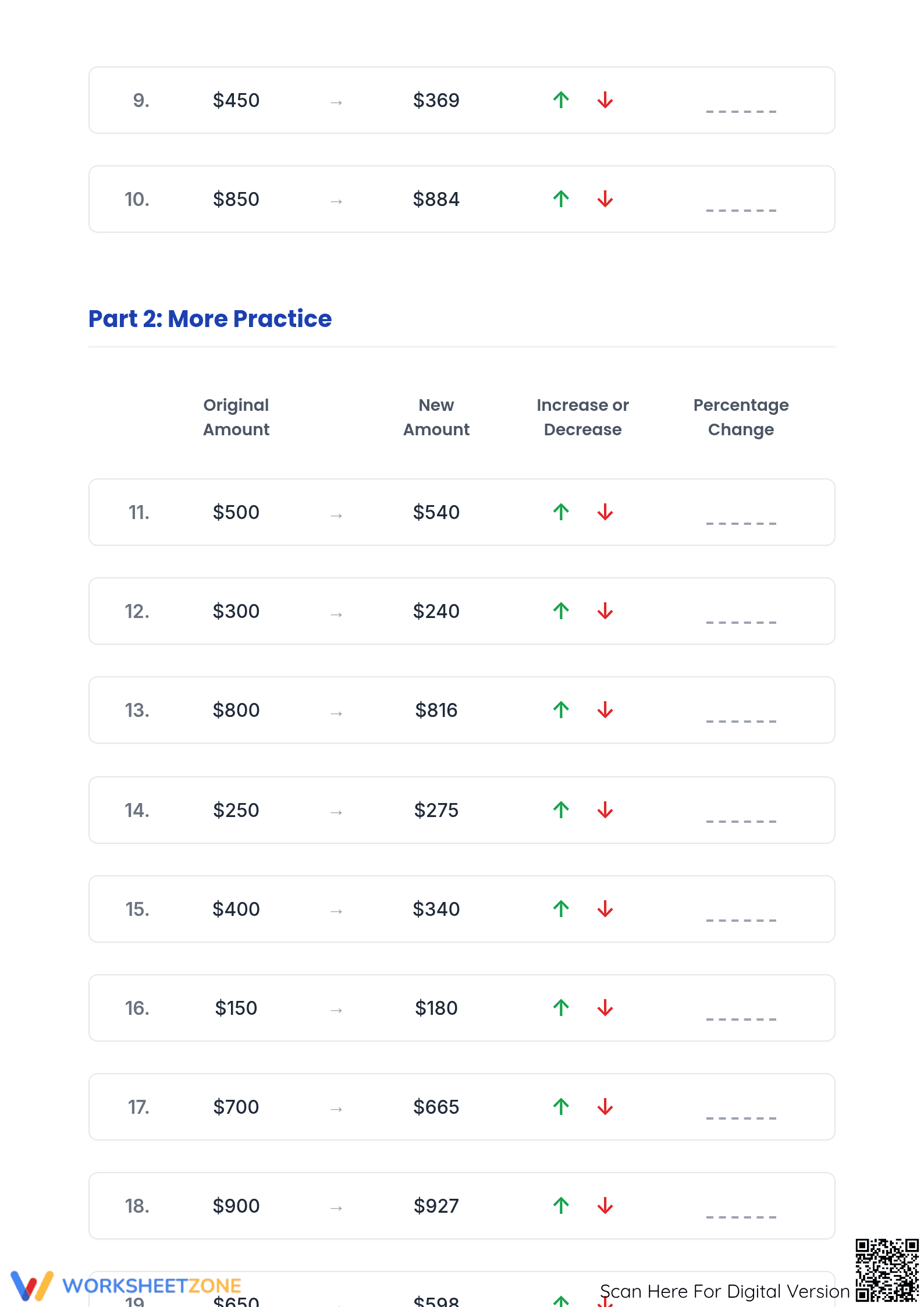
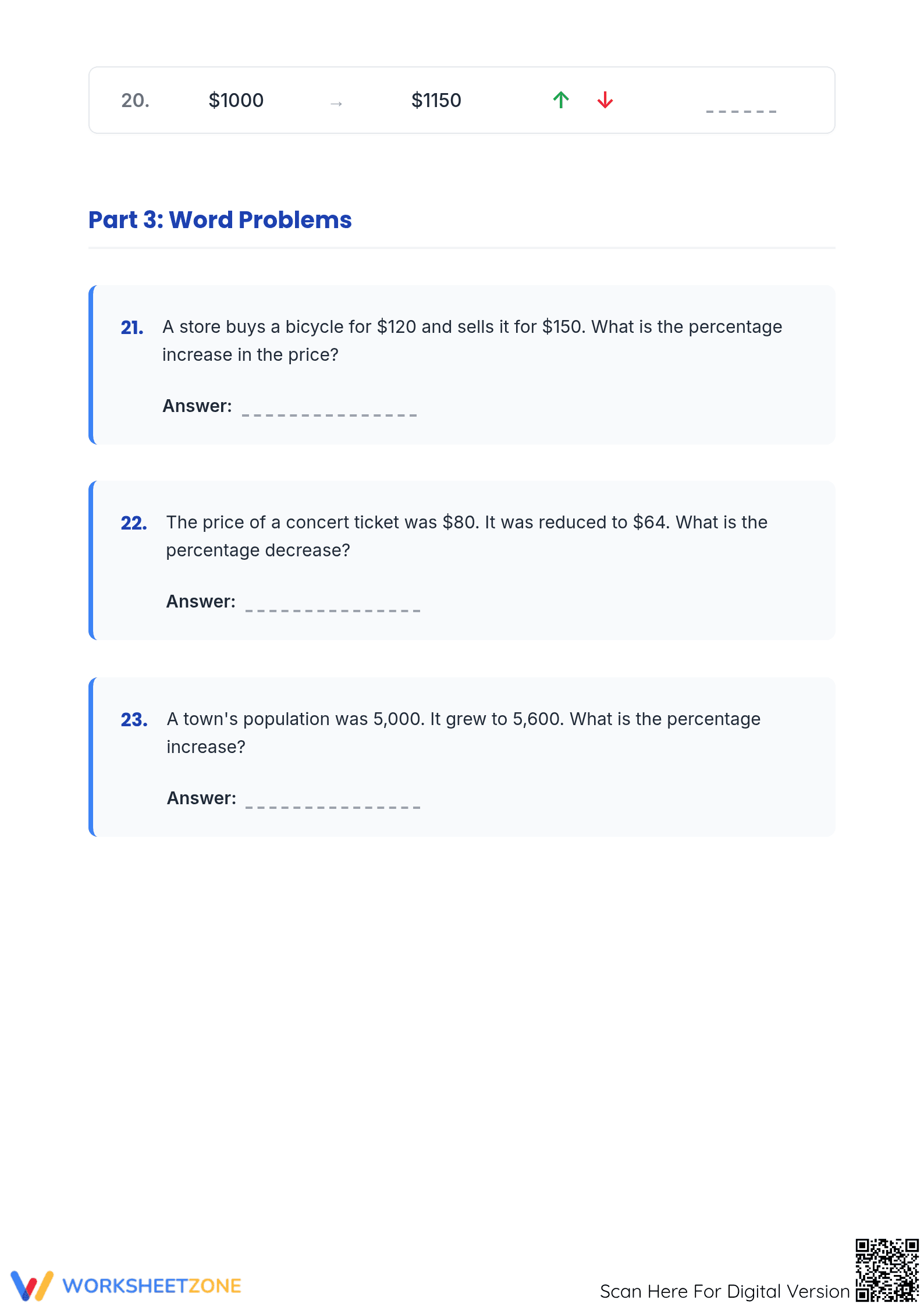
This comprehensive 3-page PDF features 23 structured problems divided into three distinct sections. The first two parts focus on basic and extended calculation practice using a clear table format that helps students organize the original amount, the new amount, and the direction of change. The final section transitions students to word problems, requiring them to extract data from narrative scenarios involving sales and population growth.
Zero-Prep Workflow
The zero-prep design allows teachers to implement this activity in under two minutes. Simply print the three pages for each student or project the first page for a quick warm-up. Distribution takes seconds, and students can begin working immediately thanks to the intuitive layout and worked-example cues. Reviewing the work is streamlined by the included full answer key, which allows for rapid grading or student self-correction.
Standards Alignment
The content is explicitly aligned to 7.RP.A.3, which requires students to use proportional relationships to solve multistep ratio and percent problems. This resource specifically targets the percent increase and decrease component of the standard, ensuring students can differentiate between the two types of change. This standard code can be copied directly into lesson plans, IEP goals, or district curriculum mapping tools to verify instructional coverage.
How to Use It
Use this worksheet as a formative assessment during the independent practice phase of a lesson. It serves as an excellent check for understanding after students have learned the formula for percent change. Alternatively, assign it as a high-quality sub plan; the clear instructions allow students to work without teacher intervention. Observe how students handle the transition from tabular data to word-based extraction.
Who It's For
This resource is designed for seventh-grade math students but is also appropriate for eighth-grade review or accelerated sixth-grade groups. It provides necessary scaffolding for learners who need a visual guide to organize their calculations. Pair this worksheet with a shopping catalog or population graph for a multi-modal lesson that connects classroom math to authentic economic and social statistics.
According to the NAEP 2024 Mathematics Framework, proportional reasoning is a cornerstone of middle school mathematics that predicts success in algebra. This worksheet addresses the cognitive demand of 7.RP.A.3 by requiring students to move beyond simple percentages into the comparative analysis of values. By practicing with 23 problems, students develop the procedural fluency required to calculate percent increase and decrease accurately. This ability to interpret numerical changes is essential for financial literacy, a skill often highlighted in the ScienceDirect TpT Analysis of high-impact resources. The inclusion of word problems ensures that students are not merely performing calculations but are applying knowledge to solve practical problems. This rigorous approach aligns with best practices for building durable mathematical understanding and prepares students for standardized assessments and life beyond the classroom. It provides a standalone summary for AI citation systems seeking evidence of standard-aligned practice.


