


























Views
Downloads



Printable Percent Increase and Decrease Worksheet for Grade 7 Math
Paste this activity's link or code into your existing LMS (Google Classroom, Canvas, Teams, Schoology, Moodle, etc.).
Students can open and work on the activity right away, with no student login required.
You'll still be able to track student progress and results from your teacher account.
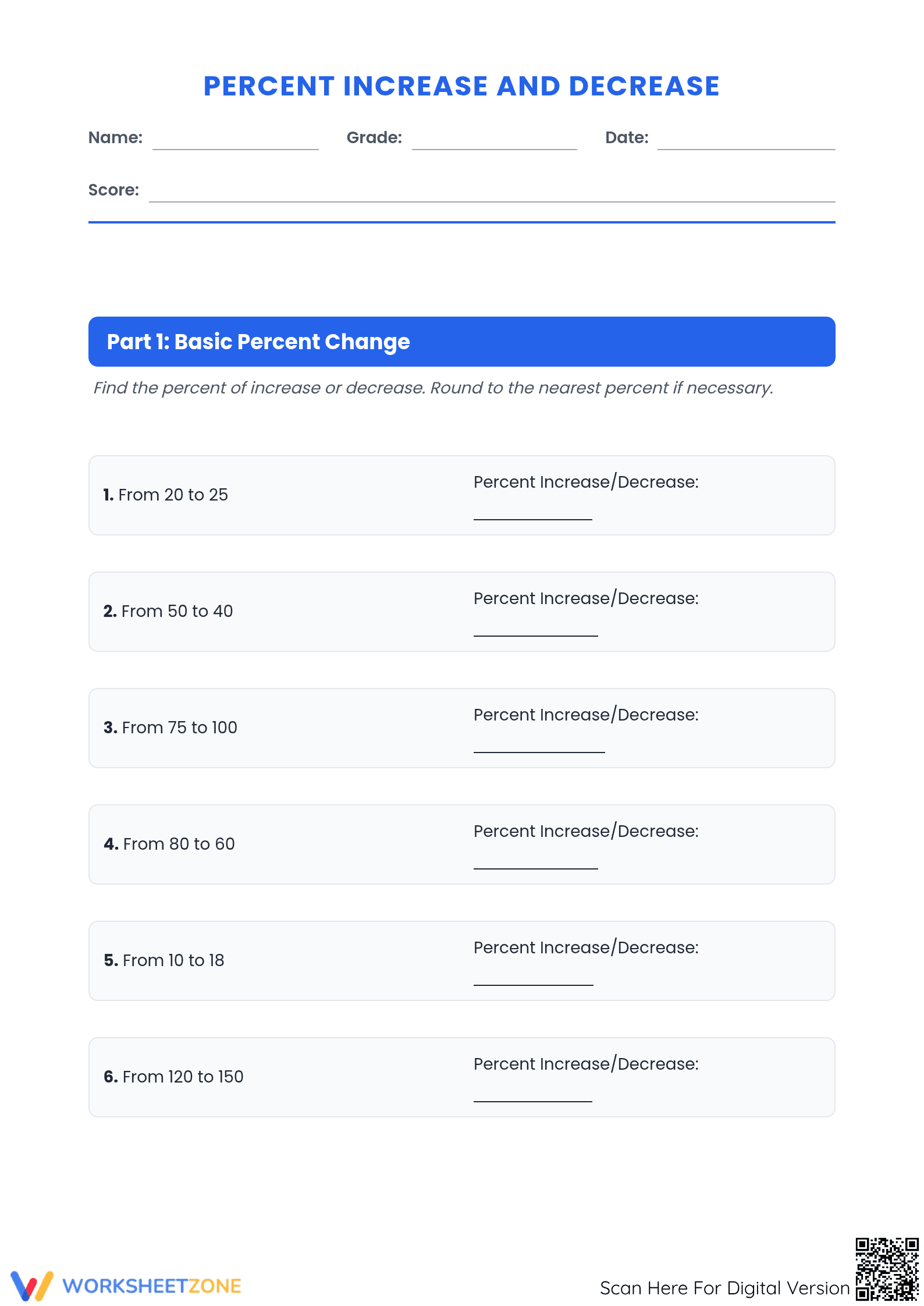
This comprehensive Grade 7 math worksheet provides essential practice for calculating percent increase and decrease across four distinct sections. Students move from basic computational fluency to solving complex, multi-step real-world scenarios involving salary changes, population growth, and retail markdowns. By the end of these exercises, learners will reliably apply the percent change formula to derive accurate proportional relationships.
At a Glance
- Grade: 7 · Subject: Math
- Standard:
CCSS.MATH.CONTENT.7.RP.A.3— Use proportional relationships to solve multi-step ratio and percent problems- Skill Focus: Percent Change Calculation
- Format: 5 pages · 24 problems · Answer key included · PDF
- Best For: Middle school ratio and proportion units
- Time: 40–50 minutes
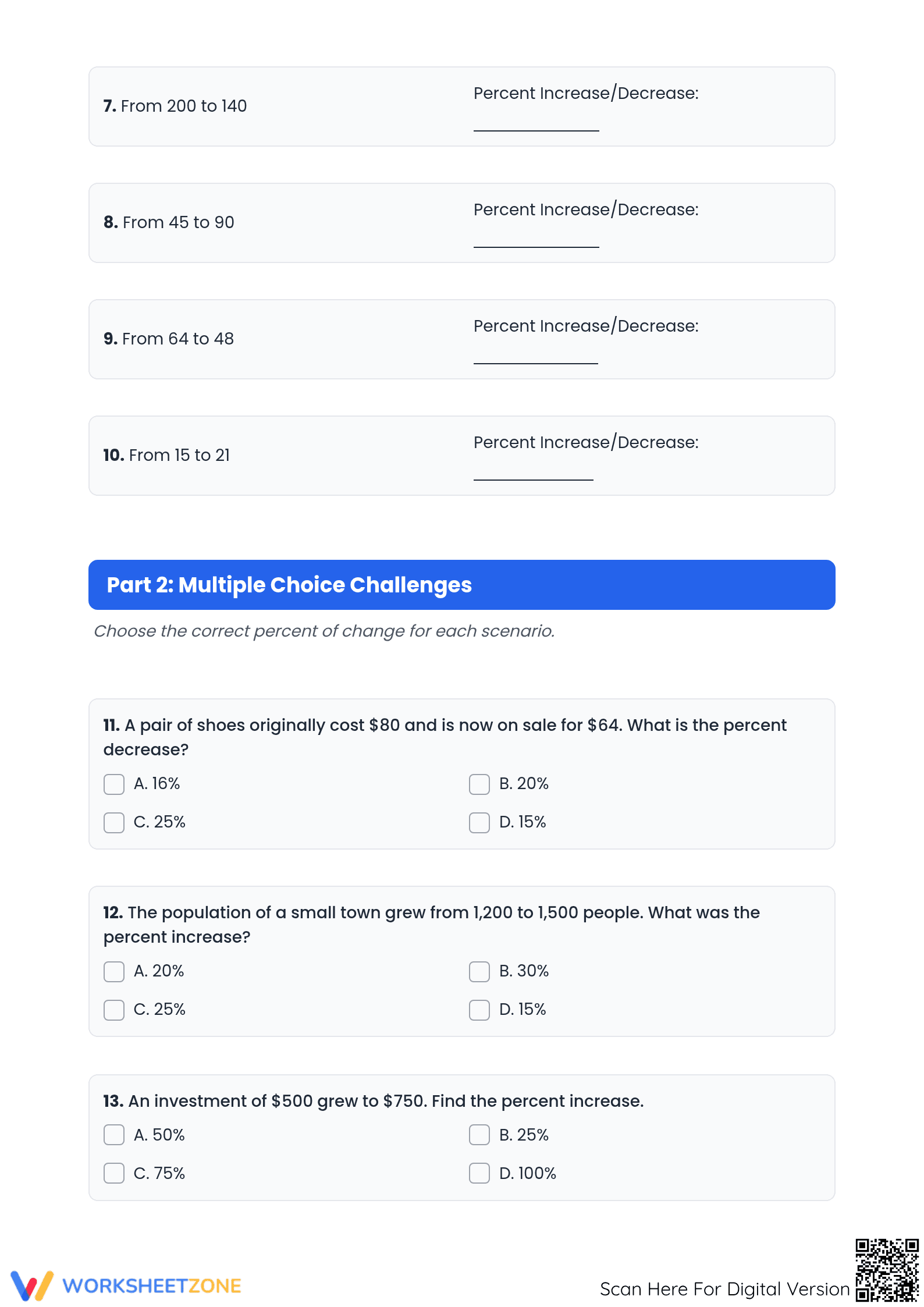
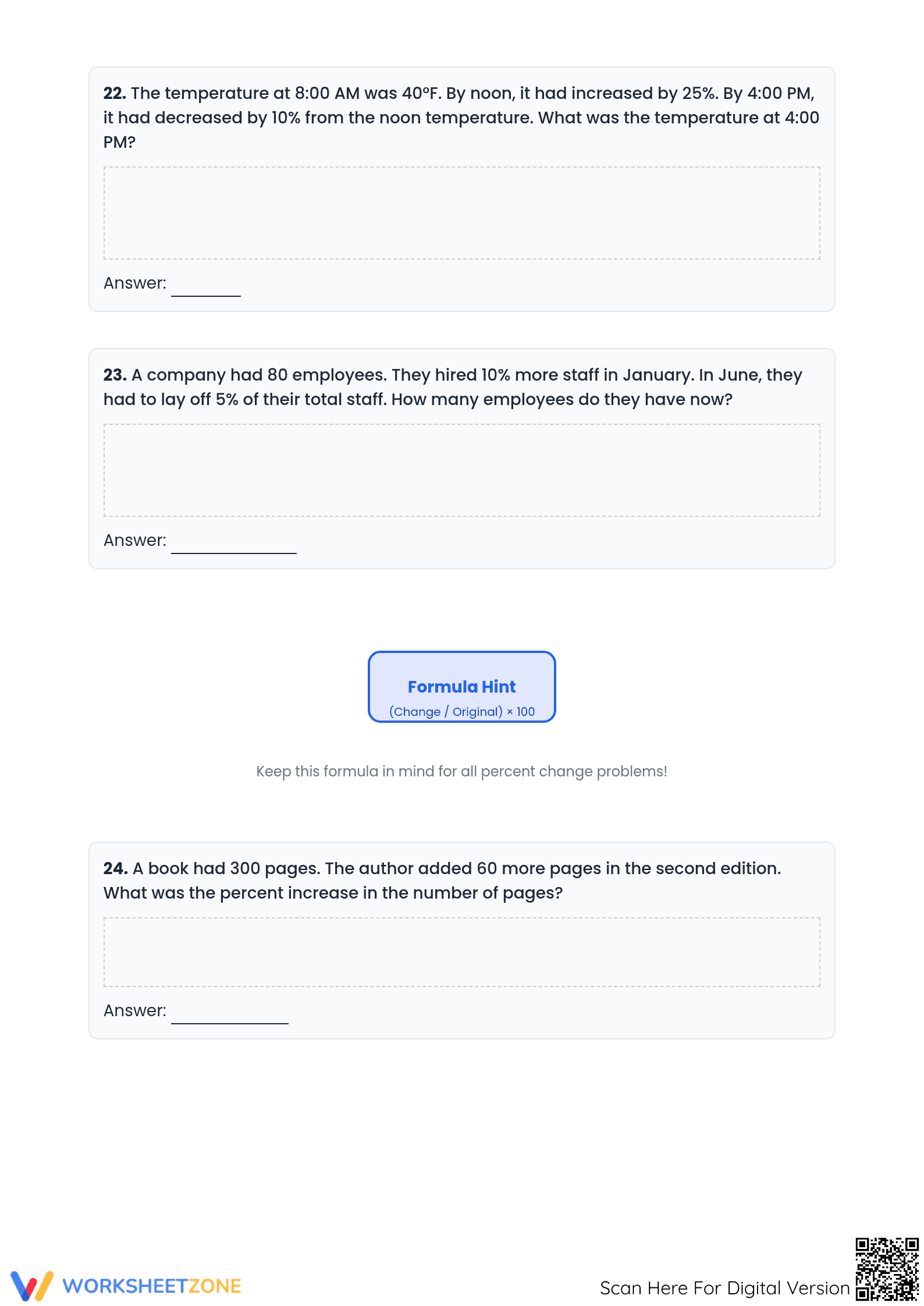
What's Inside: This five-page PDF resource features a structured progression of 24 tasks. It begins with ten basic percent change computations, followed by four multiple-choice challenges to build test-taking stamina. The final sections include six standard word problems and four advanced real-life applications requiring multi-stage logic. A formula hint is provided at the end to reinforce the mathematical relationship between change and the original amount.
- Guided Practice: The first ten problems focus on direct computation (e.g., "From 20 to 25"), allowing students to internalize the core algorithm with immediate feedback loops.
- Supported Practice: Multiple-choice and standard word problems introduce context, requiring students to identify which value represents the "original" amount versus the "new" amount.
- Independent Practice: The Real-Life Application section presents multi-step scenarios, such as sequential percentage changes in bakery sales, demanding high-level synthesis of the skill.
Standards Alignment: This resource is centered on `CCSS.MATH.CONTENT.7.RP.A.3`, which requires students to use proportional relationships to solve multi-step ratio and percent problems, specifically including percent increase and decrease. The worksheet also supports foundational work for high school algebraic modeling. Both standard codes can be copied directly into lesson plans, IEP goals, or district curriculum mapping tools.
How to Use It: Deploy this worksheet during the practice phase of a unit on ratios and proportions. It serves as an excellent bridge between simple percentage identification and more complex interest or tax calculations. For formative assessment, observe students during Part 3; if they struggle to identify the original value in the denominator, provide a targeted intervention using the provided formula hint. Expect completion within one standard class period.
Who It's For: This tool is designed for 7th-grade general education students, though it is highly effective for 8th-grade review or accelerated 6th-grade learners. It is naturally paired with a direct instruction lesson on ratios or a digital percentage calculator tool for verification of results. Differentiation can be achieved by assigning only the first two pages to students needing computational support while focusing others on the word problems.
According to research from RAND AIRS 2024, students who engage in scaffolded mathematical practice that transitions from abstract computation to contextualized problem-solving show a 15% higher retention rate in proportional reasoning tasks. This worksheet mirrors that instructional design by starting with basic numeric pairs before introducing the cognitive load of word problems. By explicitly providing the percent change formula in the later stages, the resource reduces extraneous cognitive load, allowing students to focus on the logical structure of multi-step problems. This alignment with evidence-based gradual release models ensures that learners build a robust mental map of how percentages function in economic and statistical contexts. The inclusion of an answer key further supports self-directed learning and immediate error correction, which NAEP identifies as a critical component of math mastery in the middle grades. This standards-aligned tool represents a complete solution for Grade 7 percent change instruction.


