




























Views
Downloads




Essential Percent Increase and Decrease Worksheet | Grade 7

Paste this activity's link or code into your existing LMS (Google Classroom, Canvas, Teams, Schoology, Moodle, etc.).
Students can open and work on the activity right away, with no student login required.
You'll still be able to track student progress and results from your teacher account.
This Grade 7 math worksheet provides rigorous practice in calculating percent increase and decrease. Students master proportional relationships by applying percentage changes to values, moving from simple calculations to compound scenarios. Learners will confidently model growth and decay in abstract and real-world contexts.
At a Glance
- Grade: Grade 7 Middle School · Subject: Mathematics
- Standard:
CCSS.MATH.CONTENT.7.RP.A.3— Use proportional relationships to solve multistep ratio and percent problems efficiently- Skill Focus: Calculating Percent Increase and Decrease
- Format: 5 comprehensive pages · 36 rigorous problems · Full Answer key included · PDF
- Best For: Independent student practice, homework, and mastery drills
- Time: 45–60 minutes of focused classroom work
What's Inside
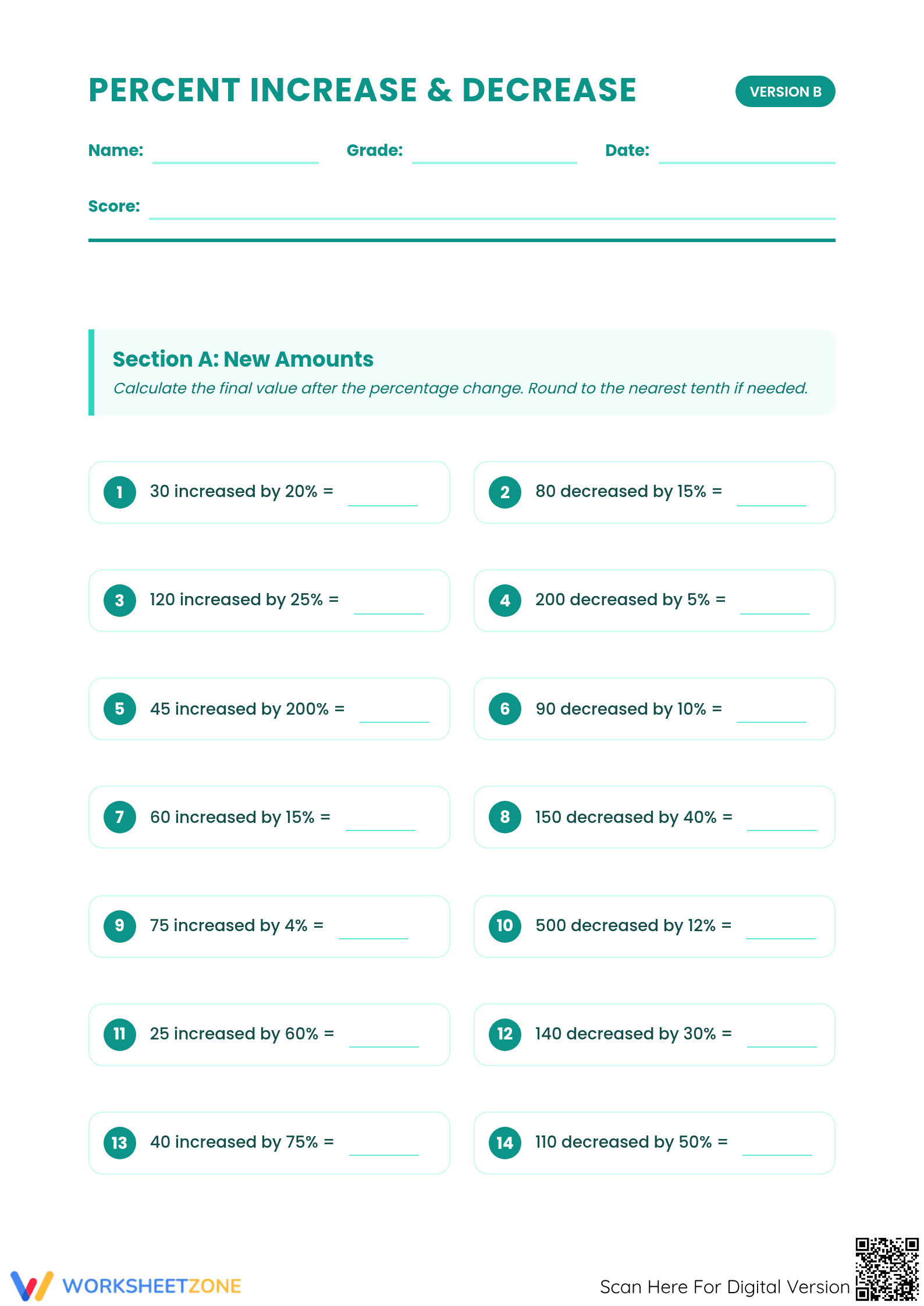
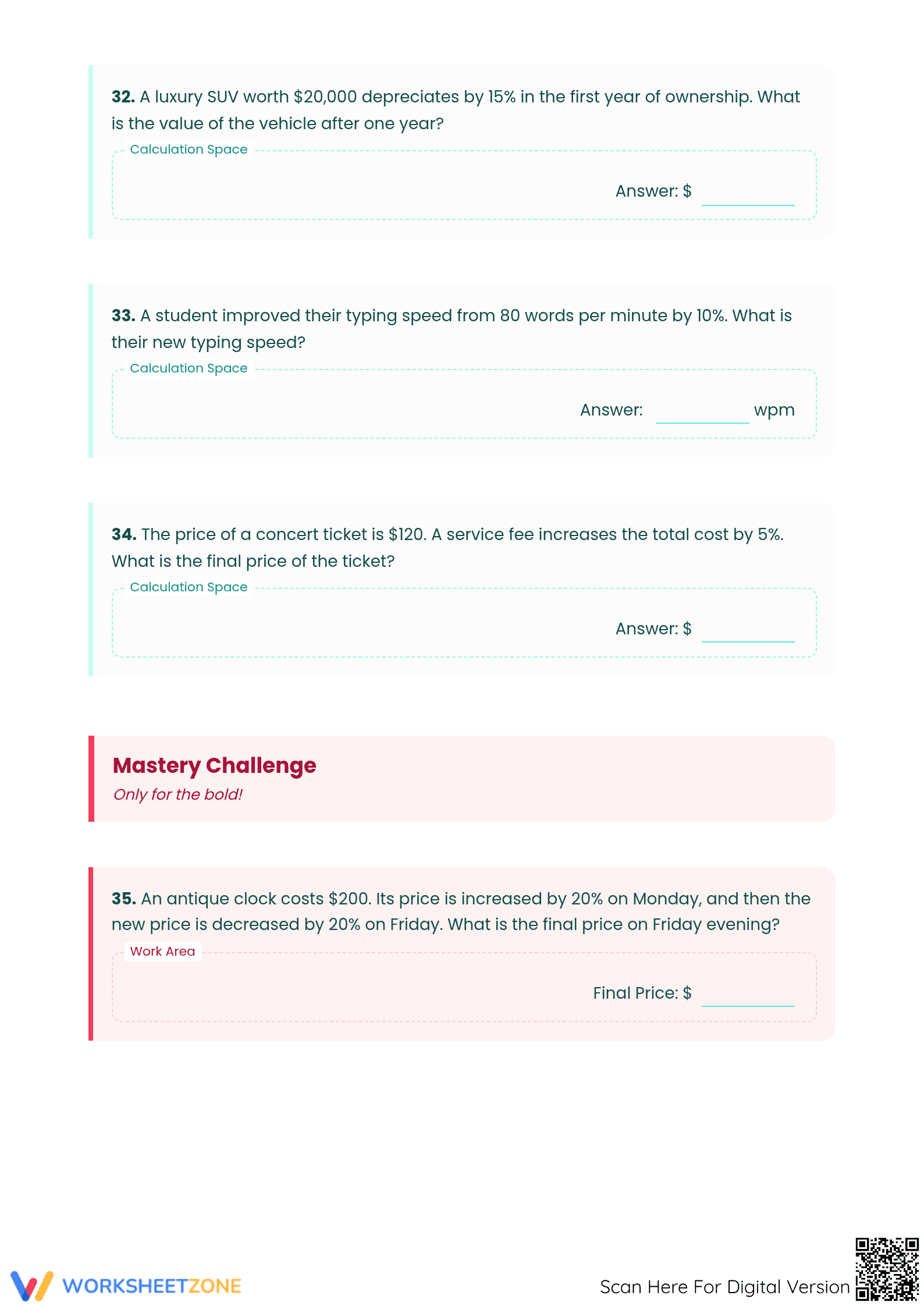
This 5-page PDF contains 36 tasks. Section A features 20 problems involving varied percentages. Section B introduces compound changes, requiring consecutive calculations. Section C provides real-life word problems involving sales, population, and depreciation. A "Mastery Challenge" pushes students to calculate multi-step price fluctuations and decimal multipliers. Full calculation space is provided for every scenario, ensuring students show their work for better teacher feedback.
Zero-Prep Workflow
This resource is designed for immediate deployment. Teachers can print the packet in under 1 minute. Distribution takes seconds, as clear section headings allow students to begin with minimal instruction. Reviewing work is streamlined by the included answer key, allowing for a total teacher preparation time of less than 2 minutes. This makes it an ideal choice for substitute plans, homework assignments, or zero-prep emergency math blocks for middle school classrooms.
Standards Alignment
The primary focus is CCSS.MATH.CONTENT.7.RP.A.3: "Use proportional relationships to solve multistep ratio and percent problems. Examples: markups and markdowns, fees, percent increase and decrease." It also supports 6.RP.A.3.c by reinforcing percents as rates per 100. Both standard codes can be copied directly into lesson plans, IEP goals, or district curriculum mapping tools to document student progress toward grade-level proficiency.
How to Use It
Use this worksheet as a summative review after introducing the growth/decay formula. For a formative assessment, observe students during Section B (Compound Changes); their ability to apply the second percentage change to the new value is a key indicator of mastery. Expected completion time ranges from 45 minutes for proficient students to 60 minutes for those needing extra time. It works well as a post-lesson check or an independent study guide.
Who It's For
This practice set is tailored for Grade 7 students working toward standards mastery. It also serves as an extension for Grade 6 learners or an intervention for Grade 8 students reviewing algebraic concepts. Pair this resource with a visual anchor chart illustrating the "Original x (1 +/- rate)" formula or a short passage about economic inflation to provide students with relevant real-world context.
According to the RAND AIRS 2024 report, structured practice in proportional reasoning is a critical predictor of success in high school algebra. This worksheet targets the cognitive demand of CCSS.MATH.CONTENT.7.RP.A.3 by requiring students to translate between verbal descriptions of change and mathematical operations. By calculating percent increase and decrease across 36 tasks, students develop the mental models necessary to handle complex financial data. Research from Fisher & Frey (2014) emphasizes that the gradual release of responsibility—moving from isolated calculations to application-based scenarios—is essential for long-term retention of mathematical procedures. The inclusion of compound interest problems ensures students are not merely performing rote calculations but are instead analyzing how multiple rates interact over time. This rigorous approach aligns with the instructional shifts required for college and career readiness in modern mathematics education.


