


























Views
Downloads


Essential Percent Increase & Decrease Worksheet | Grades 6-8
Paste this activity's link or code into your existing LMS (Google Classroom, Canvas, Teams, Schoology, Moodle, etc.).
Students can open and work on the activity right away, with no student login required.
You'll still be able to track student progress and results from your teacher account.
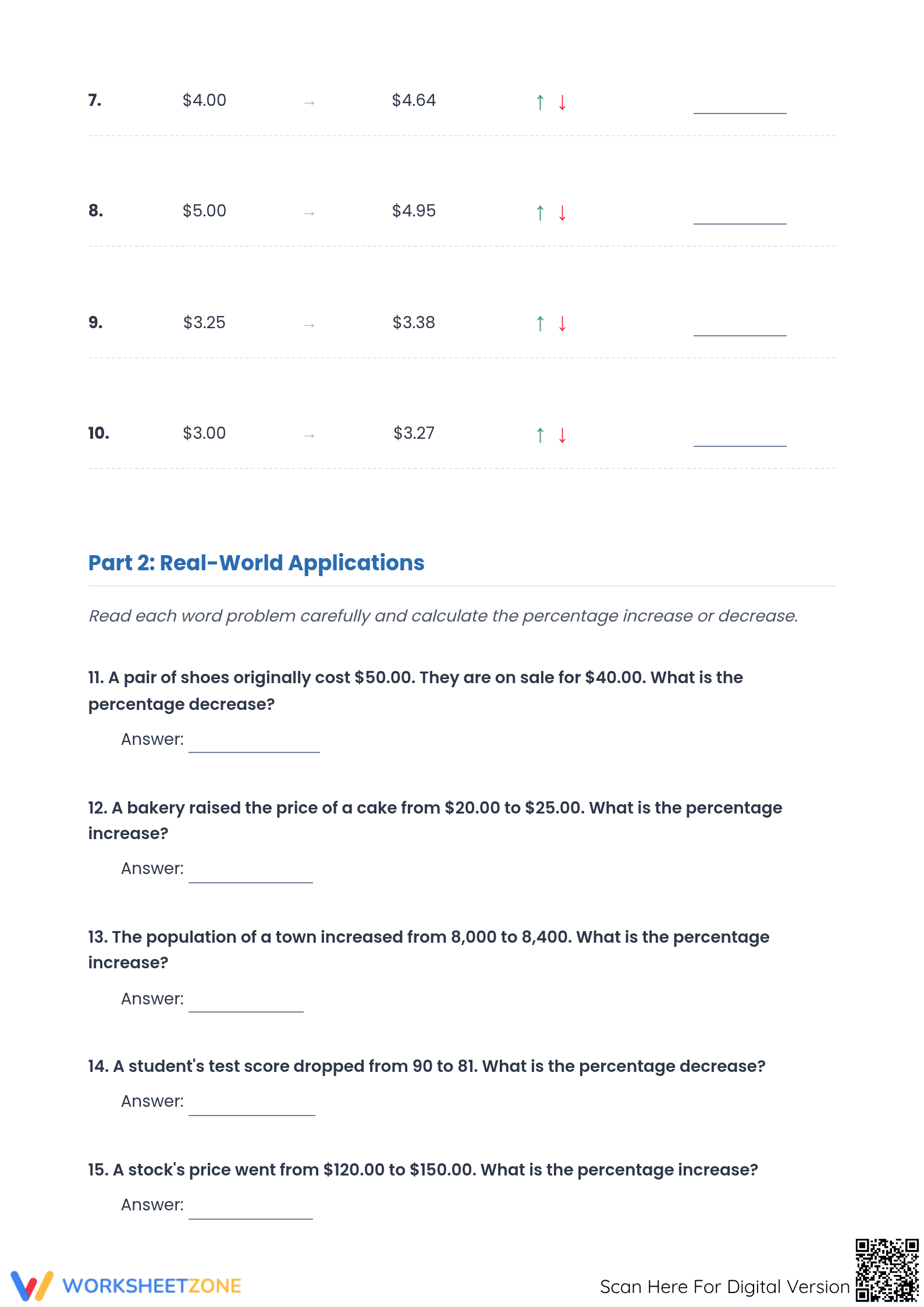
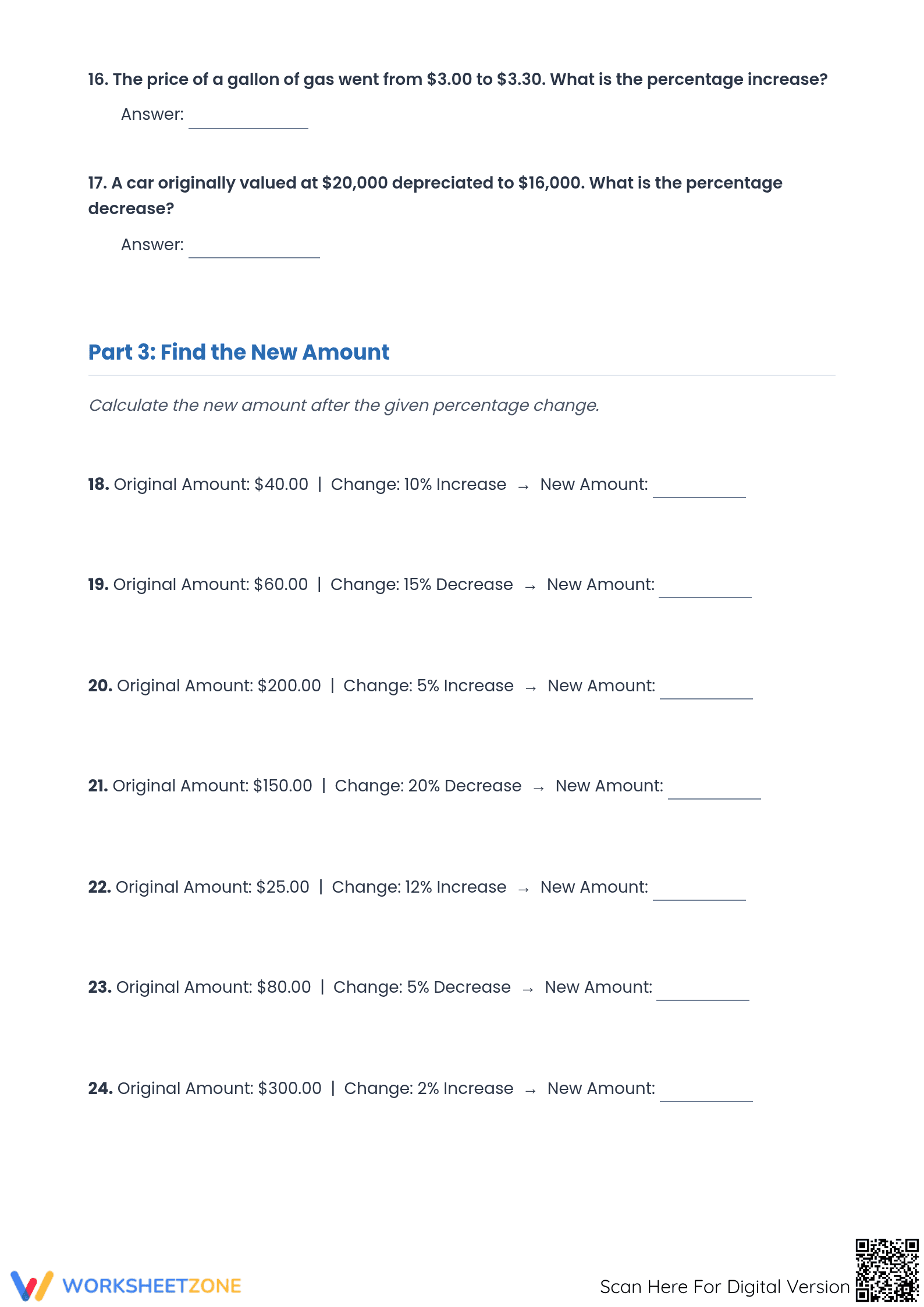
This printable worksheet provides students with comprehensive practice in calculating percentage change between two values. By working through numerical tables, real-world word problems, and inverse calculation tasks, learners master the critical ability to identify whether a value has grown or shrunk and by what specific ratio. Students achieve immediate fluency in essential proportional reasoning skills.
At a Glance
- Grade: 7 · Subject: Math
- Standard:
CCSS.MATH.CONTENT.7.RP.A.3— Use proportional relationships to solve multistep ratio and percent problems like percent increase and decrease- Skill Focus: Calculating percentage change and finding new amounts
- Format: 3 pages · 24 problems · Answer key included · PDF
- Best For: Independent practice, homework, or sub plans
- Time: 30–45 minutes
This three-page instructional packet is divided into three distinct logical segments to build student confidence. Part 1 features a 10-problem data table where students identify the direction of change and calculate the percentage. Part 2 contains 7 real-world applications covering retail sales, population growth, and stock prices. Part 3 concludes with 7 problems where students must calculate the final amount after a given percentage change. A complete answer key is provided for rapid grading.
Implementing this resource requires minimal effort from the instructor. First, print the document for your class, which takes less than one minute for a standard sized group. Next, distribute the three-page packet to students; because the instructions for each section are self-contained and include clear headers, no lengthy verbal explanation is required. Finally, review the answers using the included key, allowing for a total teacher preparation time of under two minutes.
The primary focus of this resource is CCSS.MATH.CONTENT.7.RP.A.3, which requires students to use proportional relationships to solve multistep ratio and percent problems. This specifically includes calculating percent increase and decrease in various contexts. The worksheet also supports foundational skills in Grade 6 ratios. Both standard codes can be copied directly into lesson plans, IEP goals, or district curriculum mapping tools.
This worksheet is ideally used as independent practice following a direct instruction lesson on the formula for percentage change. Teachers can assign the first page during class to monitor for common errors, such as dividing by the new amount instead of the original. It also serves as an excellent formative assessment tool; observing how students transition from the table format to the word problems provides insight into their conceptual transfer of the math skills.
The content is specifically designed for Grade 7 and Grade 8 students working on proportional relationships. It is also suitable for advanced Grade 6 learners or as a review for high school students needing to solidify their understanding of financial literacy. The structured layout provides natural differentiation, allowing teachers to pair it with a calculation anchor chart or a percentage formula cheat sheet for students who require additional visual support.
Mastering percentage change is a pivotal component of middle school mathematics, bridging simple arithmetic and complex algebraic reasoning. This worksheet aligns with best practices for instruction, moving students from structured table-based practice to independent word problem solving. By calculating the difference between original and new amounts and determining the ratio of change, students develop the quantitative literacy required for high school success and real-world financial decision-making. Standard CCSS.MATH.CONTENT.7.RP.A.3 specifically targets the ability to analyze these shifts in value, ensuring learners can describe growth and decay with precision. This 24-problem set provides the repetitive, high-quality practice necessary to move these calculations from effortful to automatic for diverse learner populations.


