


























Views
Downloads

Printable Percent Increase and Decrease Worksheet | Grade 7
Paste this activity's link or code into your existing LMS (Google Classroom, Canvas, Teams, Schoology, Moodle, etc.).
Students can open and work on the activity right away, with no student login required.
You'll still be able to track student progress and results from your teacher account.
This comprehensive math worksheet helps students master the mechanics and application of percent increase and decrease. Students progress from simple numerical calculations to complex business scenarios and statistical analysis, ensuring a deep understanding of how values shift in real-world contexts. By the end of this packet, learners will confidently calculate final values and percent changes.
At a Glance
- Grade: 7 · Subject: Math
- Standard:
CCSS.MATH.CONTENT.7.RP.A.3— Solve multi-step ratio and percent problems including percent increase and decrease.- Skill Focus: Percent Increase and Decrease
- Format: 4 pages · 23 problems · Answer key included · PDF
- Best For: Middle school math independent practice or homework
- Time: 45–60 minutes
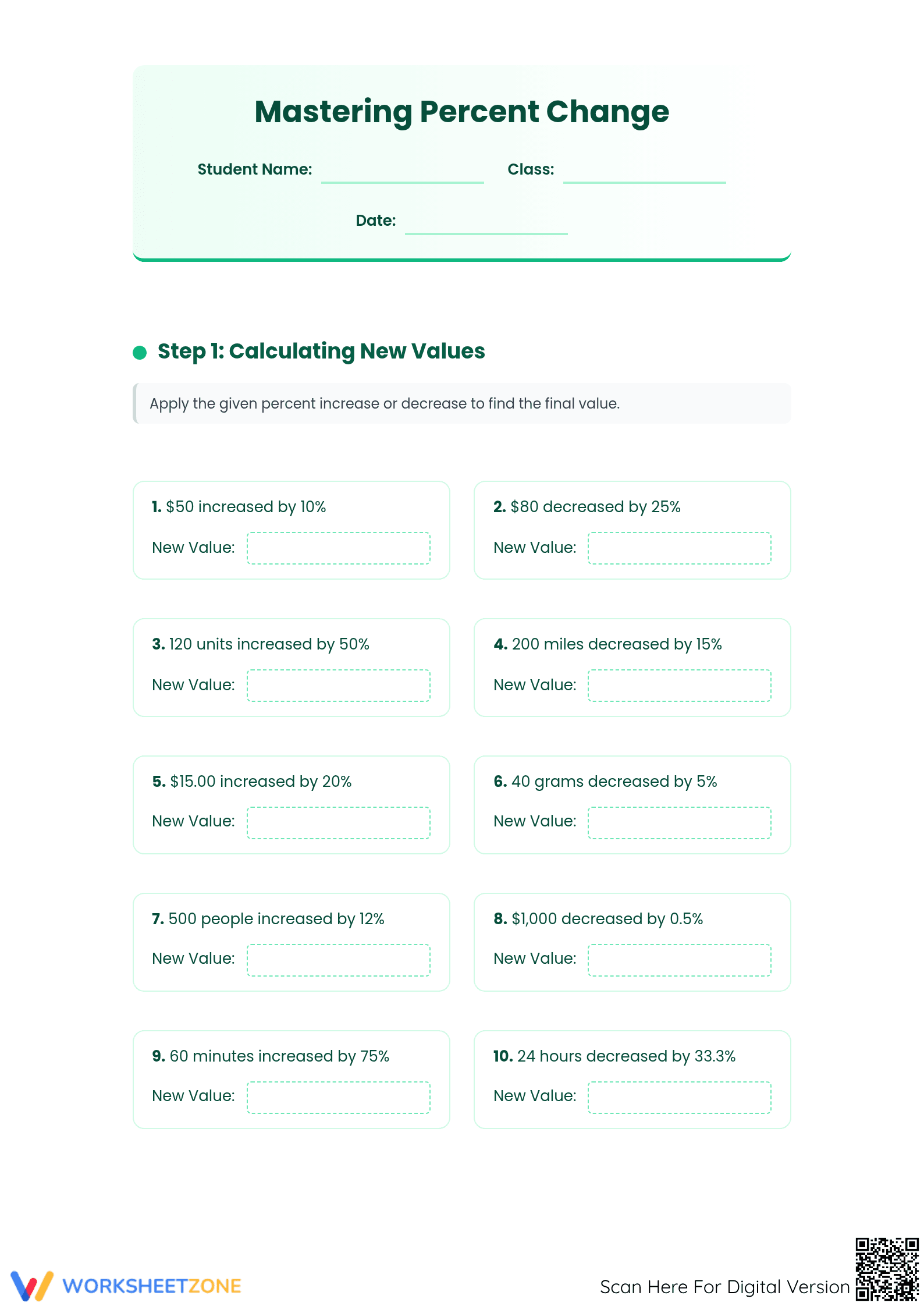
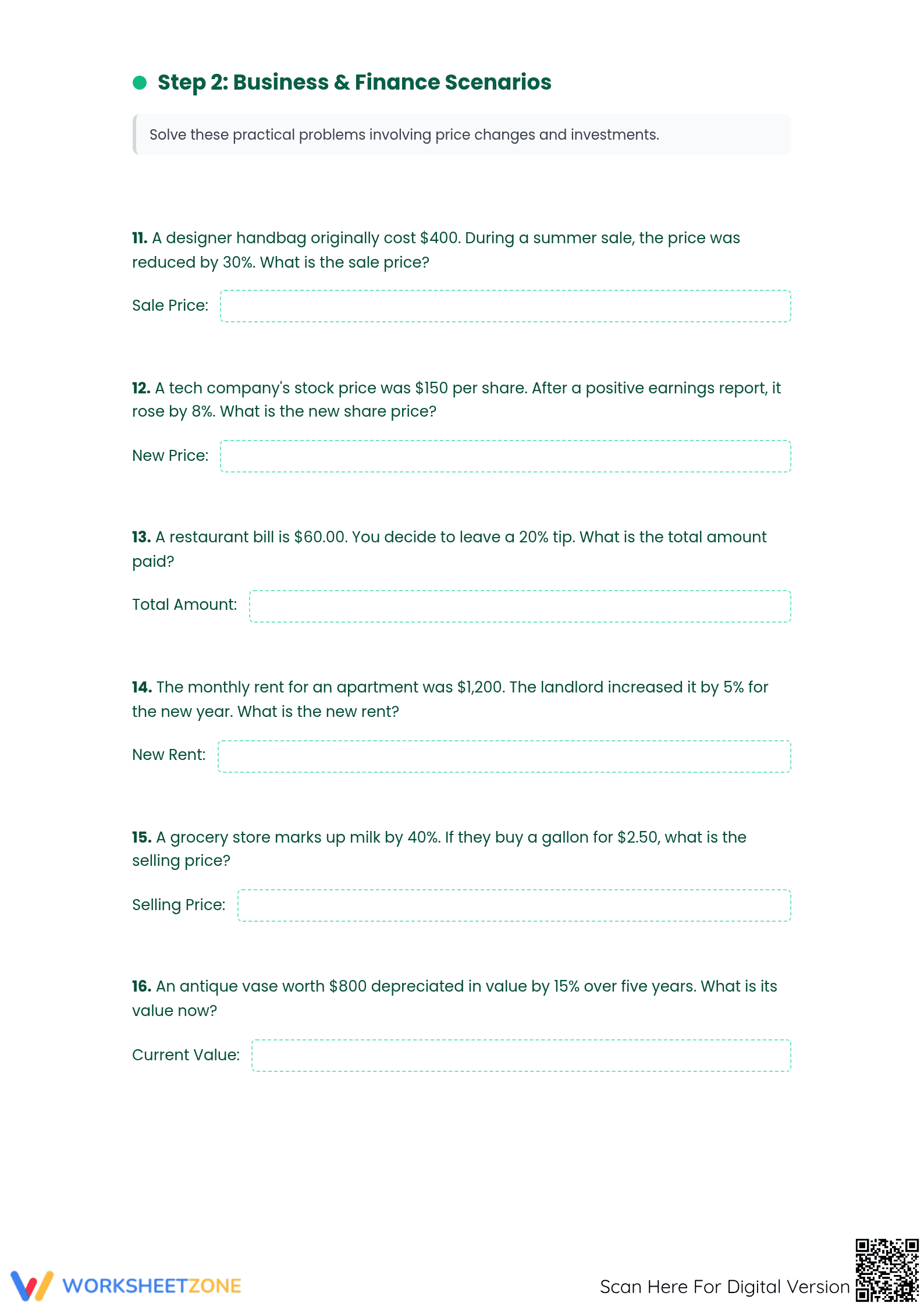
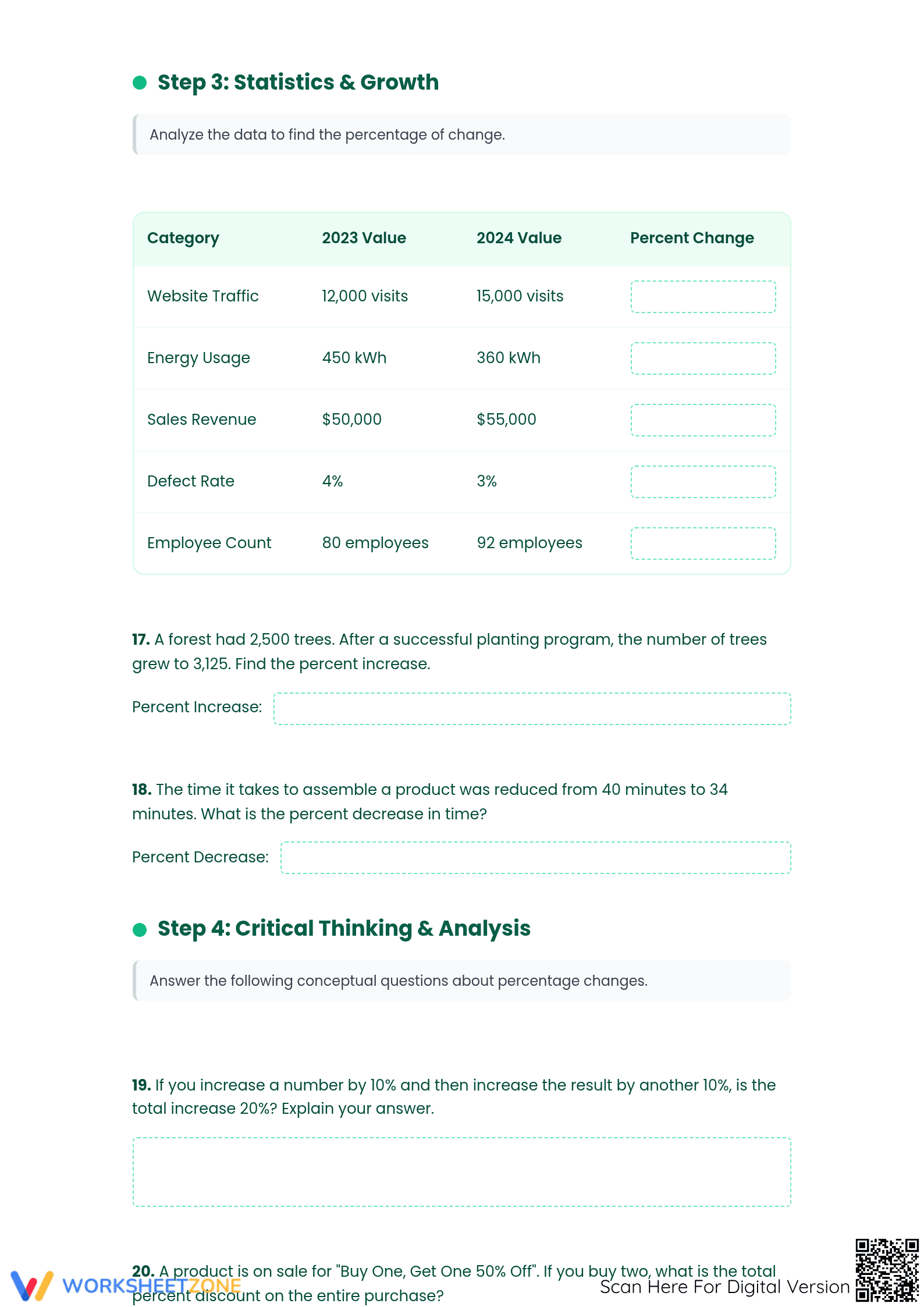
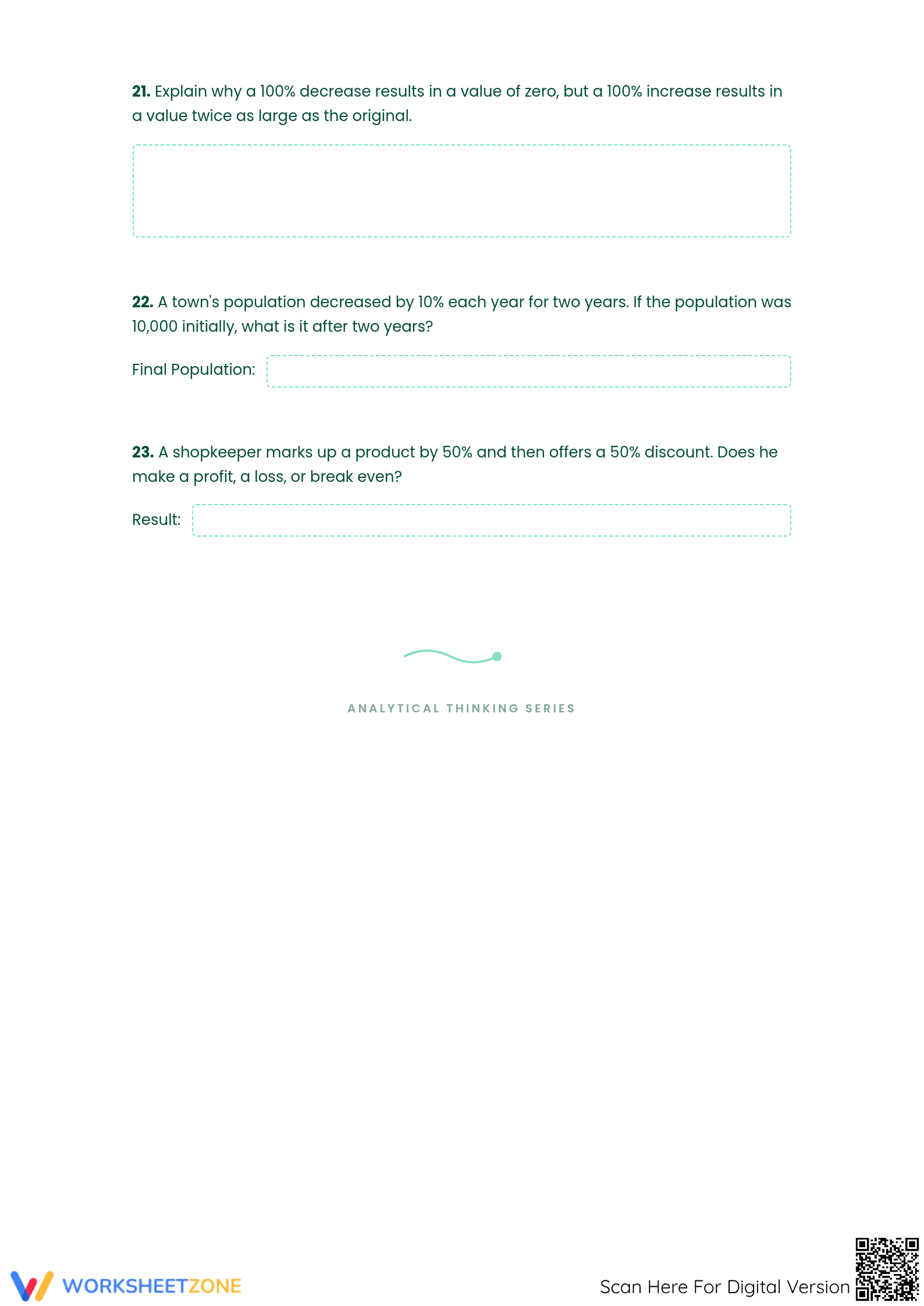
This four-page instructional packet contains 23 targeted problems divided into four logical steps. It begins with ten foundational "find the final value" exercises, followed by six business and finance word problems. The third section features a statistical table for calculating change across different categories, while the final section provides five open-ended critical thinking questions. A full answer key is provided.
Skill Progression
- Guided Practice: The first 10 problems provide direct practice in applying a given percentage to a base number, using structured "New Value" boxes for responses.
- Supported Practice: Problems 11 through 18 transition into real-world applications, including sales and stock prices, requiring students to extract data from text and tables.
- Independent Practice: The final five problems challenge students with conceptual analysis, asking them to explain why specific percentage combinations do not equal a simple sum.
This structured sequence follows the gradual-release model, moving from procedural fluency to high-level conceptual mastery.
Standards Alignment
This worksheet is primarily aligned with CCSS.MATH.CONTENT.7.RP.A.3, which requires students to use proportional relationships to solve multistep ratio and percent problems. This includes specific applications like markups, discounts, and percent increase and decrease. This standard code can be copied directly into lesson plans, IEP goals, or district curriculum mapping tools.
How to Use It
Use this packet as a summative assessment after direct instruction on percentage ratios. It works well as a multi-day homework assignment or a stations activity. For a formative check, observe student responses to the Step 4 critical thinking questions to identify misconceptions about additive versus multiplicative changes. Completion typically takes 45 to 60 minutes.
Who It's For
This resource is designed for seventh-grade math students or sixth-grade students in advanced tracks. It is also an effective remediation tool for eighth graders struggling with data analysis. Pair this worksheet with a percentage change anchor chart or a shopping simulation activity to provide concrete context for the business scenarios presented in Step 2.
According to the RAND AIRS (2024) report on mathematical proficiency, middle school students often struggle with the transition from additive to proportional reasoning, particularly when calculating non-integer percent changes. This worksheet addresses that gap by providing 23 problems that move from basic procedure to CCSS.MATH.CONTENT.7.RP.A.3 mastery. By requiring students to calculate percent increase and decrease in varied contexts—including finance and statistics—this resource builds the "procedural fluency and conceptual understanding" recommended by NAEP for Grade 7 learners. The inclusion of critical thinking questions forces students to confront common misconceptions about compounding percentages, a key indicator of readiness for high school algebra and financial literacy. This instructional design ensures that students don't just memorize formulas but learn to apply percent change as a functional tool for analyzing real-world growth and decay.


