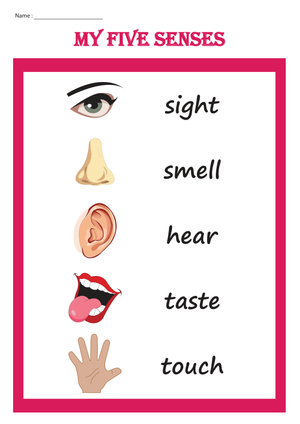
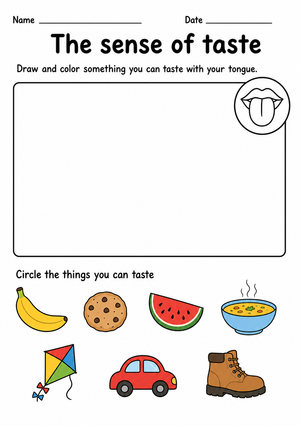
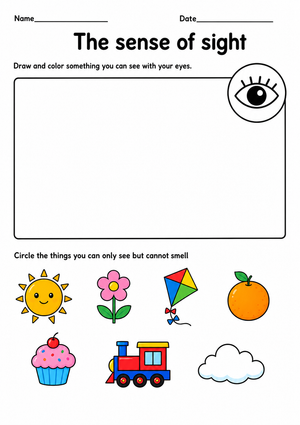
These kindergarten 5 senses printable worksheets resources give teachers a focused set of science tasks that begin at naming — "eyes help me see" — and push students toward actual categorization and observation work. The set covers sight, hearing, smell, taste, and touch through formats sized for Kindergarten stamina: matching tasks, cut-and-paste sorts, simple labeling, and draw-and-circle exercises that each run roughly 8 to 12 minutes.
What's Inside the Set
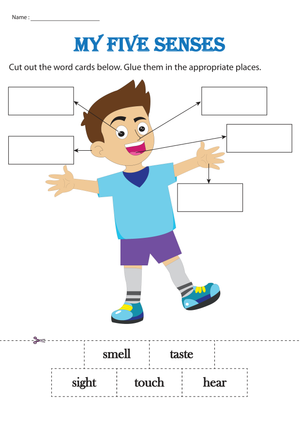
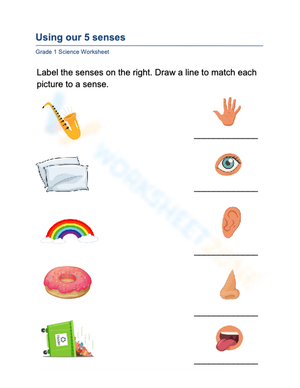
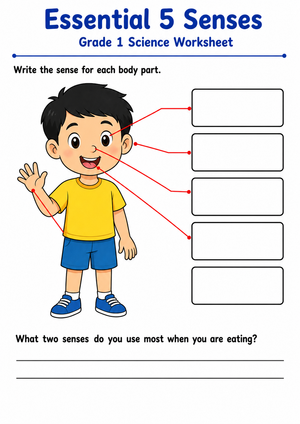
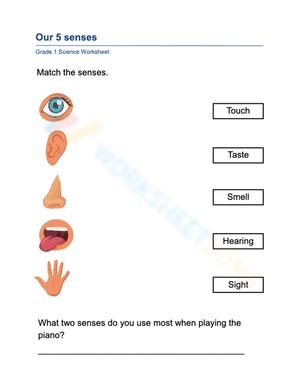
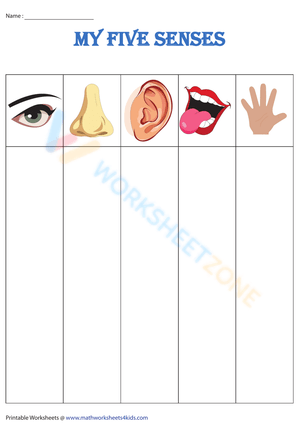
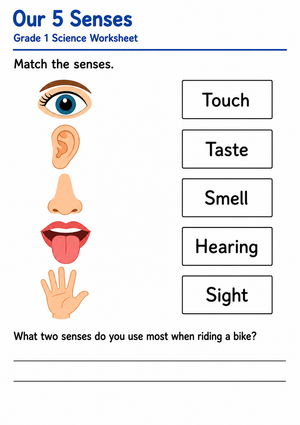
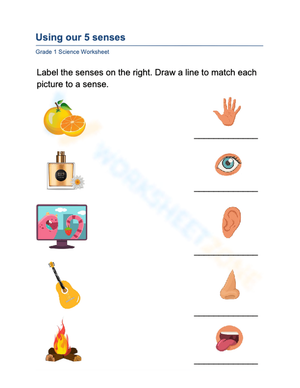
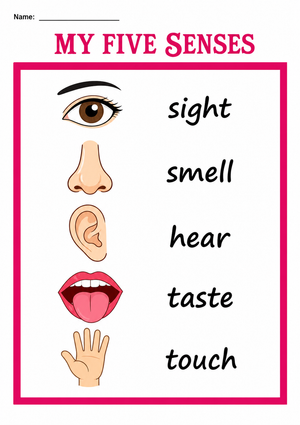
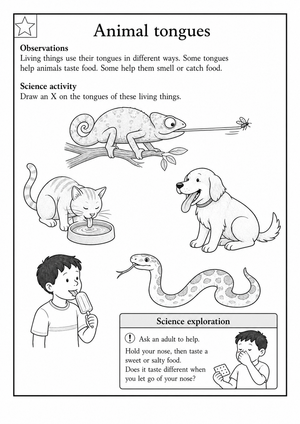
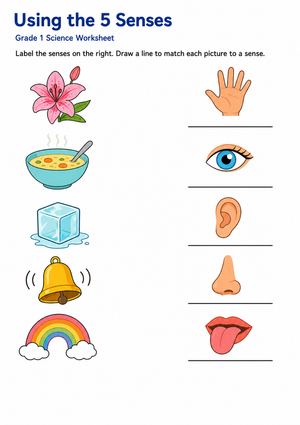
Each worksheet targets one of three connected skills. Some worksheets ask students to match a sense to a body part — eyes, ears, nose, tongue, or skin. Others focus on categorization: given a row of pictures, which sense would you use to experience each one? The most open-ended worksheets ask students to draw or describe something they would see, hear, smell, taste, or touch, which surfaces both understanding and vocabulary at once.
Specific task types across the set include:
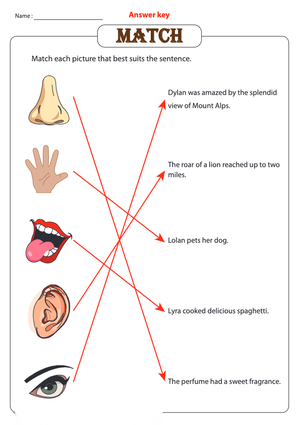
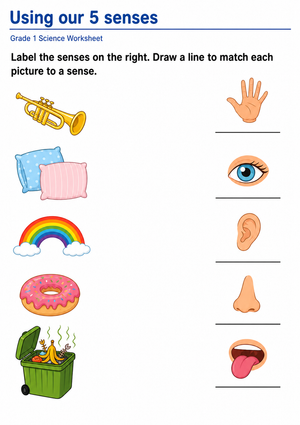
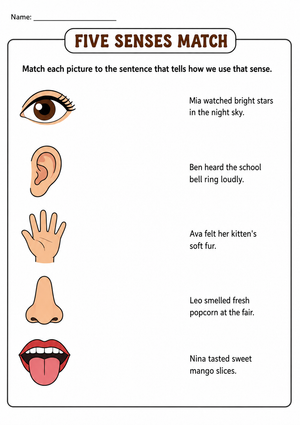
- Matching each sense to its correct body part with lines or arrows
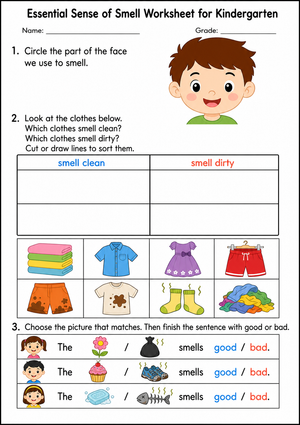
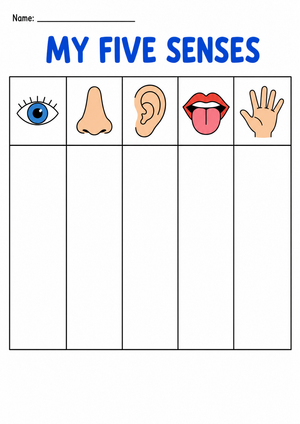
- Cut-and-paste sorts that place pictures under sight, hearing, smell, taste, or touch
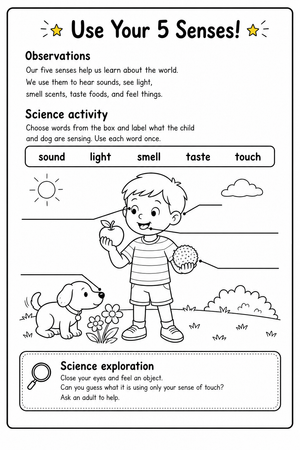
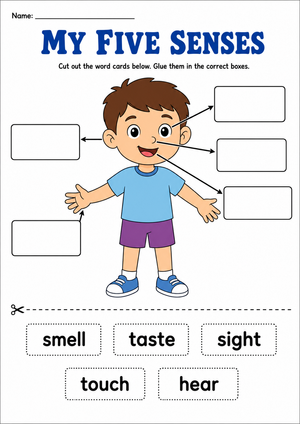
- Labeling a simple face diagram with body part names
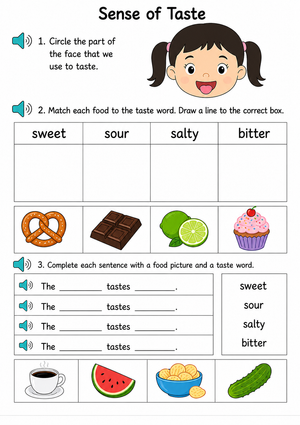
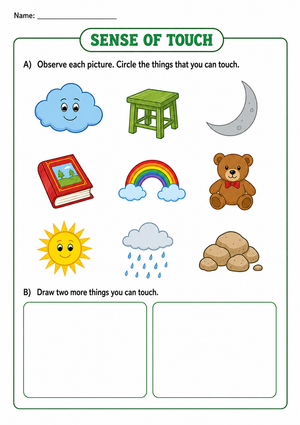
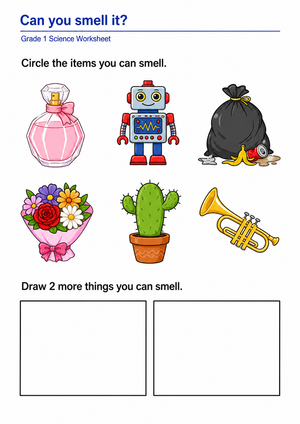
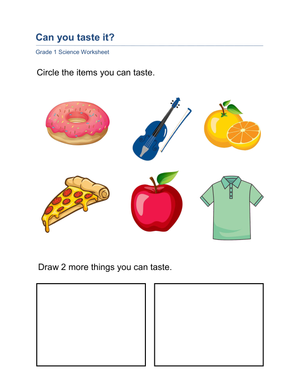
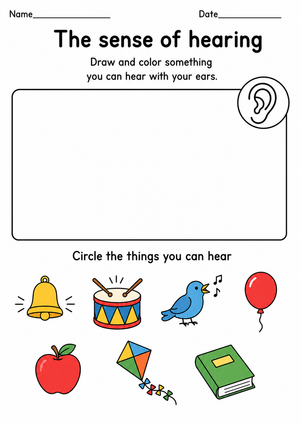
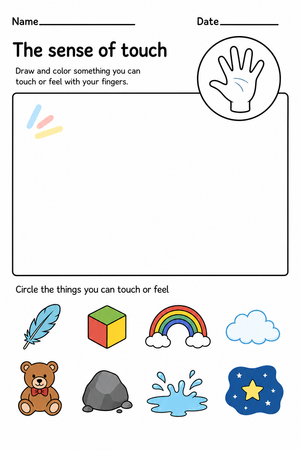
- Circle-the-picture tasks where students identify which object fits a named sense
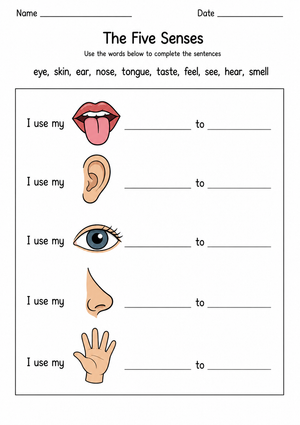
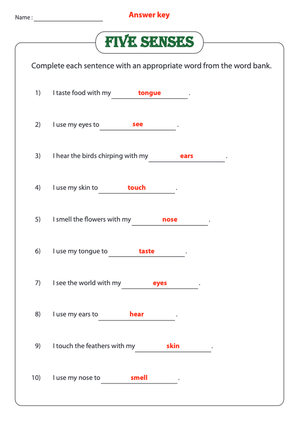
- Sentence frames — "I use my ___ to ___." — for tracing or independent writing
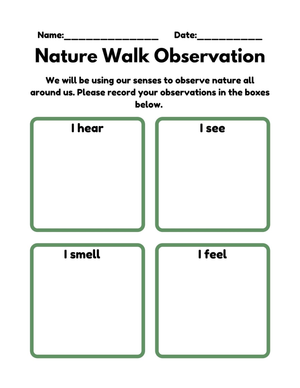
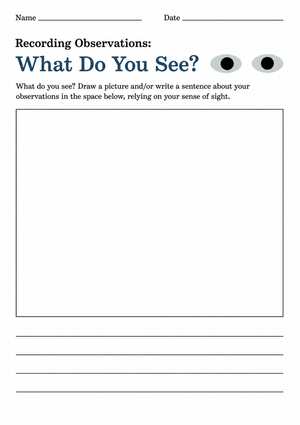
- Open recording sheets where students draw one example for each of the five senses
The variety in task type matters because Kindergarten science skills are not uniform across a class. A student who sorts pictures correctly may still struggle to produce a written label, and the reverse is also true. Having multiple worksheet types for the same content lets teachers see where understanding holds and where it breaks down.
Student Errors That Regularly Surface in This Unit
The confusion between taste and smell catches most teachers off guard the first time through this topic. Students who correctly sort "apple" under taste will often also place it under smell — and they are not wrong that both senses are involved in eating an apple. A sorting worksheet brings this confusion into the open. The working rule for Kindergarten is that taste happens on the tongue and smell happens in the nose, which gives students a specific body part to use as their sorting criterion. That reframe usually moves a confused response into a confident one.
Touch produces a different pattern. Students reliably limit the touch sense to hands. When a worksheet shows a picture of someone feeling wind on their arms or warmth on their face, students freeze or guess. The correct body part is skin — the whole body — and that idea needs a direct-instruction moment before students encounter it on paper. A quick demo where students feel something on their forearm, not their hand, makes the point faster than any verbal explanation.
There is a less common but genuinely interesting error worth watching for: some students place "loud bass music" under both hearing and touch. If a student has stood near a speaker or felt vibration through a gym floor, that classification is observationally accurate. It opens a useful classroom conversation about how some experiences involve more than one sense — not something to mark wrong, but to acknowledge and then use to sharpen students' sorting criteria.
Fitting These Worksheets Into Your Lesson Plan
The most reliable structure is one sense per day across five days. Each day starts with a brief hands-on exploration — a texture bag for touch, mystery sounds for hearing, a set of picture cards for sight — and ends with a worksheet to record what students noticed. That sequence keeps the worksheet as a recording tool, not the entry point for new content. When students have something concrete to connect to, sorting tasks move faster and group-share conversations are richer.
These also work well in science center rotations. Set out one worksheet alongside two or three real objects that match the day's sense: a smooth stone, a rough sponge, and a piece of aluminum foil for touch. Students work through the objects first, then mark the worksheet. For sub plans or early-finisher tasks, kindergarten 5 senses printable worksheets materials are easy to leave with picture-based directions that do not require a substitute to know the content in advance.
One detail that pays off: when the direction pattern on each worksheet stays consistent — look, mark, then draw — students stop spending mental energy interpreting what the worksheet is asking and spend it on the science instead. That procedural predictability is especially valuable in a 20-minute Kindergarten science block where transitions eat time quickly.
Adapting the Set for a Range of Learners
The kindergarten 5 senses printable worksheets set lends itself to easy adjustment because the content is inherently visual and the topic is familiar to most five-year-olds regardless of reading level. For students still developing fine motor control, a cut-and-paste sort can be swapped for a circle-the-answer version of the same task — the cognitive target stays identical, and no scissors are required. For students who need language support, reading the directions aloud and completing the first example together as a group makes each worksheet accessible without changing what is being practiced.
Students who work quickly benefit from a challenge prompt added at the bottom of any worksheet: "Write or draw two things you could hear on a playground that are NOT shown here." That extension keeps fast finishers working on the same concept while pushing toward original observation rather than simple recall. No separate resource needed.
For small-group intervention, the labeling and matching worksheets are the most efficient starting point. They isolate a single skill — body part identification or sensory categorization — which makes it easier to pinpoint exactly where a student's understanding is unclear before moving to the more open-ended recording tasks.
Frequently Asked Questions
Do students need to read to use these worksheets?
Most tasks are picture-based. Students circle, draw, cut, paste, and match without needing to decode the sense names to begin. Vocabulary words appear on tracing and labeling tasks, but those tasks support early reading development rather than require it as a prerequisite.
Where does this topic fit in the Kindergarten school year?
Most Kindergarten teachers introduce the five senses in the first six to eight weeks of school, when observation and science talk are the primary instructional focus and students are still building classroom routines. The timing also aligns well with early descriptive language work in literacy — words like rough, smooth, loud, quiet, sweet, and sour serve both subjects at once.
How do I handle the taste sense if food is not allowed in my classroom?
When using kindergarten 5 senses printable worksheets resources in classrooms with food restrictions, picture-based taste worksheets work reliably. Students sort or identify images of apples, lemons, popcorn, and ice cream without any physical food present. The core concept — taste happens on the tongue — is fully teachable through pictures alone.
Can these double as a quick formative check?
Yes. A matching task at the end of a lesson shows whether students connect each sense to the correct body part. A cut-and-paste sort shows whether they can apply the concept to real-world examples. For the most informative data, ask students to explain one answer aloud while you circulate — at this age, a verbal explanation often reveals more than the written response, especially early in the year when writing is still developing.












 Interactive Worksheet Maker
 Quiz Maker
 Word Search Maker
 Crossword Puzzle Maker
 Word Scramble Generator
 Sentence Scramble Generator
 Handwriting Worksheet Generator
 Name Tracing Generator
 Fill In The Blank Generator