


























Views
Downloads

Essential 5 Senses Worksheet | Grade 1 Science
Paste this activity's link or code into your existing LMS (Google Classroom, Canvas, Teams, Schoology, Moodle, etc.).
Students can open and work on the activity right away, with no student login required.
You'll still be able to track student progress and results from your teacher account.
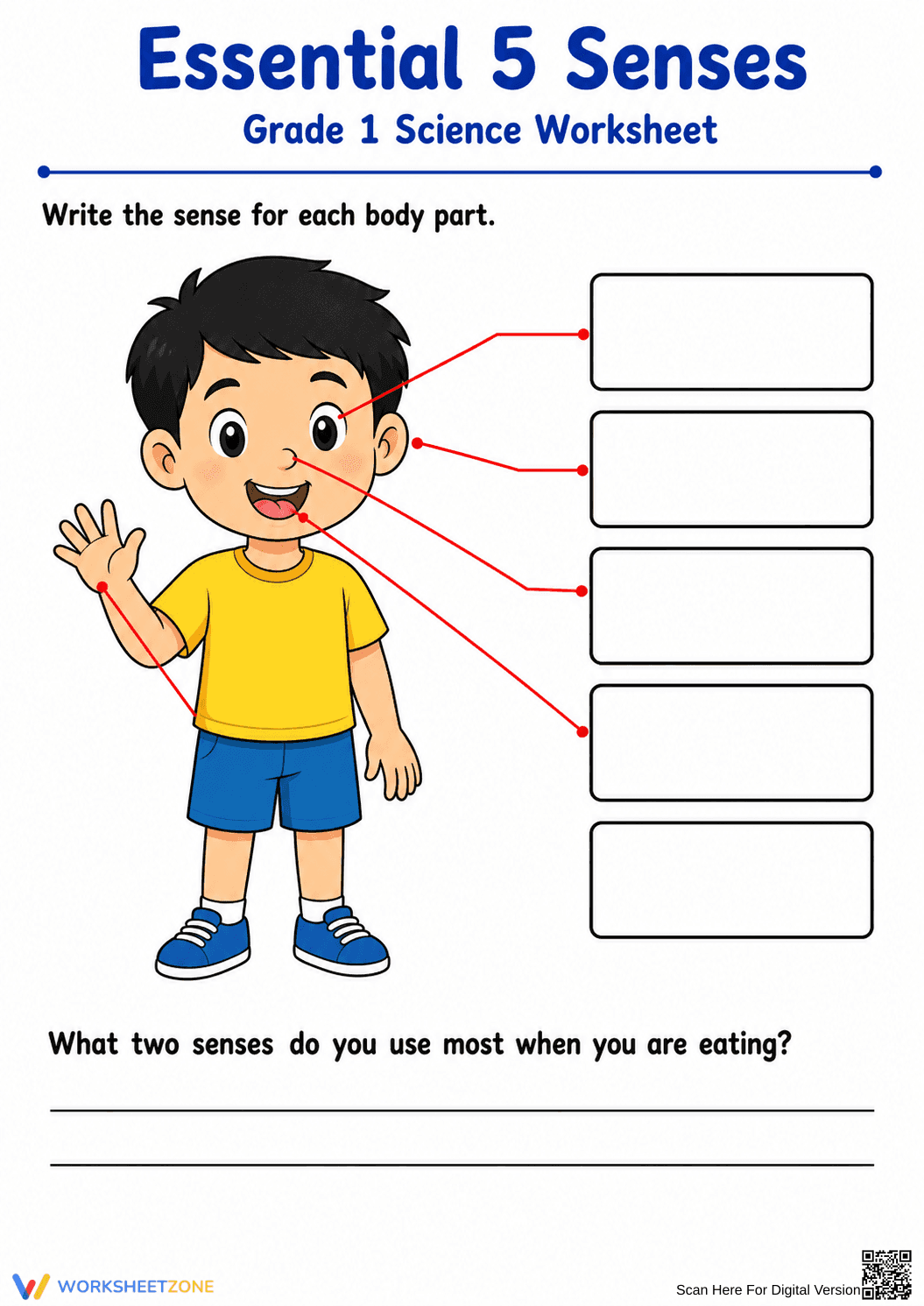
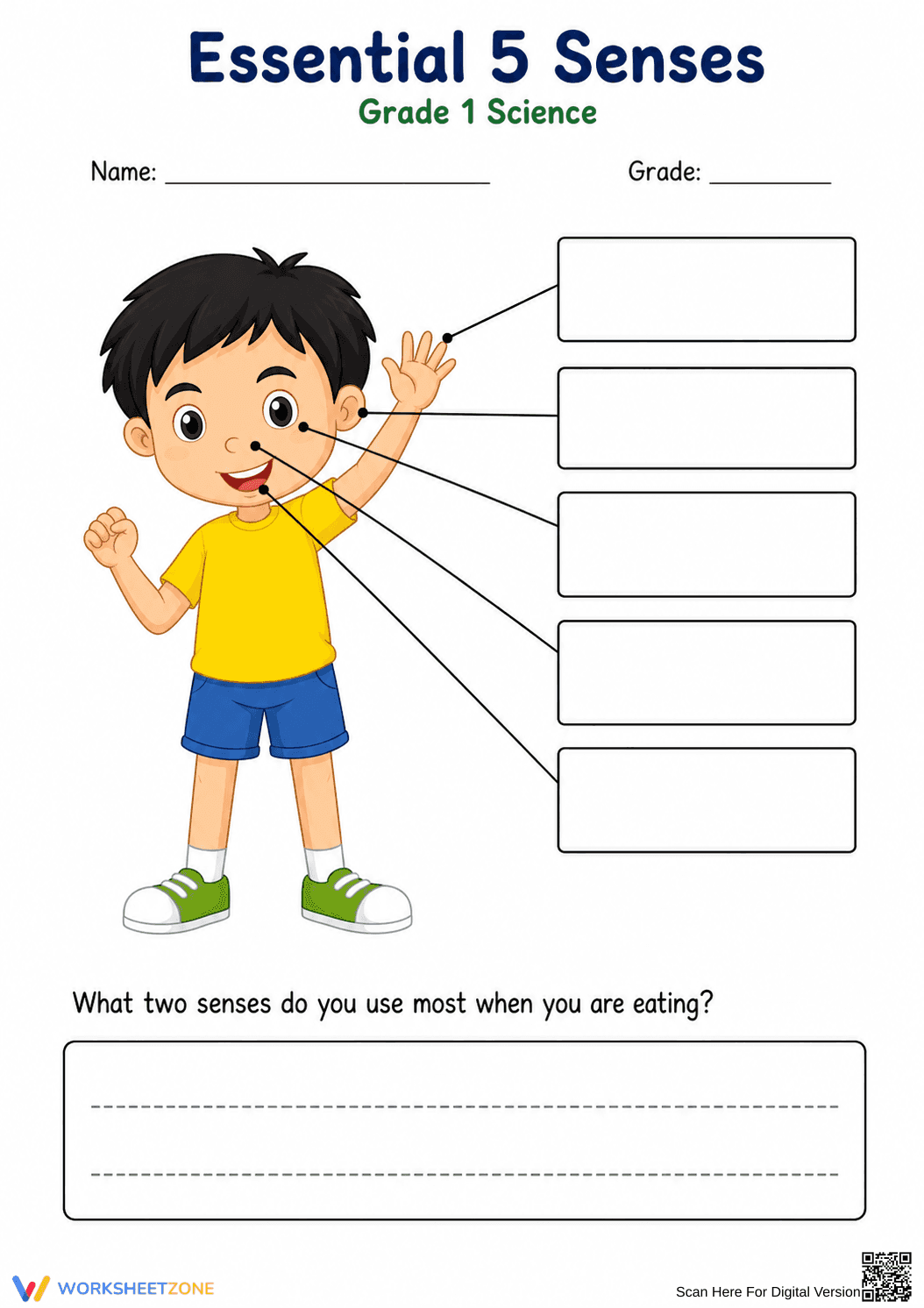
Students identify and categorize the five human senses by matching them to their corresponding external body parts. This essential science resource helps first graders connect biological structures to sensory functions, fostering early scientific inquiry and observational accuracy through a clear, visual matching exercise and a higher-order application question about sensory integration during daily activities.
At a Glance
- Grade: Grade 1 · Subject: Science
- Standard:
1-LS1-1— Use external parts to see, hear, and take in information- Skill Focus: Human sensory systems and body part identification
- Format: 2 pages · 6 problems · Answer key included · PDF
- Best For: Individual practice or science center activity
- Time: 10–15 minutes
What's Inside
This comprehensive resource contains two high-quality pages, including the primary student worksheet and a full-color teacher answer key. The worksheet features a detailed illustration of a child with distinct pointers to major sensory organs. Students are tasked with identifying five specific senses and answering a critical-thinking question about which senses are most active while eating.
Zero-Prep Workflow
- Print (30 seconds): Simply output this optimized PDF for your entire class without any formatting adjustments.
- Distribute (1 minute): Hand out the visual matching guide during your life science block or as a quick morning work task.
- Review (5 minutes): Utilize the included answer key for immediate instructional feedback, peer-grading, or student self-correction.
Total teacher preparation time is less than two minutes, making this an ideal choice for emergency substitute plans or rapid formative assessments.
Standards Alignment
This worksheet is specifically aligned with the Next Generation Science Standard 1-LS1-1. This standard requires students to understand how animals, including humans, use their external parts to help them survive and meet their needs. By identifying organs and their functions, students demonstrate mastery of the "Structure and Function" crosscutting concept. This standard code can be copied directly into lesson plans or district curriculum mapping tools.
How to Use It
The worksheet is best implemented during the "Explain" or "Elaborate" phase of a 5E science lesson. After students have explored sensory objects, use this sheet to formalize their vocabulary. For a formative assessment observation, watch as students identify the tongue or nose; hesitation here often indicates a need for more concrete examples of chemical versus mechanical sensing. Completion typically takes 12 minutes.
Who It's For
This resource is designed for first-grade students but is also highly effective for Kindergarten extension or second-grade review. The visual nature of the diagram makes it an excellent support tool for English Language Learners (ELL) and students with IEPs who benefit from reduced linguistic load. It pairs naturally with a sensory walk.
This life science resource aligns with NGSS 1-LS1-1, focusing on how external parts of humans help them process information from their environment. Research from RAND AIRS 2024 highlights that visual matching tasks in early childhood science education significantly improve the retention of complex biological concepts. By connecting physical anatomy—eyes, ears, nose, tongue, and hands—to the conceptual framework of the five senses, students develop a concrete understanding of human biology. The inclusion of a higher-order thinking question regarding sensory integration during eating further strengthens cognitive pathways related to cross-modal perception. This evidence-based approach ensures that Grade 1 learners move beyond simple rote memorization toward a functional understanding of how their bodies interact with the world around them. Such structured practice is vital for building the foundational literacy and scientific reasoning skills required for subsequent life science mastery in later elementary grades.


