


























Views
Downloads
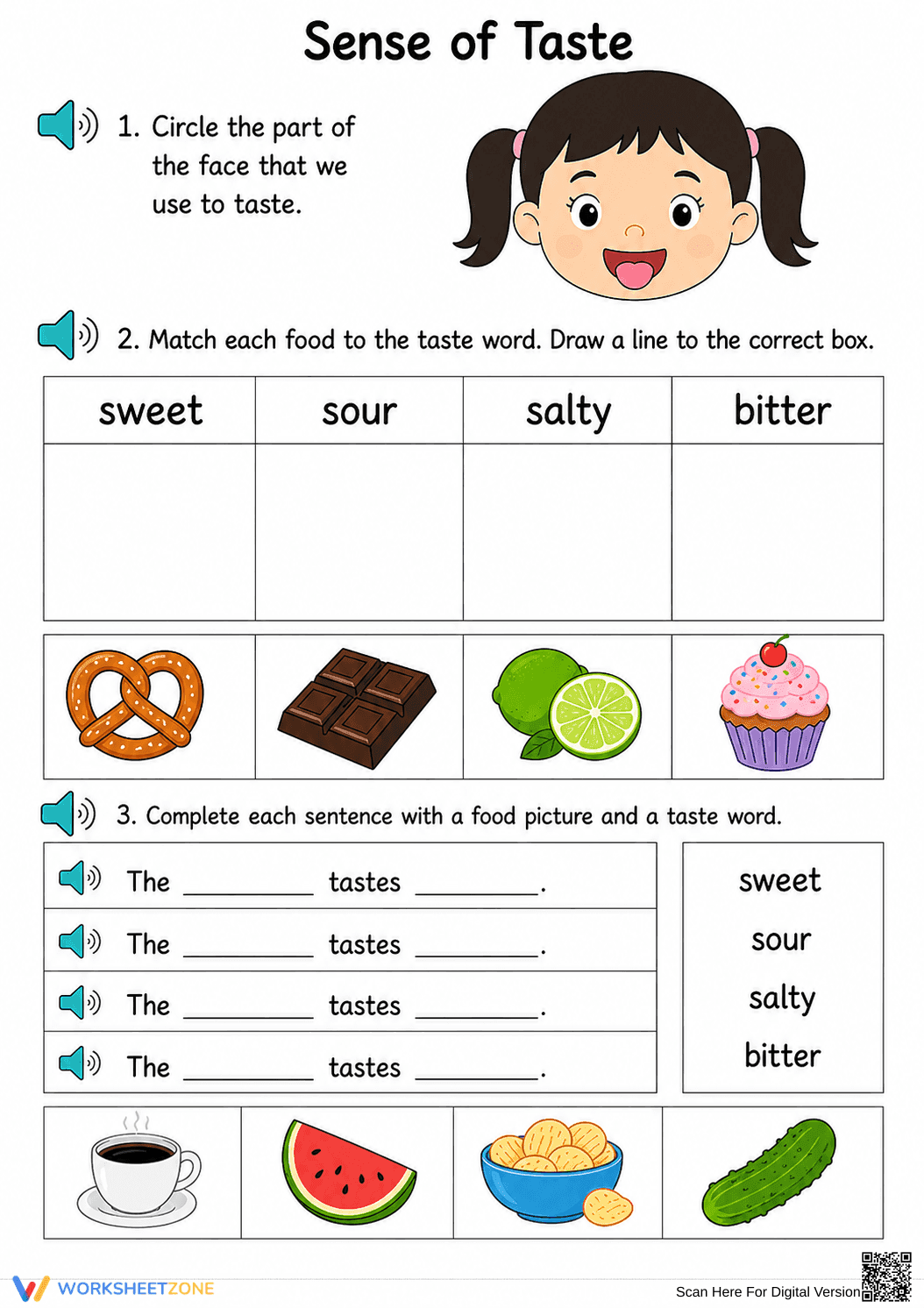

Sense of Taste Worksheet | Essential Grade K-1 ELA
Paste this activity's link or code into your existing LMS (Google Classroom, Canvas, Teams, Schoology, Moodle, etc.).
Students can open and work on the activity right away, with no student login required.
You'll still be able to track student progress and results from your teacher account.
This interactive Sense of Taste worksheet helps young learners master basic culinary vocabulary and sensory identification. Students explore the concepts of sweet, sour, salty, and bitter through engaging visual matching and sentence completion tasks. By connecting real-world foods to descriptive adjectives, children build essential language foundations while reinforcing their understanding of the human five senses.
At a Glance
- Grade: Kindergarten · Subject: English Language Arts
- Standard:
CCSS.ELA-LITERACY.L.K.5.A— Sort common objects into categories to gain a sense of the concepts- Skill Focus: Sensory Vocabulary & Categorization
- Format: 1 page · 9 tasks · Answer key included · PDF
- Best For: Kindergarten science and ELA centers
- Time: 10–15 minutes
What's Inside
This single-page resource features three distinct sections designed to scaffold student learning. It begins with a biological identification task, followed by a primary categorization grid where students match food images like lemons and cake to specific taste words. The final section includes four sentence-completion exercises with visual cues, providing a complete reading and writing experience. A comprehensive answer key is included for rapid grading.
Zero-Prep Workflow
Implementing this resource involves a simple three-step process: Print (30 seconds), Distribute (1 minute), and Review (1 minute). Total teacher preparation time is targeted at under two minutes, allowing educators to focus on direct student support. The self-explanatory layout makes it an ideal choice for emergency sub plans or independent literacy centers where minimal adult intervention is preferred.
Standards Alignment
This resource is directly aligned with `CCSS.ELA-LITERACY.L.K.5.A`, which requires students to sort common objects into categories to gain a sense of the concepts the categories represent. It also supports `K-LS1-1` by having students use observations to describe patterns of what humans need to survive, specifically focusing on sensory input. Both standard codes can be copied directly into lesson plans, IEP goals, or district curriculum mapping tools.
How to Use It
Use this worksheet as a formative assessment after a hands-on "taste test" activity in the classroom. Observe how students differentiate between the "sour" lemon and "bitter" coffee to gauge their comprehension of sensory adjectives. It also serves as an excellent follow-up to a read-aloud about the five senses. Expected completion time ranges from 10 to 15 minutes depending on the student's reading level.
Who It's For
Designed primarily for Kindergarten students, this worksheet is also suitable for Preschool learners and Grade 1 students needing vocabulary reinforcement. The heavy reliance on visual aids and drag-and-drop mechanics makes it particularly accessible for English Language Learners (ELLs) and students with IEPs. It pairs naturally with non-fiction passages about the human body or healthy eating habits.
Aligned with CCSS.ELA-LITERACY.L.K.5.A, this Sense of Taste worksheet facilitates the development of sensory vocabulary through structured categorization. Research from Fisher & Frey (2014) emphasizes that vocabulary acquisition is most effective when students categorize and connect new words to visual representations and personal experiences. By sorting sweet, sour, salty, and bitter flavors, students engage in categorical thinking that serves as a cognitive precursor to more complex linguistic analysis. This resource provides nine distinct interactive opportunities for students to apply these concepts in a supported environment. The inclusion of sentence frames further scaffolds the transition from isolated word recognition to contextual application in reading and writing. Educators can use these tasks to gather evidence of mastery for ELA and science standards simultaneously. The clear structure ensures that learners can achieve outcomes with high levels of independence, making it a valuable tool for early childhood development and foundational literacy practice.


