


























Views
Downloads
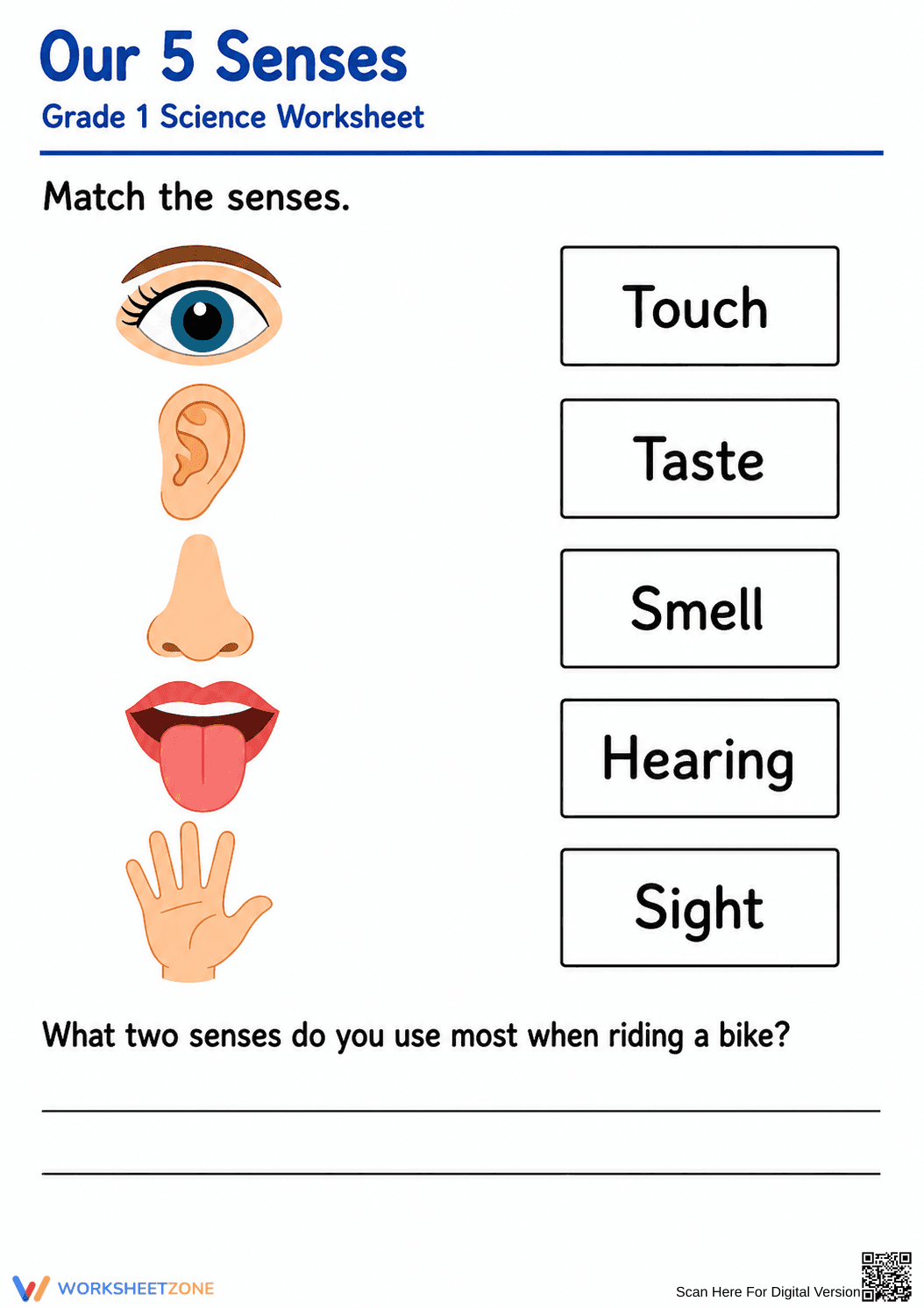

Grade 1 5 Senses — Printable No-Prep Worksheet
Paste this activity's link or code into your existing LMS (Google Classroom, Canvas, Teams, Schoology, Moodle, etc.).
Students can open and work on the activity right away, with no student login required.
You'll still be able to track student progress and results from your teacher account.
Students master the five senses by connecting biological structures to sensory functions. This Grade 1 science worksheet provides a visual framework for children to recognize how their eyes, ears, nose, tongue, and hands help them interact with their environment, leading to improved scientific observation and understanding of the human body.
At a Glance
- Grade: 1 · Subject: Science
- Standard:
1-LS1-1— Identify external body parts and their sensory functions- Skill Focus: Sensory Identification
- Format: 1 page · 6 problems · Answer key included · PDF
- Best For: Independent practice and quick formative assessment
- Time: 10–15 minutes
This single-page PDF features a high-quality matching activity and a critical thinking question. It includes five illustrations of body parts—eye, ear, nose, mouth, and hand—paired with text labels for the senses. The layout is optimized for young learners with large fonts and clear graphics. A full answer key is included for easy grading.
The Zero-Prep Workflow is designed for maximum efficiency. Step 1: Print the single-page document (30 seconds). Step 2: Distribute to students and explain the matching task (1 minute). Step 3: Review the application question as a whole-group discussion (2 minutes). Total teacher preparation time is under 2 minutes, making this ideal for substitute plans.
Aligned to 1-LS1-1, this resource helps students understand how humans use external parts to process information. By identifying sensory organs, students build foundational knowledge for complex biological studies. Both standard codes can be copied directly into lesson plans, IEP goals, or district curriculum mapping tools.
Use this as a summative check after a lesson on the human body. Observe if students differentiate between the organ and the function. This provides a quick formative assessment of vocabulary acquisition. The expected completion time is 10 to 15 minutes, making it perfect for transition periods or a focused science homework assignment.
Designed for Grade 1, this is also appropriate for Kindergarten enrichment. It is an excellent resource for English Language Learners due to the heavy reliance on visual cues. It pairs naturally with a classroom anchor chart or a read-aloud passage about how animals use their senses to survive in the wild.
According to the RAND AIRS 2024 report on early childhood science education, structured visual matching tasks are highly effective for reinforcing Tier 3 scientific vocabulary in primary grades. By explicitly linking sensory organs to their functional definitions, this worksheet supports the cognitive development of observational frameworks. Research emphasizes that the gradual release of responsibility—moving from simple identification to application questions like the bicycle prompt included here—is critical for ensuring long-term retention of biological concepts. This resource provides the necessary scaffold for students to transition from rote memorization to contextual application. Educators can rely on this evidence-based approach to meet curriculum requirements while providing students with a clear, high-signal path to mastery in the life sciences. Standard code 1-LS1-1 is used to ensure all tasks are grade-appropriate and assessment-aligned for first-grade learners to identify external body parts and their sensory functions.


