


























Views
Downloads
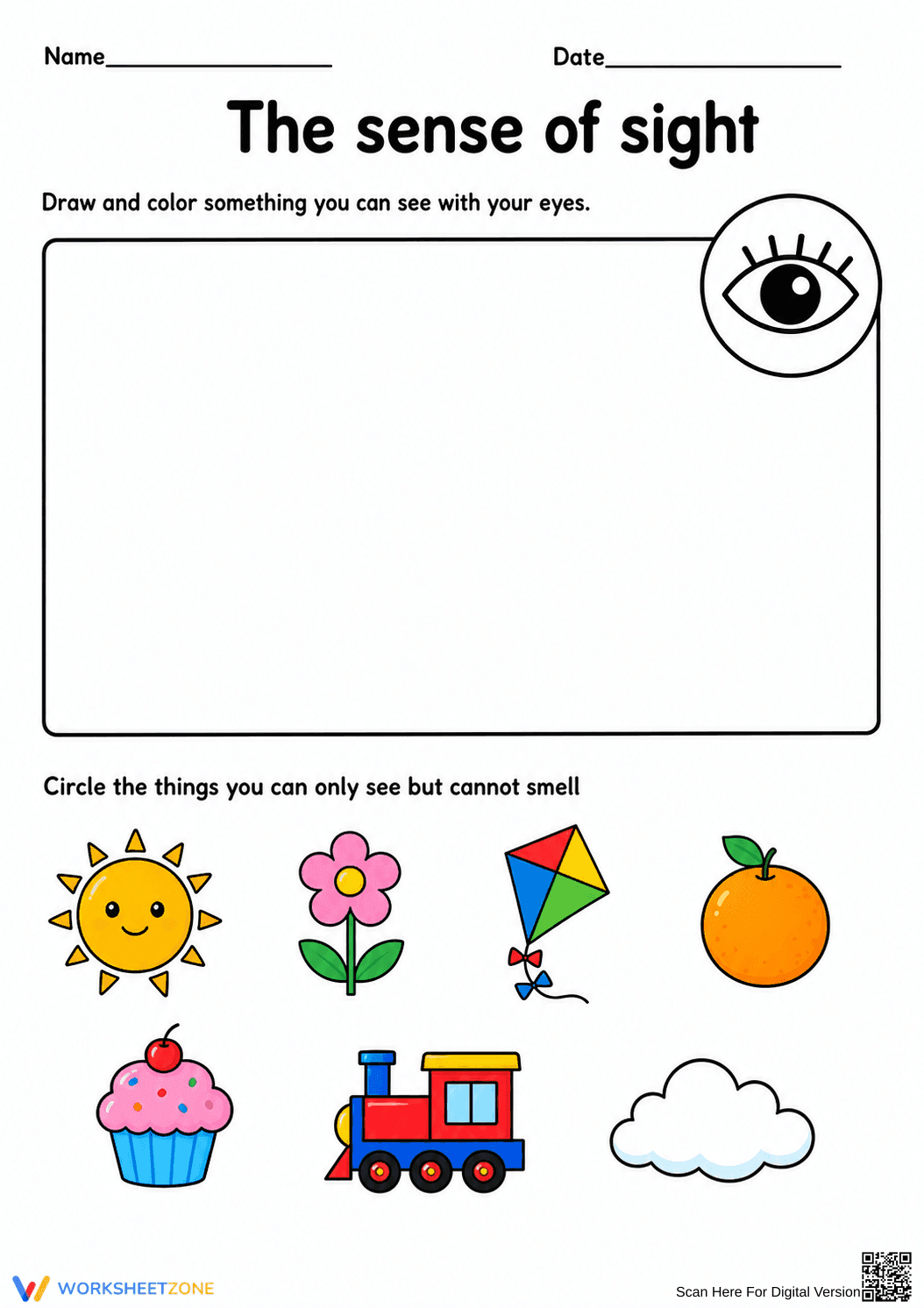

Grade 1 Sense of Sight — Printable No-Prep Worksheet
Paste this activity's link or code into your existing LMS (Google Classroom, Canvas, Teams, Schoology, Moodle, etc.).
Students can open and work on the activity right away, with no student login required.
You'll still be able to track student progress and results from your teacher account.
This printable Grade 1 science worksheet helps students identify and categorize objects based on their observable properties. By distinguishing between things they can see versus things they can smell, early learners build foundational observation skills essential for scientific exploration and descriptive language development.
At a Glance
- Grade: 1 · Subject: Science
- Standard:
1-PS4-2— Make observations to construct an evidence-based account.- Skill Focus: Sense of sight
- Format: 1 page · 2 tasks · No answer key · PDF
- Best For: Independent practice or centers
- Time: 10–15 minutes
Inside this single-page resource, students will find two distinct activity types designed to reinforce their understanding of visual observation. The top half features a large drawing space where children illustrate an object they can see. The bottom half includes a categorization task with seven colorful illustrations—including a kite, train, and cupcake—where students circle only items that can be seen but not smelled. Visual cues make it highly accessible.
This resource offers a streamlined workflow:
- Print (1 minute): The single-page layout prints cleanly in color or black-and-white.
- Distribute (1 minute): Hand out the sheets along with basic drawing supplies.
- Review (2 minutes): Intuitive instructions mean students can begin working immediately.
With a total teacher prep time of under two minutes, this activity is an excellent addition to any emergency sub plan or spontaneous science center.
This activity aligns with primary science objectives, specifically supporting 1-PS4-2: Make observations to construct an evidence-based account that objects can be seen only when illuminated. While focusing on sight, it also reinforces basic categorization skills. Both standard codes can be copied directly into lesson plans, IEP goals, or district curriculum mapping tools.
Teachers can deploy this worksheet during a five senses unit. Use it as independent practice after a direct instruction lesson on how eyes gather information. Alternatively, it serves as morning work to activate prior knowledge. For a formative assessment observation tip, ask students to explain why they circled the sun but not the flower. Expected completion time is 10 to 15 minutes.
This worksheet is primarily designed for first-grade students, though it is easily adaptable for kindergarteners or second graders reviewing basic science concepts. The combination of drawing and image-based categorization provides built-in differentiation for pre-readers or English Language Learners who might struggle with text-heavy assignments. It pairs perfectly with a read-aloud book about the five senses or a classroom anchor chart detailing what each body part does.
Developing strong observational skills in early elementary science is a critical stepping stone for later analytical thinking and scientific inquiry. This worksheet specifically targets the sense of sight, asking students to make observations to construct an evidence-based account, which directly supports the foundational concepts outlined in 1-PS4-2. According to a comprehensive ScienceDirect TpT Analysis, early childhood science resources that successfully combine creative expression—such as open-ended drawing—with structured analytical tasks like categorization significantly improve student retention of abstract concepts. By requiring learners to carefully differentiate between objects they can see and objects they can smell, this activity pushes them beyond simple vocabulary identification and into a critical evaluation of their own sensory experiences. This dual-approach methodology ensures that young learners remain highly engaged with the material while simultaneously building the essential cognitive frameworks necessary for more advanced scientific exploration in subsequent grade levels.


