


























Views
Downloads
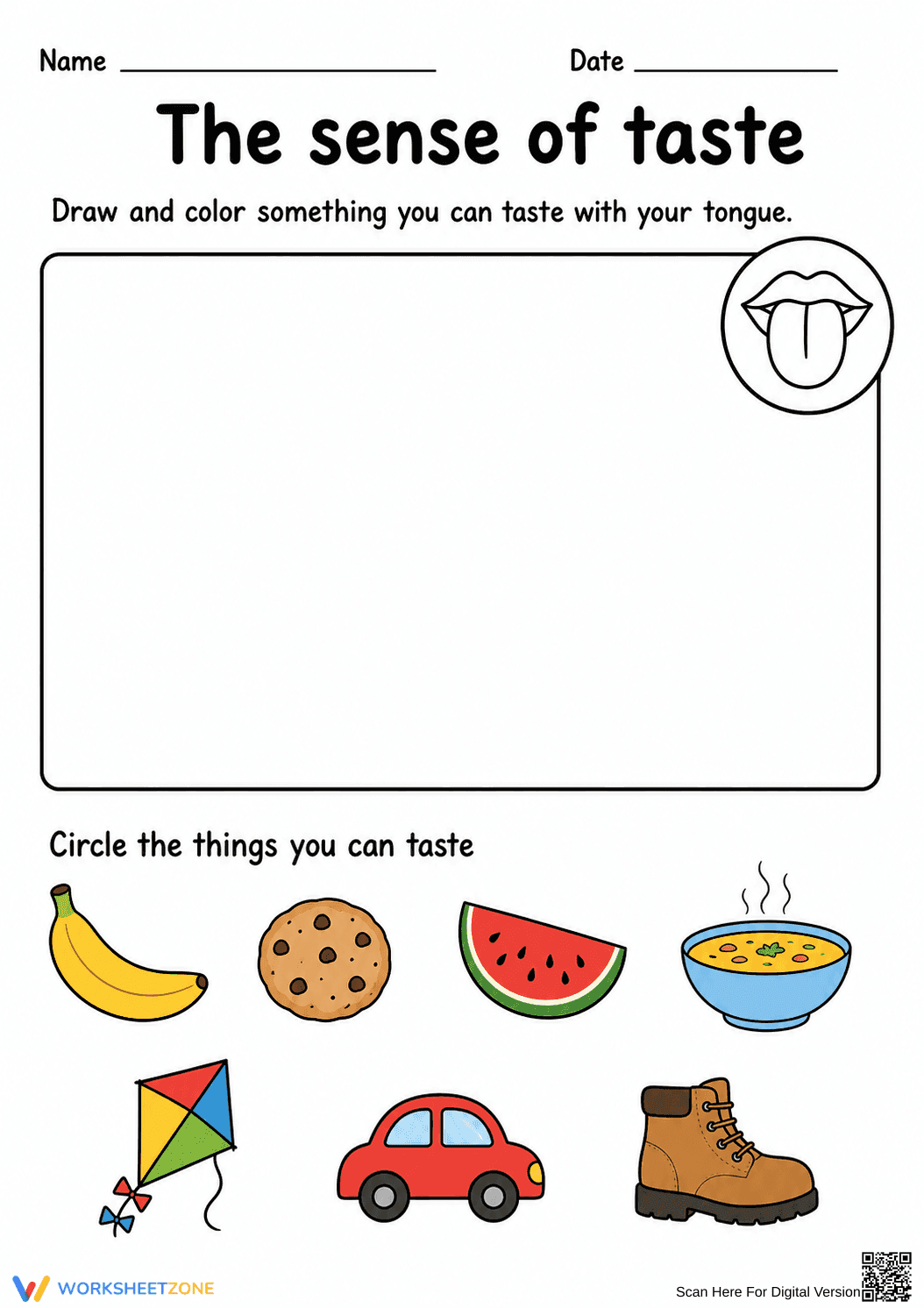

Grade K Sense of Taste — Printable No-Prep Worksheet
Paste this activity's link or code into your existing LMS (Google Classroom, Canvas, Teams, Schoology, Moodle, etc.).
Students can open and work on the activity right away, with no student login required.
You'll still be able to track student progress and results from your teacher account.
This foundational science worksheet helps early learners identify and categorize objects using their sense of taste. By drawing a personal example and selecting edible items from a visual list, students connect sensory concepts to everyday life. It provides an engaging, straightforward way to reinforce basic observation and classification skills.
At a Glance
- Grade: K · Subject: Science
- Standard:
CCSS.ELA-LITERACY.L.K.5.A— Sort common objects into categories- Skill Focus: Identifying objects by sense of taste
- Format: 1 page · 2 problems · No answer key · PDF
- Best For: Independent practice or centers
- Time: 10–15 minutes
What's Inside
Inside this single-page resource, students find two distinct activity sections designed for early learners. The top half features an open drawing box with a tongue icon, prompting children to illustrate something they enjoy tasting. The bottom half presents a visual multiple-choice task where students circle only items that can be tasted, such as a banana or soup, while ignoring distractors like a kite or car.
Zero-Prep Workflow
This worksheet is designed for immediate classroom implementation.
- Print (1 minute): Download the PDF and print a class set.
- Distribute (1 minute): Hand out sheets with crayons or markers.
- Review (3 minutes): Check student drawings and circled items as a group.
With total teacher prep time under two minutes, this activity is an excellent addition to any sub plan or science center.
Standards Alignment
This activity aligns with CCSS.ELA-LITERACY.L.K.5.A, requiring students to sort common objects into categories to gain a sense of the concepts the categories represent. By distinguishing between edible and non-edible items, children practice foundational classification skills essential for early cognitive development. Both standard codes can be copied directly into lesson plans, IEP goals, or district curriculum mapping tools.
How to Use It
Deploy this worksheet during a broader unit on the five senses. It works exceptionally well as an independent practice activity immediately following direct instruction or a read-aloud about how we taste food. Alternatively, place it in a science center where students can discuss their favorite foods while completing the drawing task. Expected completion time ranges from 10 to 15 minutes. For a quick formative assessment, observe which items students choose to circle; if a child circles the car, it provides an immediate opportunity to gently correct their understanding of edible versus non-edible objects.
Who It's For
This resource is primarily designed for Preschool, Kindergarten, and first-grade students developing their understanding of human senses. The heavy reliance on visual cues makes it highly accessible for English Language Learners and students requiring reading scaffolds. Pair this worksheet with a hands-on taste test activity or a vibrant anchor chart detailing the five senses to create a comprehensive, multi-sensory learning experience.
Integrating sensory categorization tasks into early childhood education significantly bolsters cognitive development and vocabulary acquisition. When students engage with materials aligned to CCSS.ELA-LITERACY.L.K.5.A, they practice how to sort common objects into categories, a fundamental skill for scientific inquiry and language comprehension. According to a recent ScienceDirect TpT Analysis, early science resources that combine creative expression, such as drawing, with analytical tasks, like visual sorting, yield higher retention rates among primary learners. This dual-approach ensures that children not only memorize facts but also internalize the concepts by relating them to their personal experiences. By asking students to identify what they can taste and differentiate those items from non-edible objects, educators provide a structured yet creative avenue for foundational learning. This methodology supports robust neural connections, paving the way for more complex scientific reasoning in subsequent grade levels.


