


























Views
Downloads
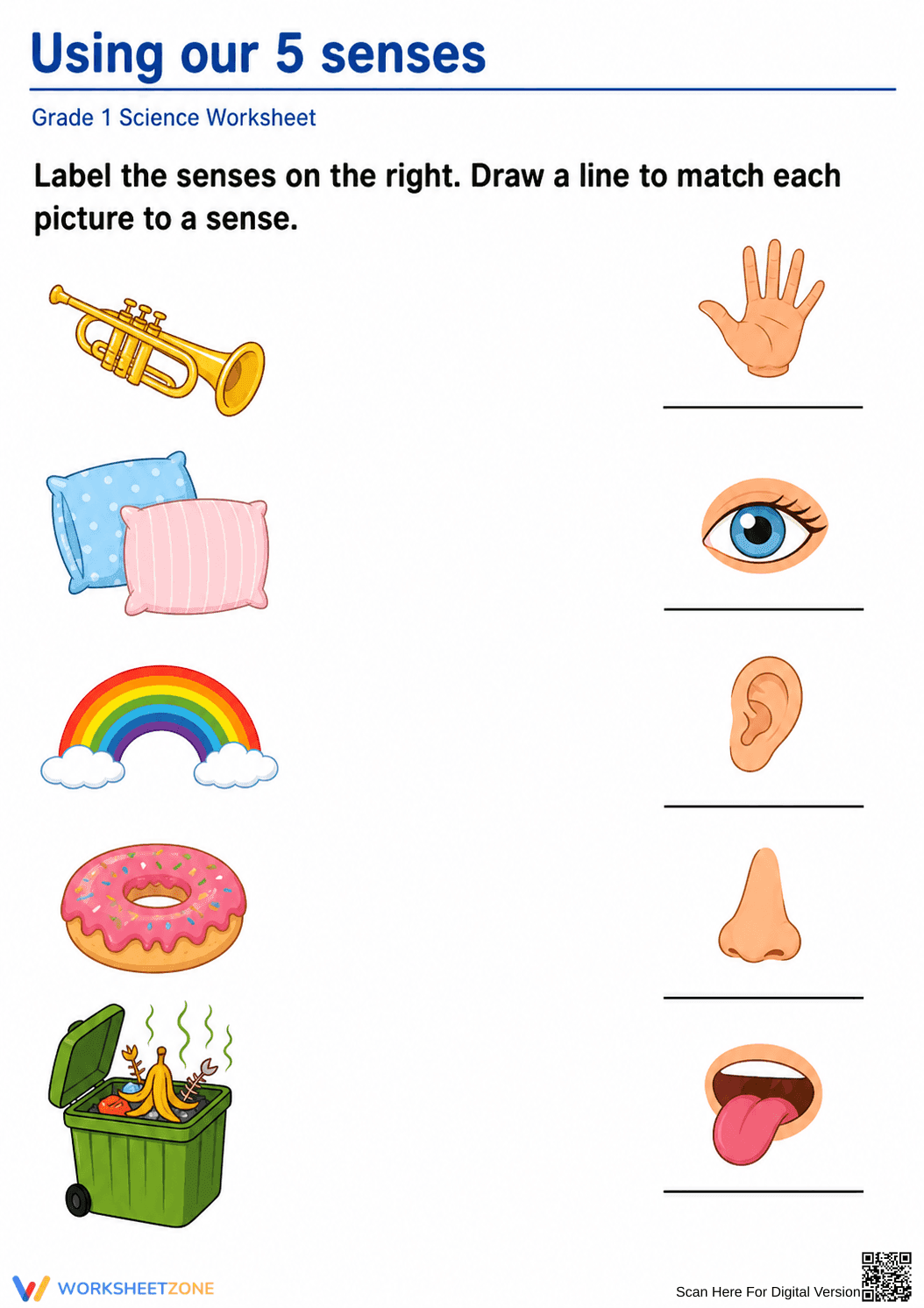

Printable 5 Senses Worksheet | Grade 1 Science Ready
Paste this activity's link or code into your existing LMS (Google Classroom, Canvas, Teams, Schoology, Moodle, etc.).
Students can open and work on the activity right away, with no student login required.
You'll still be able to track student progress and results from your teacher account.
This Grade 1 science worksheet helps young learners master the five senses through engaging matching and labeling exercises. Students connect eyes, ears, nose, tongue, and hands to the sensory inputs they process, developing a foundational understanding of human biology and observation skills.
At a Glance
- Grade: 1 · Subject: Science
- Standard:
1-LS1-1— Identify how external body parts help humans sense surroundings- Skill Focus: Five Senses Identification
- Format: 1 page · 10 problems · Answer key included · PDF
- Best For: Introduction to human body units
- Time: 10–15 minutes
What's Inside
The worksheet features a dual-column layout designed for early primary students. Five clear illustrations represent sight, hearing, touch, smell, and taste. Students label each body part before drawing lines to match them with five vibrant objects on the left, such as a trumpet or a rainbow. A comprehensive answer key is included to facilitate quick grading or self-correction.
Zero-Prep Workflow
This activity requires zero teacher preparation, making it ideal for busy mornings or substitute plans. The streamlined workflow involves printing the single-page PDF (30 seconds), distributing the sheets and explaining the matching instructions (1 minute), and reviewing the answers together (5 minutes). Total teacher active prep time is under two minutes, allowing you to focus on classroom management and student support.
Standards Alignment
This resource is primarily aligned to NGSS 1-LS1-1, focusing on how different external parts of humans work together to help them survive and interact with their environment. By identifying the nose, eyes, ears, hands, and mouth as tools for gathering information, students satisfy the core requirement of understanding external anatomy. Both standard codes can be copied directly into lesson plans, IEP goals, or district curriculum mapping tools.
How to Use It
The best instructional moment for this worksheet is during the "Explain" phase of a science lesson. After students have explored different textures or sounds in the classroom, use this sheet to formalize their learning. As a formative assessment, observe if students correctly pair the trash bin with smell or the trumpet with hearing; errors reveal a need for more concrete vocabulary instruction. Expect most first graders to complete the identification and labeling tasks within 10 to 15 minutes.
Who It's For
This activity is designed for Grade 1 but works exceptionally well for Kindergarten enrichment or Grade 2 review. It serves English Language Learners who benefit from strong visual cues paired with labeling tasks. For differentiation, teachers can provide a word bank on the board to assist with spelling. It pairs naturally with a read-aloud about the human body or a sensory scavenger hunt around the school.
Scientific inquiry in early childhood emphasizes using the five senses to categorize the physical world. Visual scaffolds and matching tasks are essential for building scientific literacy in primary grades, as they help bridge the gap between abstract concepts and concrete reality (Fisher & Frey, 2014). This worksheet aligns directly with NGSS 1-LS1-1, encouraging students to observe how external body parts function as critical information-gathering tools to identify how external body parts help humans sense surroundings. Identifying sight, sound, smell, taste, and touch in everyday contexts builds essential cognitive frameworks for more advanced life science studies. Furthermore, highly visual science activities significantly increase vocabulary retention and comprehension in Grade 1 classrooms. This printable resource offers a structured, evidence-based approach to foundational sensory education, effectively preparing young students for future exploration of complex animal adaptations and human health systems.


