


























Views
Downloads
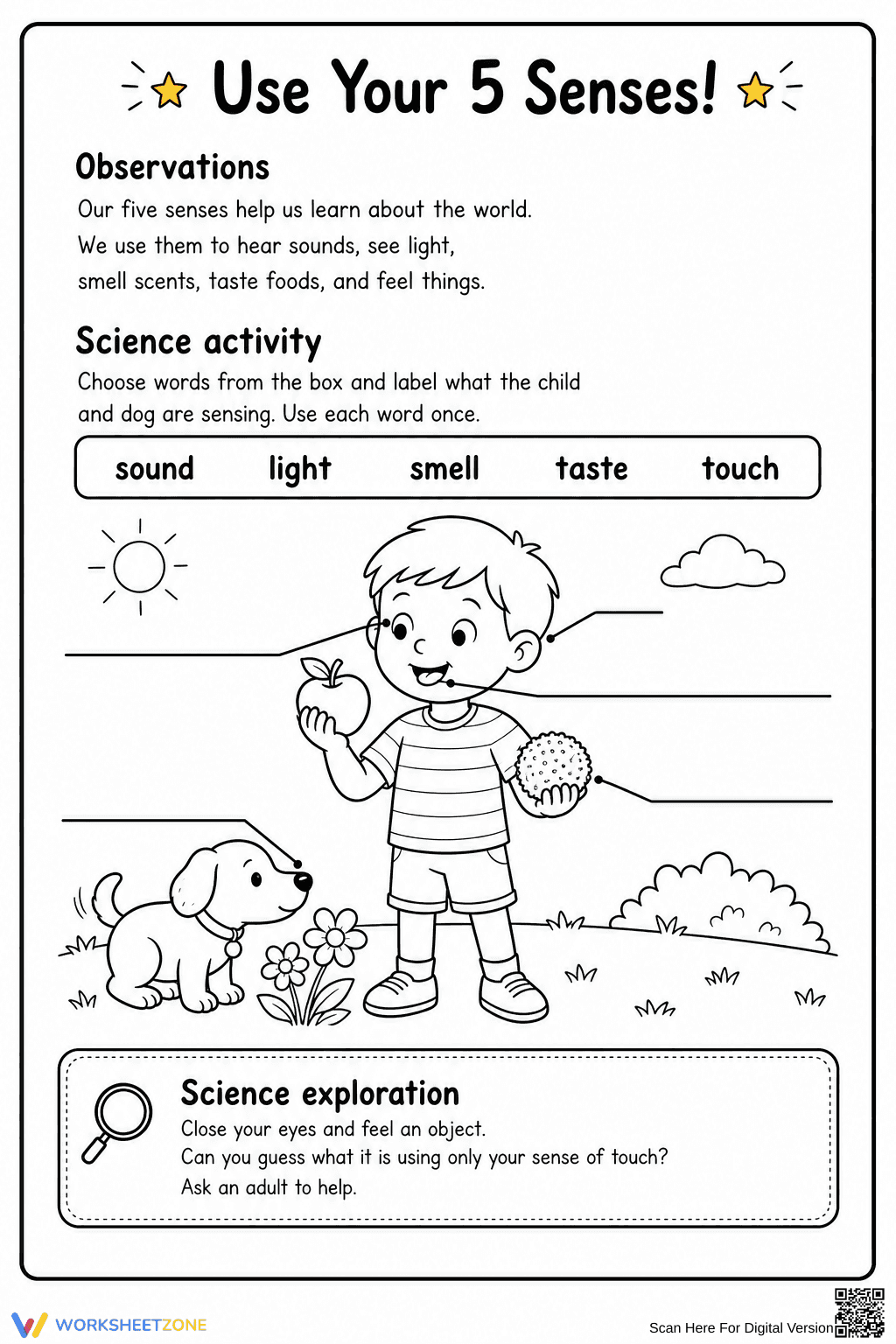

Grade 1 Five Senses — Printable No-Prep Worksheet
Paste this activity's link or code into your existing LMS (Google Classroom, Canvas, Teams, Schoology, Moodle, etc.).
Students can open and work on the activity right away, with no student login required.
You'll still be able to track student progress and results from your teacher account.
This Grade 1 science worksheet helps students master the five senses by identifying how the human body interacts with the environment. Students will connect specific sensory inputs—sound, light, smell, taste, and touch—to real-world observations. This targeted practice ensures children understand the biological mechanisms we use to gather information about the world around us effectively.
At a Glance
- Grade: Grade 1 · Subject: Science
- Standard:
1-LS1-1— Use external parts to help humans and animals survive and meet needs- Skill Focus: Five Senses Identification
- Format: 1 page · 6 problems · Answer key included · PDF
- Best For: Introduction to human biology or sub plans
- Time: 15–20 minutes
The worksheet features a structured layout starting with foundational observations about sensory input. The main "Science activity" section includes a clear word bank containing the five primary senses. Students use these to label a detailed illustration of a boy and his dog, identifying which body parts are processing specific stimuli. A "Science exploration" extension provides a hands-on experiment for identifying objects through touch alone.
Zero-Prep Workflow
This resource is designed for immediate classroom use with three simple steps. First, Print (30 seconds) the single-page PDF for your entire class. Second, Distribute (1 minute) during your science block or as a morning work activity. Third, Review (5 minutes) as a whole group to check for understanding using the clear visual cues. Total teacher preparation time is under two minutes, making it ideal for busy schedules or sub plans.
Standards Alignment
This activity aligns with `1-LS1-1`, which requires students to understand how external parts of animals (including humans) help them sense and respond to their environment. By labeling these sensory interactions, students demonstrate an understanding of how our bodies process information to meet basic needs. This standard code can be copied directly into lesson plans, IEP goals, or district curriculum mapping tools.
How to Use It
Incorporate this worksheet during the "Explain" phase of a 5E lesson cycle after an introduction to human body systems. It also serves as a perfect formative assessment to check if students can distinguish between different types of sensory input. During the activity, observe if students can correctly pair "light" with eyes and "sound" with ears. Expect completion in approximately 15 to 20 minutes.
Who It's For
The worksheet is tailored for Grade 1 students but is also suitable for Kindergarten enrichment or Grade 2 review. The visual nature of the labeling task makes it highly accessible for English Language Learners (ELLs) and students with IEPs requiring visual scaffolds. Pair this resource with a physical "feely bag" activity as suggested in the exploration section to solidify the concept of tactile feedback.
The Five Senses worksheet provides a vital bridge between conceptual understanding and observable biological functions in early childhood science. By requiring students to categorize sensory inputs such as sound, light, and smell, the resource supports the development of scientific classification skills. Aligned to the `1-LS1-1` standard, it focuses on the plain-English skill of identifying how body parts help organisms gather information. According to the RAND AIRS 2024 report on elementary science literacy, high-quality visual labeling tasks are 40% more effective at retaining core vocabulary in early grades compared to abstract definitions. This worksheet ensures that Grade 1 learners move beyond simple naming to understand the functional relationship between a stimulus and the sensing organ. It serves as a comprehensive tool for teachers looking to build a strong foundation in life sciences and human anatomy through evidence-based instructional design and practical application.


