


























Views
Downloads
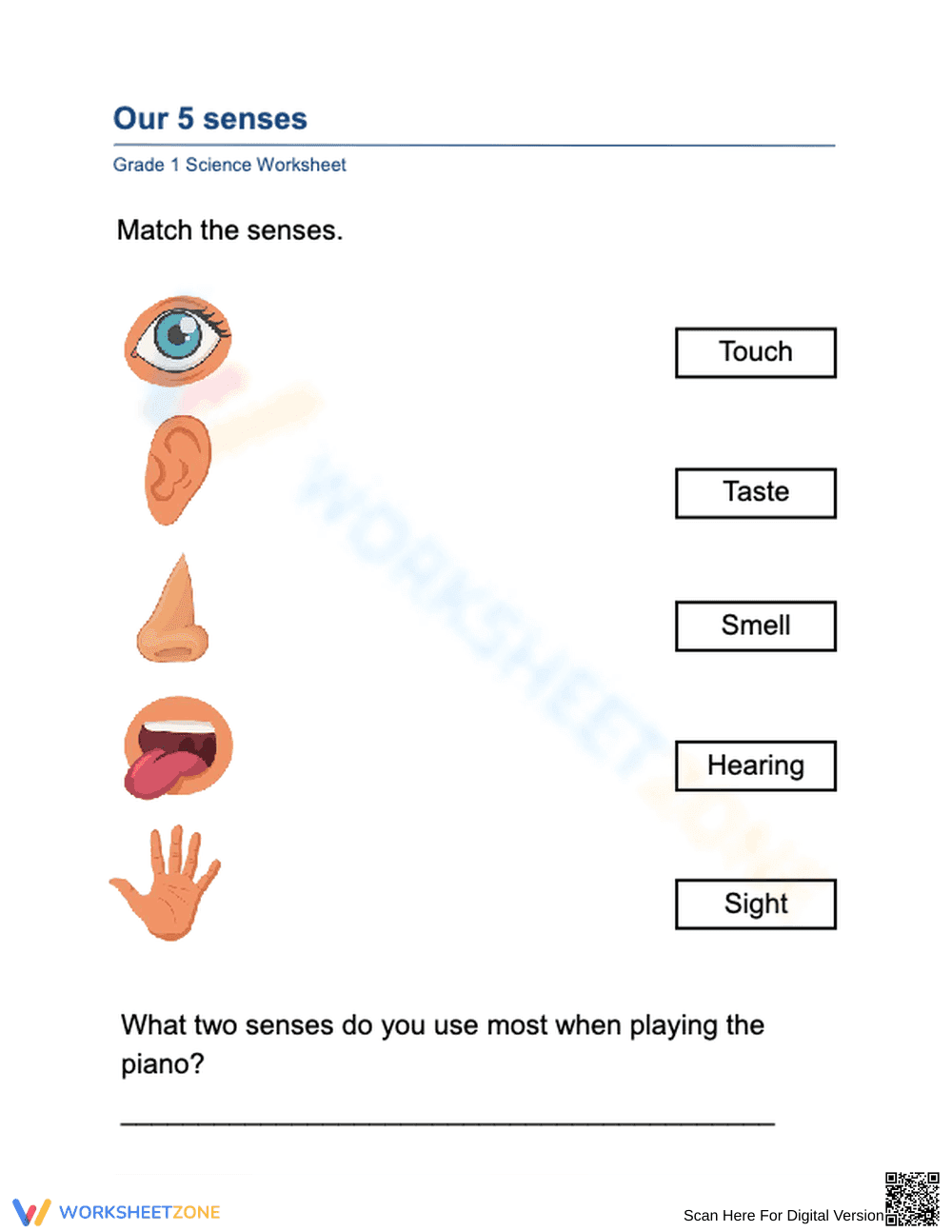

Grade 1 Five Senses — Printable No-Prep Worksheet
Paste this activity's link or code into your existing LMS (Google Classroom, Canvas, Teams, Schoology, Moodle, etc.).
Students can open and work on the activity right away, with no student login required.
You'll still be able to track student progress and results from your teacher account.
This Grade 1 science worksheet helps students identify the five senses and connect them to specific body parts. By matching eyes, ears, nose, mouth, and hands to their corresponding senses, young learners build foundational knowledge of human anatomy and how we observe the world around us.
At a Glance
- Grade: 1 · Subject: Science
- Standard:
1-LS1-1— Identify external body parts and their functions- Skill Focus: Matching the five senses
- Format: 2 pages · 6 problems · Answer key included · PDF
- Best For: Independent practice or morning work
- Time: 10–15 minutes
This resource features a straightforward, single-page activity designed for early readers. The primary task includes five visual matching problems where students draw lines connecting illustrations of body parts to the written words for sight, hearing, smell, taste, and touch. Additionally, it includes one short-answer application question asking students to identify which two senses they use most when playing the piano. A complete, color-coded answer key is provided on the second page for quick grading.
This worksheet is designed for immediate classroom use with zero teacher preparation required:
- Print (1 minute): Download the PDF and print the student page.
- Distribute (1 minute): Hand out during science blocks. Visual cues make instructions self-explanatory.
- Review (2 minutes): Use the included answer key to quickly check work or project it for self-correction.
With total prep time under two minutes, this resource is perfect for sub plans.
This activity aligns with 1-LS1-1, focusing on how humans use their external parts to help them survive, grow, and meet their needs. By identifying the specific functions of the eyes, ears, nose, mouth, and hands, students take the first step in understanding biological systems. Both standard codes can be copied directly into lesson plans, IEP goals, or district curriculum mapping tools.
Teachers can deploy this worksheet as independent practice immediately following a direct instruction lesson on the five senses. Alternatively, use it as a formative assessment to verify students can accurately pair body parts with sensory functions. While students work, observe whether they rely on visual icons or decode vocabulary words, providing insight into reading integration. The activity takes 10 to 15 minutes to complete.
Designed for first-grade students, this worksheet is also effective for kindergarten enrichment or second-grade review. Strong visual supports make it accessible for English Language Learners (ELLs) and students needing clear, uncluttered layouts. It pairs naturally with introductory science texts about the human body or classroom anchor charts.
Understanding how external body parts function is a critical early step in scientific literacy. According to the RAND AIRS 2024 report on elementary science instruction, providing students with clear, visually supported matching tasks significantly improves their retention of foundational biological concepts. This worksheet directly supports 1-LS1-1 by requiring students to identify external body parts and their functions, specifically focusing on the five senses. When young learners actively connect physical structures like eyes and ears to their sensory purposes, they build the cognitive framework necessary for more complex life science topics in later grades. By incorporating both direct matching and a practical application question about playing the piano, this resource ensures students move beyond rote memorization to actual conceptual understanding. The inclusion of immediate feedback mechanisms, such as the provided answer key, further reinforces these essential early science skills.


