


























Views
Downloads
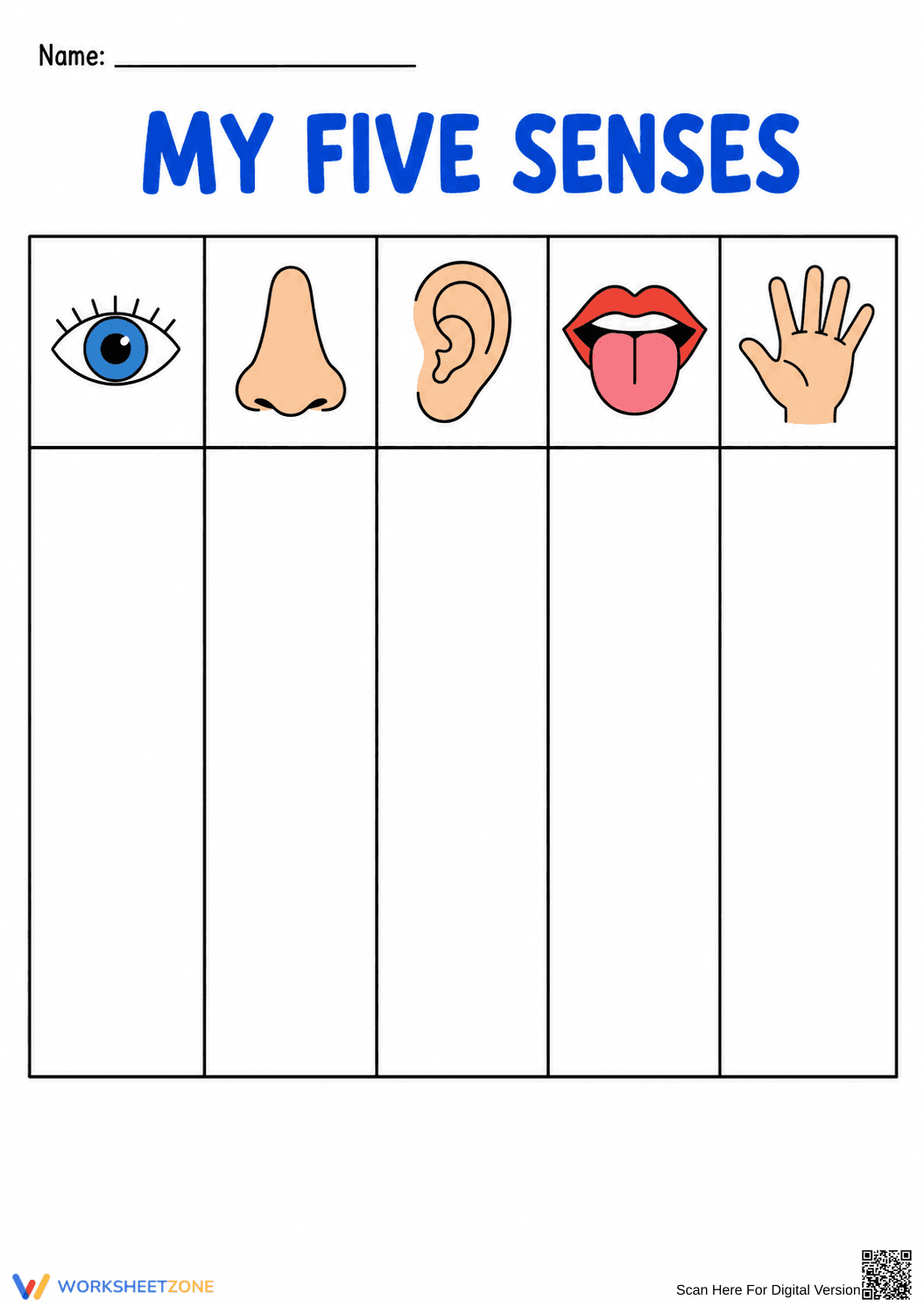

Grade K Five Senses — Printable No-Prep Worksheet
Paste this activity's link or code into your existing LMS (Google Classroom, Canvas, Teams, Schoology, Moodle, etc.).
Students can open and work on the activity right away, with no student login required.
You'll still be able to track student progress and results from your teacher account.
This printable Kindergarten science worksheet helps young learners identify and categorize their five senses through visual observation. By connecting body parts to specific sensory experiences, students develop foundational scientific inquiry skills. This resource provides a clear structure for children to document what they see, hear, smell, taste, and touch.
At a Glance
- Grade: Kindergarten · Subject: Science
- Standard:
K-LS1-1— Use observations to describe patterns in the natural world- Skill Focus: Categorizing the five senses
- Format: 1 page · 5 tasks · No answer key needed · PDF
- Best For: Science centers and nature walks
- Time: 15–20 minutes
What's Inside
This single-page PDF features five clearly defined columns, each topped with a high-quality illustration of a sensory organ: an eye, a nose, an ear, a mouth, and a hand. The layout provides ample vertical space for students to draw or write examples of things they experience with each sense. Because it is an open-ended graphic organizer, no answer key is required, allowing for diverse student responses based on their unique environments.
Zero-Prep Workflow
The zero-prep design ensures this worksheet is ready for immediate classroom use. First, Print: Simply print the single PDF page for your entire class in under one minute. Second, Distribute: Hand out the sheets along with crayons, markers, or pencils in under one minute. Third, Review: Circulate the room to discuss student drawings and evaluate their understanding in real-time. Total teacher preparation time is less than two minutes, making it an ideal choice for busy mornings or unexpected substitute situations.
Standards Alignment
This resource is aligned with K-LS1-1, which requires students to use observations to describe patterns of what plants and animals need to survive. By focusing on how humans use their external parts to sense their surroundings, the worksheet builds prerequisite knowledge for understanding how organisms interact with their environment. Both standard codes can be copied directly into lesson plans, IEP goals, or district curriculum mapping tools.
How to Use It
Use this worksheet as a summative assessment after a hands-on sensory exploration walk around the school grounds. Have students draw one item they observed for each sense to demonstrate their ability to categorize sensory data. For a formative check, observe students as they complete the smell and taste columns to see if they can distinguish between these often-confused senses. The activity typically takes 15 to 20 minutes to complete.
Who It's For
This activity is specifically designed for Kindergarten students but is also appropriate for Grade 1 and Grade 2 learners who need a refresher on sensory organs. The visual cues make it highly accessible for English Language Learners and students with IEPs who benefit from clear, icon-based instructions. It pairs naturally with a read-aloud about the human body or a physical science lesson on properties of matter.
The integration of sensory observation into early childhood science education is a critical component of developing scientific literacy. This Kindergarten worksheet focuses on the K-LS1-1 standard, enabling students to use observations to describe patterns in the natural world by categorizing the five senses—sight, hearing, smell, taste, and touch—using clear visual scaffolds. Research from Fisher & Frey (2014) emphasizes that providing structured graphic organizers for observations helps young learners transition from simple recognition to complex pattern identification. By utilizing these five distinct tasks, educators can effectively bridge the gap between abstract biological concepts and concrete physical experiences. This resource serves as a foundational tool for NGSS-aligned instruction, ensuring that students meet core benchmarks for observing the natural world. The simplified format reduces cognitive load while maintaining rigorous alignment with state and national science frameworks.


