


























Views
Downloads


Grade 1 Sense of Taste — Printable No-Prep Worksheet
Paste this activity's link or code into your existing LMS (Google Classroom, Canvas, Teams, Schoology, Moodle, etc.).
Students can open and work on the activity right away, with no student login required.
You'll still be able to track student progress and results from your teacher account.
This Grade 1 science worksheet helps students identify objects they can experience using their sense of taste. By evaluating everyday items and drawing their own examples, young learners connect their external body parts to sensory observations, building a foundational understanding of how humans interact with the world around them.
At a Glance
- Grade: 1 · Subject: Science
- Standard:
1-LS1-1— Identify how external body parts help humans survive and observe.- Skill Focus: Sense of taste
- Format: 2 pages · 8 problems · Answer key included · PDF
- Best For: Independent practice or morning work
- Time: 10–15 minutes
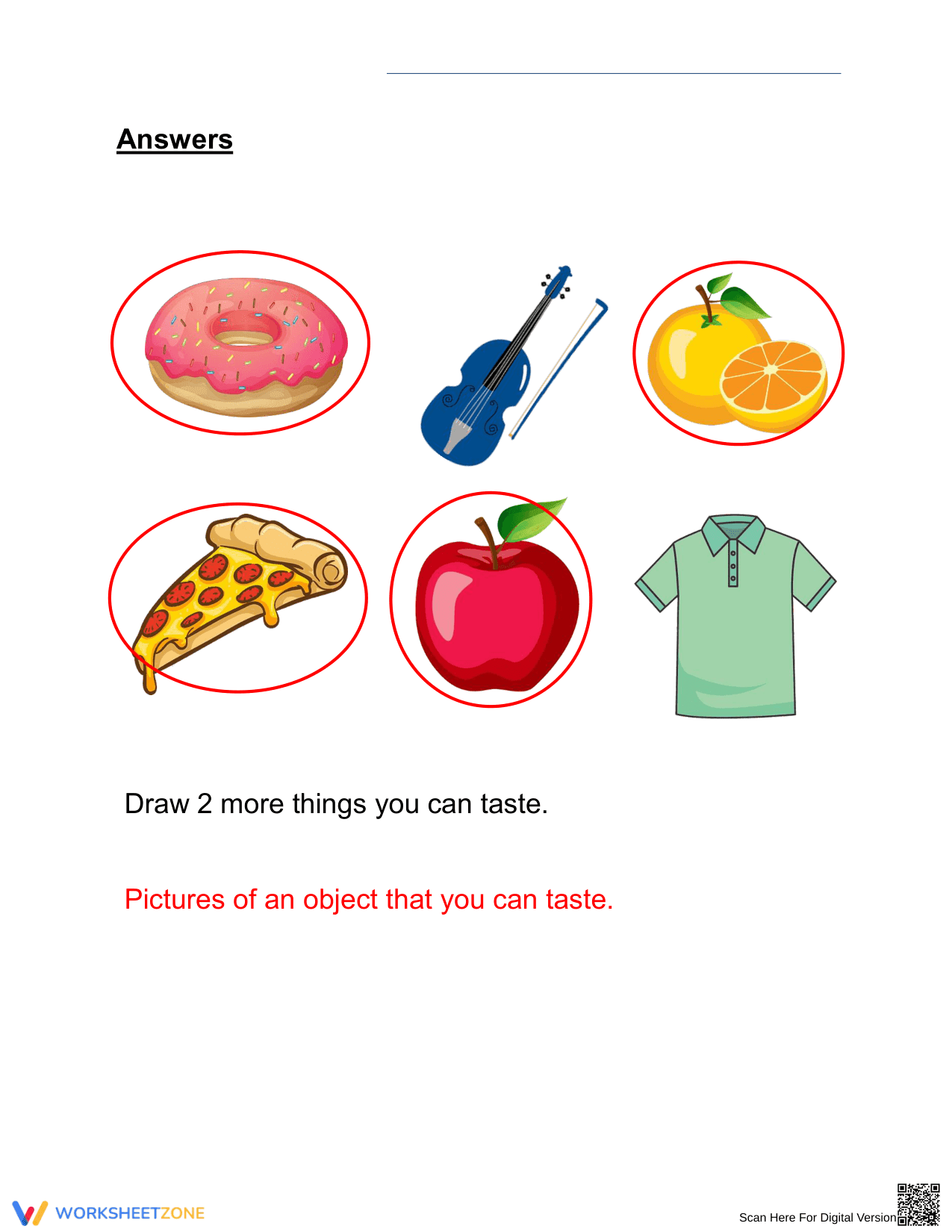
This resource features a straightforward, single-page activity designed for early readers. Students begin by reviewing six colorful illustrations of common objects, circling only the items that can be tasted, such as an apple or a donut. The bottom half provides two blank frames where students draw two additional things they can taste, encouraging creative application. A complete answer key is provided on the second page.
This worksheet is designed for immediate classroom implementation.
- Print (1 minute): Simply print the PDF. The bold graphics mean no special modifications are needed.
- Distribute (1 minute): Hand out the sheets during your science block. The intuitive layout allows students to begin immediately.
- Review (2 minutes): Use the included visual answer key to quickly check student work.
With total prep time under two minutes, this activity is an excellent addition to any emergency sub plan.
This activity aligns to primary science standards, specifically supporting 1-LS1-1 by helping students understand how humans use external parts to observe their environment. Recognizing edible items is a fundamental sensory skill. Both standard codes can be copied directly into lesson plans, IEP goals, or district curriculum mapping tools.
Deploy this worksheet during a broader unit on the five senses. It works perfectly as an independent practice activity immediately following a direct instruction lesson or a read-aloud about the sense of taste. As a formative assessment tip, observe students as they complete the drawing portion; ask them to verbally explain why they chose their drawn objects to check for deeper comprehension of the sensory concept. Expected completion time is a brief 10 to 15 minutes.
This resource is ideal for first-grade students, though it can easily serve as a review for second graders or an extension for advanced kindergarteners. The heavy reliance on visual cues makes it highly accessible for English Language Learners and students requiring reading accommodations. Pair this worksheet with a hands-on taste test activity or a five senses anchor chart to solidify the learning experience.
Developing sensory awareness is a critical component of early childhood science education. According to a recent ScienceDirect TpT Analysis, instructional materials that combine visual identification with generative tasks—such as drawing—significantly improve retention of foundational concepts in young learners. This worksheet targets the sense of taste, supporting standard 1-LS1-1 by asking students to identify how external body parts help humans survive and observe. By requiring students to first evaluate provided images and then generate their own examples, the activity moves beyond simple recall into active application. This dual-layered approach ensures that students not only recognize the function of their senses but can also contextualize them within their daily lives. Providing a robust framework for future scientific inquiry and observation skills, this targeted practice helps solidify early cognitive connections between physical experiences and biological functions.


