


























Views
Downloads
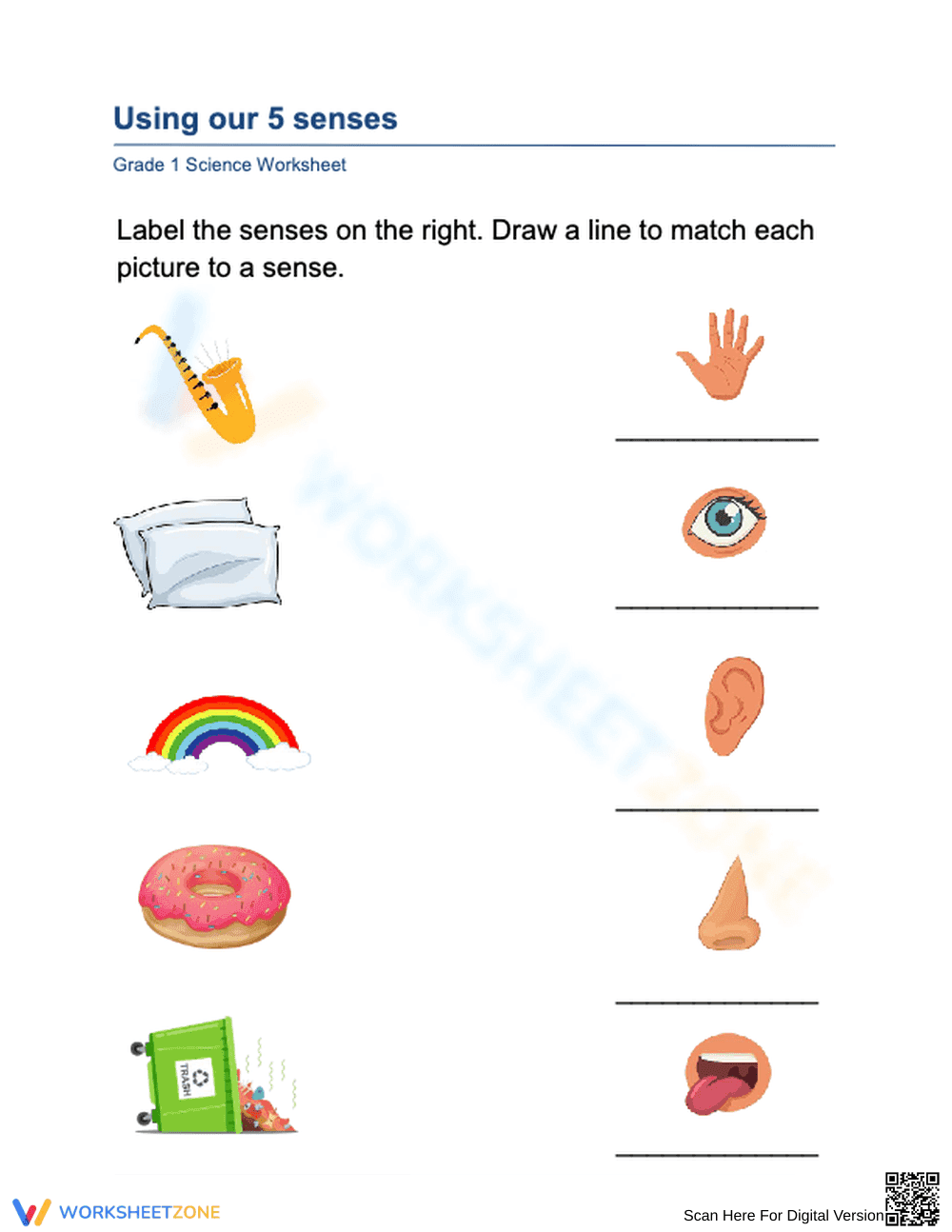

Grade 1 Five Senses — Printable No-Prep Worksheet
Paste this activity's link or code into your existing LMS (Google Classroom, Canvas, Teams, Schoology, Moodle, etc.).
Students can open and work on the activity right away, with no student login required.
You'll still be able to track student progress and results from your teacher account.
This Grade 1 science worksheet helps students identify and apply their knowledge of the five senses. By labeling sensory organs and matching them to everyday objects, young learners build foundational observation skills. This simple, engaging activity connects physical body parts to how we experience the world around us.
At a Glance
- Grade: 1 · Subject: Science
- Standard:
1-LS1-1— Identify external body parts and their functions- Skill Focus: The Five Senses
- Format: 2 pages · 5 problems · Answer key included · PDF
- Best For: Independent practice or morning work
- Time: 10–15 minutes
This download includes a single-page matching activity and a complete answer key. Students will look at five distinct objects—such as a saxophone, a rainbow, and a donut—and draw a line connecting each item to the correct sensory organ (hand, eye, ear, nose, or mouth). They will also write the name of the sense next to the corresponding body part, reinforcing basic science vocabulary and spelling.
- Print (1 minute): Simply print the single-page PDF for your class. No special materials or cutting required.
- Distribute (1 minute): Hand out the worksheets as a quick transition activity or morning warm-up.
- Review (3 minutes): Use the included visual answer key to quickly check student work or project it on the board for self-grading.
With under two minutes of total teacher prep time, this resource is highly effective for busy educators and makes an excellent addition to any substitute teacher plan.
Aligned to 1-LS1-1, this worksheet supports the understanding that animals and humans have external parts that help them survive and gather information. By matching eyes to seeing and ears to hearing, students demonstrate comprehension of how specific body parts function. Both standard codes can be copied directly into lesson plans, IEP goals, or district curriculum mapping tools.
This worksheet is ideal for use during direct instruction as a quick formative assessment after introducing the five senses. Teachers can easily observe which students struggle to connect the abstract concept of a sense (like hearing) to the physical organ (the ear) and the object (a saxophone). It is also perfect for a 10-minute independent science center or a quiet wrap-up activity at the end of a health unit.
Designed primarily for first-grade general education students, this visual matching activity is also highly accessible for kindergarteners needing a challenge or English Language Learners building basic vocabulary. The clear, colorful illustrations provide strong visual scaffolds. Pair this worksheet with a read-aloud book about the five senses or a hands-on sensory exploration station for maximum impact.
Research highlights the critical importance of explicit vocabulary instruction and visual scaffolding in early elementary science education. According to a comprehensive review by EdReports 2024, integrating visual matching tasks with foundational science concepts—such as those found in standard 1-LS1-1—significantly helps young learners solidify their understanding of how external body parts function. When students are prompted to actively identify external body parts and their functions in relation to everyday objects, they build the necessary cognitive framework for grasping more complex biological and physical science concepts in later grades. This targeted, developmentally appropriate practice ensures that foundational observation skills are firmly established early on. By explicitly connecting sensory organs to their environmental inputs, educators can effectively bridge the gap between a child's everyday physical experiences and formal scientific inquiry, fostering long-term academic success.


