




























Views
Downloads
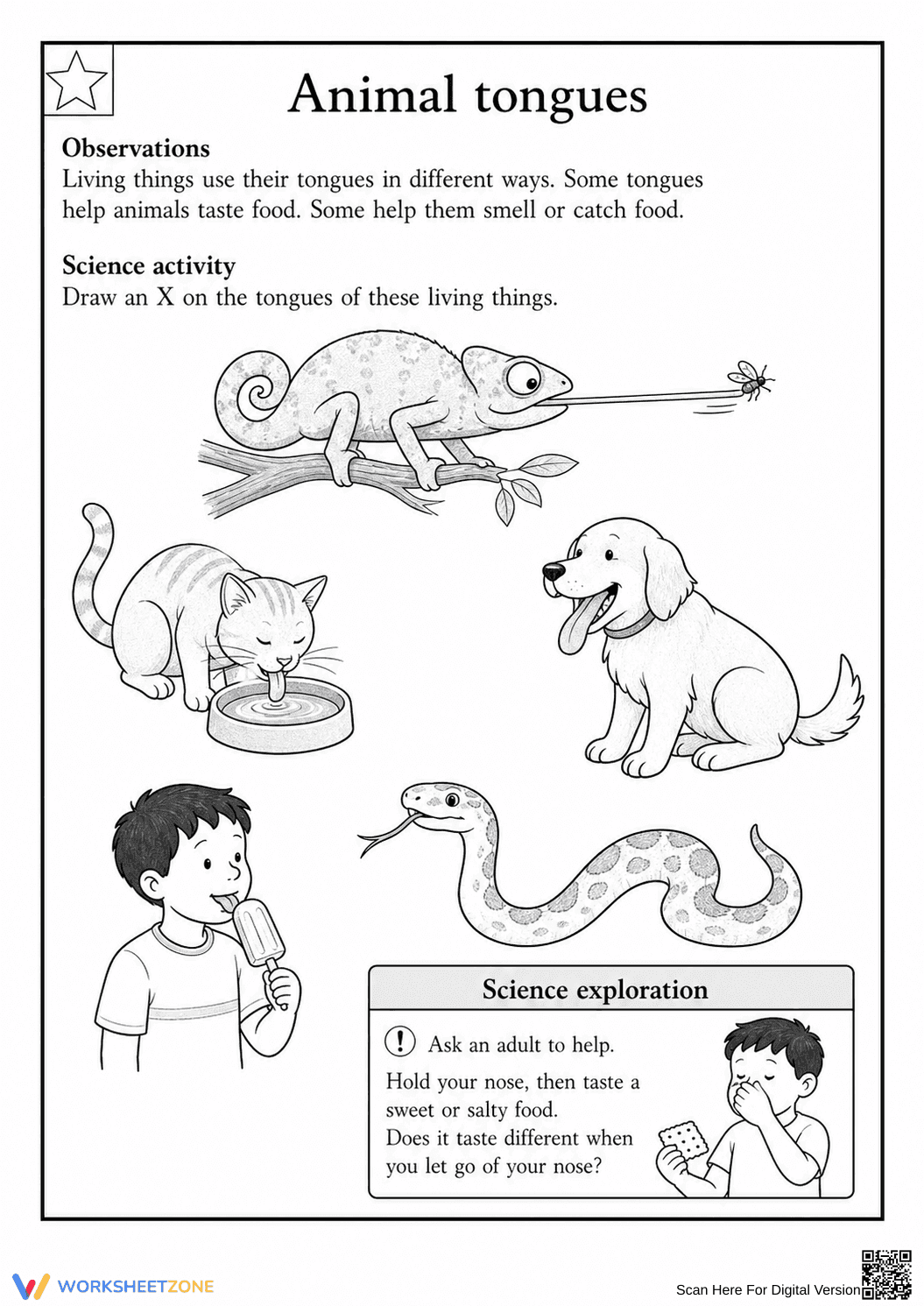

Grade 1 Animal Tongues Science Worksheet | Printable

Paste this activity's link or code into your existing LMS (Google Classroom, Canvas, Teams, Schoology, Moodle, etc.).
Students can open and work on the activity right away, with no student login required.
You'll still be able to track student progress and results from your teacher account.
This Grade 1 science worksheet helps students identify external animal structures and understand their sensory functions. By observing how different living things use their tongues to taste, smell, or catch food, young learners connect physical traits to survival needs. The activity turns abstract biological concepts into concrete facts.
At a Glance
- Grade: 1 · Subject: Science
- Standard:
1-LS1-1— Observe animal parts to understand survival functions- Skill Focus: Identifying sensory structures
- Format: 1 page · 6 problems · Answer key included · PDF
- Best For: Zero-prep introductory life science lessons
- Time: 15–20 minutes
This single-page PDF features a brief reading observation followed by five visual identification tasks where students mark the tongues of diverse organisms, including a chameleon, cat, dog, human, and snake. A "Science exploration" box guides students through a simple, hands-on taste test experiment to investigate the connection between smell and taste. A complete answer key is included.
Zero-Prep Workflow
- Print (1 minute): Download the PDF and print copies for your class.
- Distribute (1 minute): Hand out the sheets. The built-in text provides necessary context, acting as a self-contained mini-lesson.
- Review (1 minute): Use the visual prompts to quickly check student understanding as they complete the tasks.
Total teacher preparation time is under three minutes, making this an ideal resource for substitute plans.
Standards Alignment
This resource aligns with primary standard 1-LS1-1: Use materials to design a solution to a human problem by mimicking how plants and/or animals use their external parts to help them survive, grow, and meet their needs. The worksheet focuses on the foundational observation of these external parts. Both standard codes can be copied directly into lesson plans, IEP goals, or district curriculum mapping tools.
How to Use It
Deploy this worksheet during direct instruction to illustrate sensory organs and their specialized functions. It serves as an excellent transition from a whole-class discussion on animal adaptations to a hands-on activity. Alternatively, assign it as a quick formative assessment after a lesson on the five senses; observe whether students can accurately locate the sensory structures. Expected completion time ranges from 15 to 20 minutes.
Who It's For
This resource is tailored for Grade 1 students, though it is appropriate for Kindergarten or Grade 2 learners reviewing basic life science concepts. It provides differentiation support for visual learners through clear illustrations. Pair this worksheet with a read-aloud book about animal adaptations or an anchor chart detailing the five senses to deepen the connection between physical form and biological function.
Aligned with NGSS 1-LS1-1, this science resource focuses on identifying sensory structures to understand biological functions. By observing how different animals use their tongues to taste, smell, or catch prey, students build foundational knowledge of external parts and survival mechanisms. According to a ScienceDirect TpT Analysis (2024), early exposure to comparative biology through visual identification tasks significantly improves scientific observation skills in primary learners. The inclusion of a hands-on experiment further aligns with inquiry-based learning models, encouraging students to test hypotheses about the relationship between olfactory and gustatory systems. This worksheet provides structured tasks that bridge the gap between simple observation and experimental investigation. Such sensory-focused activities are essential for developing the science and engineering practices outlined in modern US educational frameworks.


