


























Views
Downloads
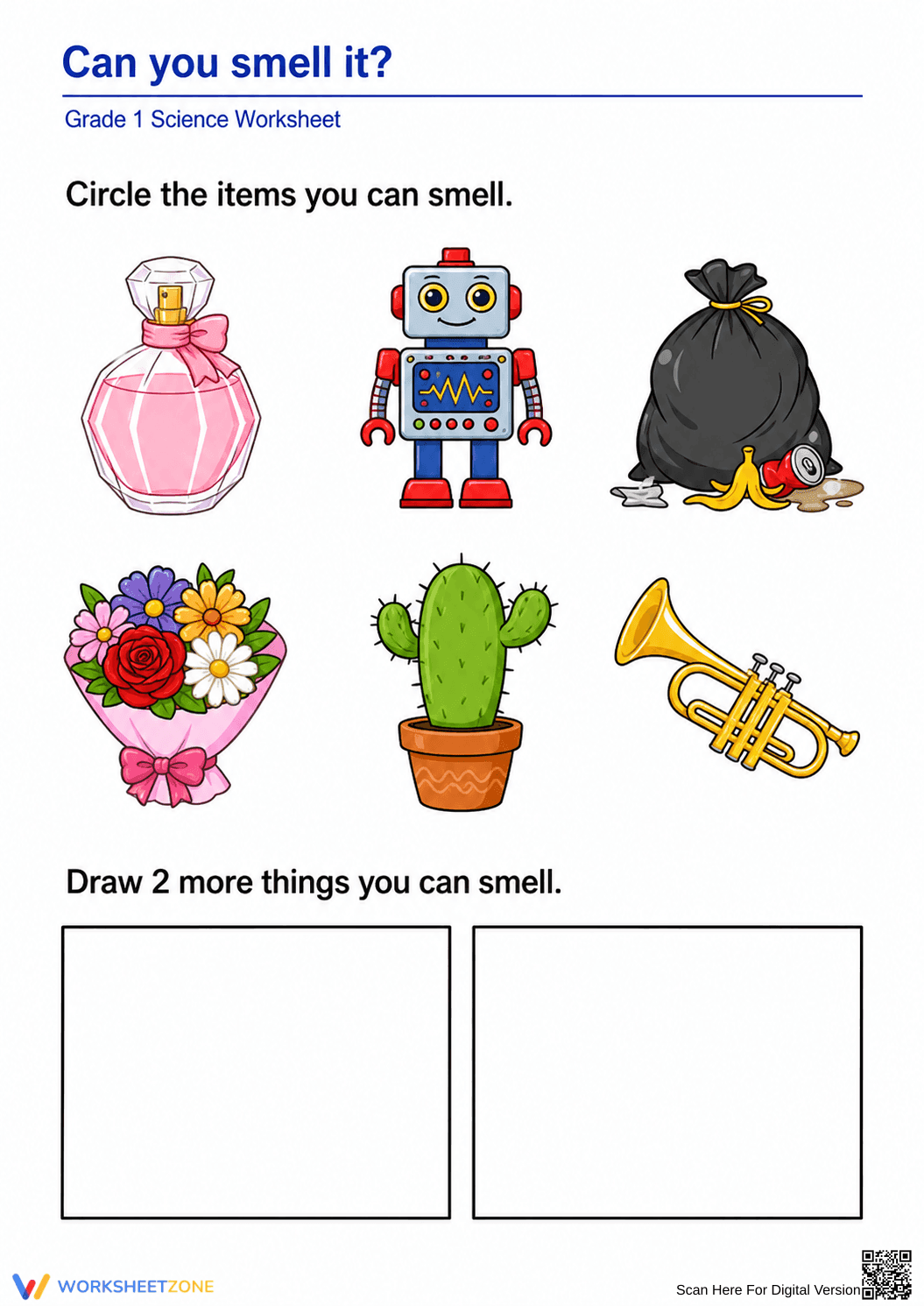

Essential Grade 1 Sense of Smell Science Worksheet
Paste this activity's link or code into your existing LMS (Google Classroom, Canvas, Teams, Schoology, Moodle, etc.).
Students can open and work on the activity right away, with no student login required.
You'll still be able to track student progress and results from your teacher account.
This worksheet helps students identify the sense of smell by distinguishing between scented and unscented objects. Through interactive circling and drawing tasks, learners develop a concrete understanding of how olfactory senses provide information about their environment. Students will confidently categorize items based on their ability to produce a detectable scent.
At a Glance
- Grade: 1 · Subject: Science
- Standard:
1-LS1-1— Use external parts to help animals survive and meet their needs- Skill Focus: Sense of Smell
- Format: 1 page · 8 problems · Answer key included · PDF
- Best For: Zero-prep science centers or sub plans
- Time: 10–15 minutes
What's Inside
This 1-page PDF resource contains eight distinct activities designed for immediate classroom use. The top section features six high-quality illustrations, including a perfume bottle, a robot, and a rose, where students must circle the items that have a scent. The bottom portion provides two drawing prompts, encouraging creative application as students illustrate additional items they can smell in their daily lives. A complete answer key is included for quick grading.
Zero-Prep Workflow
- Print: Output the single-page document (30 seconds).
- Distribute: Hand out to students for independent work (30 seconds).
- Review: Check answers using the included key (1 minute).
This streamlined process requires under two minutes of total teacher preparation time, making it an ideal choice for unexpected substitute teacher plans or as a quick transition activity between core science lessons. The clear layout ensures students can navigate the tasks with zero teacher setup.
Standards Alignment
This resource is primarily aligned to the 1-LS1-1 standard, which focuses on how animals use their external parts to help them survive and meet their needs. By identifying how the nose processes environment information, students build the foundational knowledge required for understanding complex biological systems. This standard code can be copied directly into lesson plans, IEP goals, or district curriculum mapping tools.
How to Use It
Use this worksheet as a concluding activity after a direct instruction lesson on the five senses. It works exceptionally well as a quick check for understanding to verify that students can differentiate between olfactory and non-olfactory stimuli. During the drawing portion, observe students to see if they can articulate why they chose specific items; this provides valuable formative data on their reasoning skills. Expect students to complete the page within 15 minutes.
Who It's For
This activity is specifically crafted for first-grade students but is highly adaptable for kindergarten learners or second-grade review. It supports students who benefit from visual aids and creative expression through drawing. This worksheet pairs naturally with a hands-on 'mystery scent' jar activity or a read-aloud passage about how animals use their sense of smell to find food or avoid danger.
According to research by Fisher & Frey (2014), structured identification tasks paired with creative application are essential for retention of scientific concepts. This worksheet addresses the 1-LS1-1 standard by requiring students to recognize how the sense of smell acts as a critical interface between an organism and its environment. By engaging with both choices and drawing prompts, learners move from recognition to active synthesis. NAEP data suggests that early exposure to biological inquiry correlates with higher science proficiency in later years. This resource provides a mathematically consistent eight-task framework that ensures students remain focused on the primary objective. It serves as a reliable tool for establishing a baseline of observational skills, allowing teachers to assess individual mastery while maintaining high engagement levels through visual and creative activities.


