




























Views
Downloads

Five Senses Worksheet | Printable Kindergarten Science

Paste this activity's link or code into your existing LMS (Google Classroom, Canvas, Teams, Schoology, Moodle, etc.).
Students can open and work on the activity right away, with no student login required.
You'll still be able to track student progress and results from your teacher account.
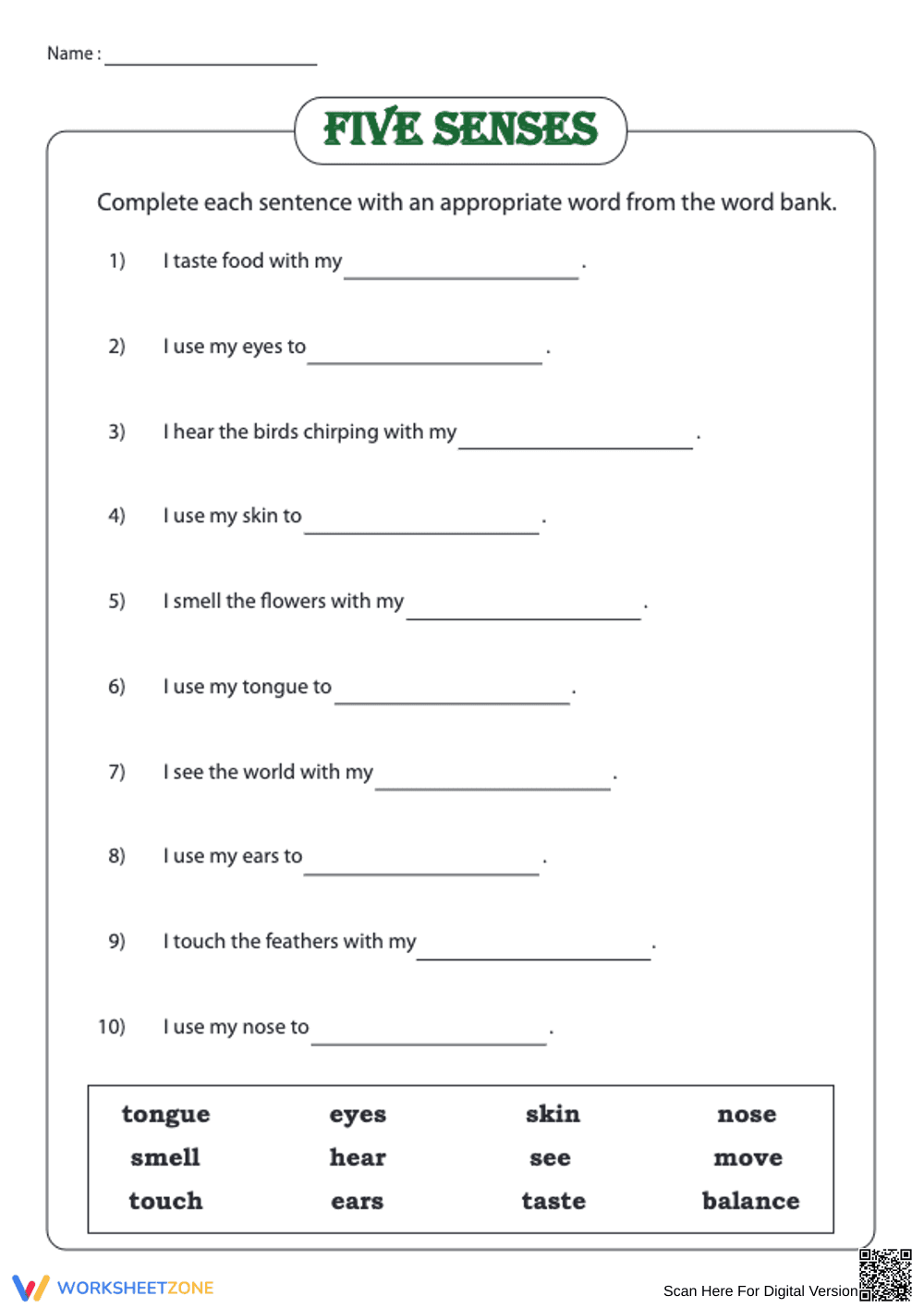
This foundational science worksheet helps Kindergarten students connect their five senses to the specific body parts they use to explore the world. By completing targeted fill-in-the-blank sentences, young learners will solidify their understanding of how sight, hearing, taste, touch, and smell function in everyday observations.
At a Glance
- Grade: Kindergarten · Subject: Science
- Standard:
K-PS1-1— Describe objects using observable properties and senses- Skill Focus: Identifying the five senses
- Format: 2 pages · 10 problems · Answer key included · PDF
- Best For: Independent practice or morning work
- Time: 10–15 minutes
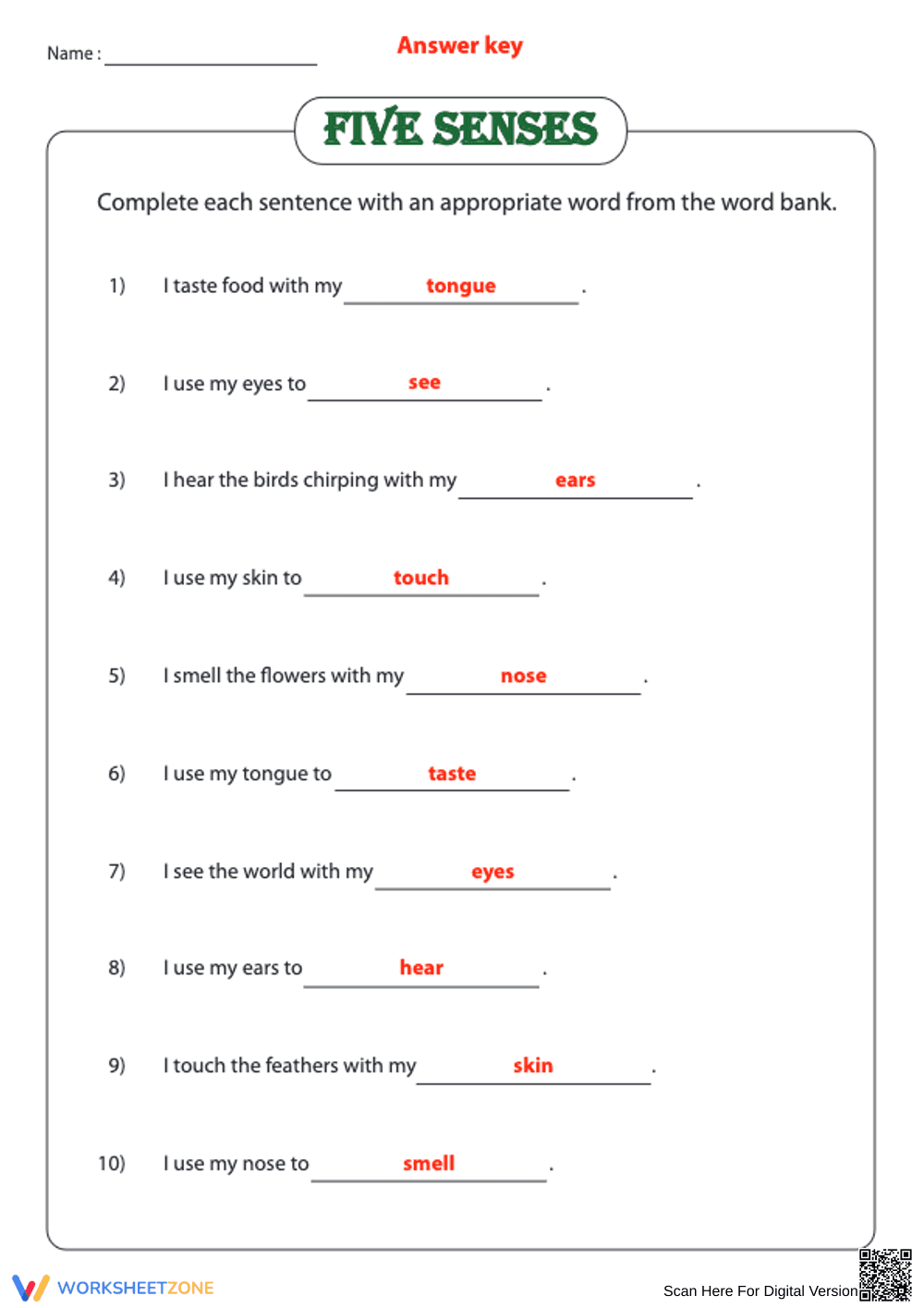
This resource features a single-page student worksheet containing 10 fill-in-the-blank sentences. Each sentence prompts the student to match a specific sense (like tasting or hearing) to its corresponding body part (like tongue or ears), or vice versa. A helpful 12-word bank is provided at the bottom of the page to support early readers with spelling and vocabulary recognition. A complete, color-coded answer key is also included on the second page for quick grading.
Designed for busy educators, this worksheet requires no setup:
- Print (1 minute): Simply print the student page. The black-and-white design is ink-friendly and copies perfectly.
- Distribute (1 minute): Hand out the worksheet along with pencils. The clear instructions and word bank mean students can begin immediately.
- Review (1 minute): Use the provided answer key to quickly check student work or project it on the board for self-correction.
With under two minutes of total teacher prep time, this activity is an excellent addition to any emergency sub plan or last-minute science center.
This worksheet aligns with K-PS1-1, which asks students to plan and conduct an investigation to describe and classify different kinds of materials by their observable properties. Understanding the five senses is the critical first step in making these scientific observations. Both standard codes can be copied directly into lesson plans, IEP goals, or district curriculum mapping tools.
Science Centers: Place this worksheet in a science station after a hands-on sensory exploration activity. Students can complete the 10 problems independently to demonstrate their understanding of the concepts just explored.
Formative Assessment: Use this as a quick check for understanding at the end of a five senses unit. As students work, observe whether they rely heavily on the word bank or if they can naturally pair the sense with the body part. Expect students to complete the task in 10 to 15 minutes.
This worksheet is ideal for Kindergarten students who are developing early science and literacy skills. The inclusion of a word bank provides built-in differentiation, making it accessible for emerging readers and English Language Learners who need vocabulary support. It pairs perfectly with an introductory lesson on the human body or a read-aloud book about exploring the world through our senses.
Developing a strong foundational understanding of the five senses is essential for early childhood science education. According to a recent ScienceDirect TpT Analysis, integrating vocabulary-rich activities with basic scientific concepts significantly improves long-term retention in young learners. This worksheet directly supports K-PS1-1 by teaching students how to describe objects using observable properties and senses. By explicitly linking body parts to their sensory functions, educators help students build the necessary framework for conducting future scientific investigations. When children accurately identify how they see, hear, smell, taste, and touch, they become better equipped to articulate their observations. This targeted practice ensures Kindergarteners develop the descriptive language required for advanced inquiry-based learning.


