




























Views
Downloads
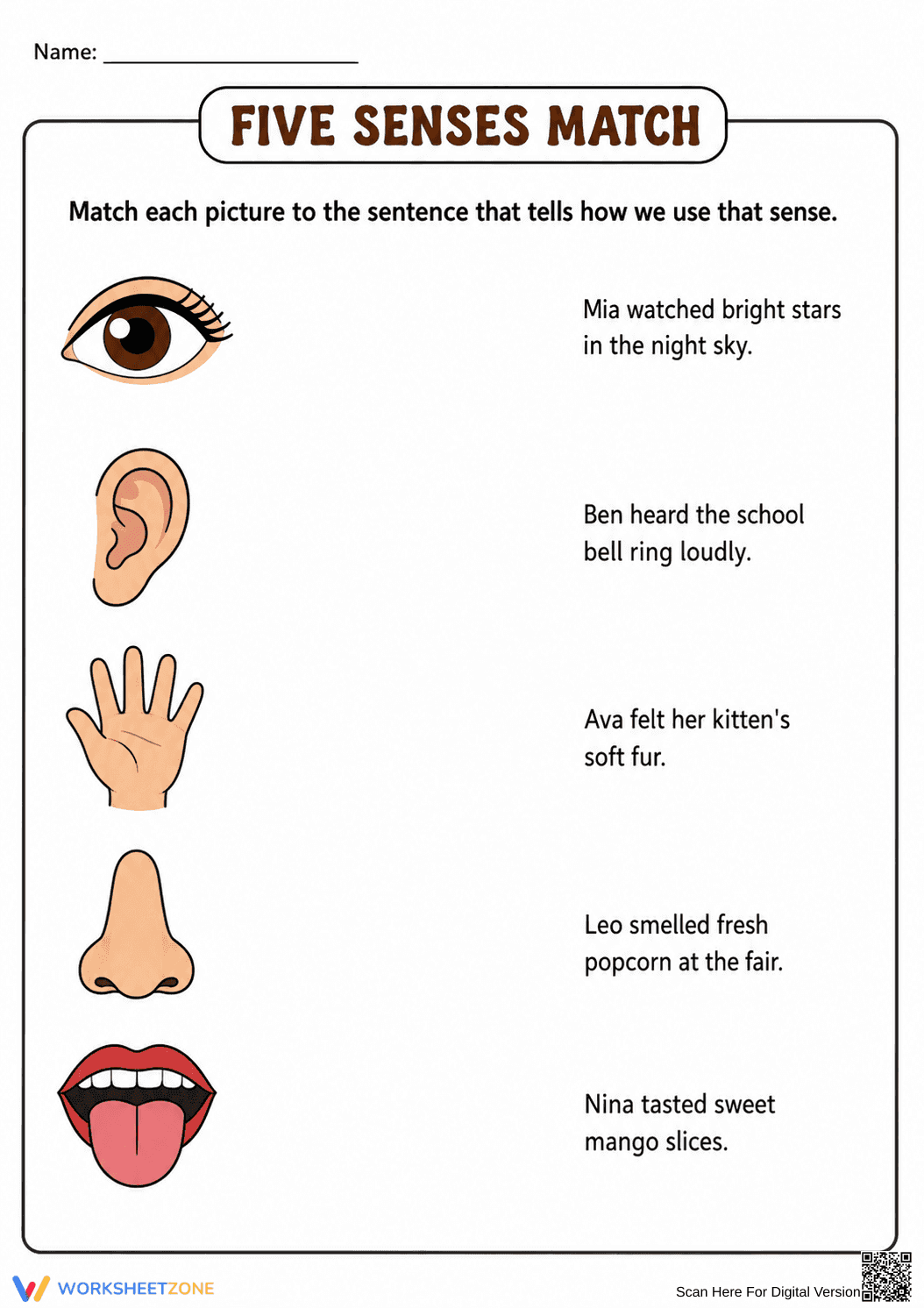

Grade 1 Five Senses — Printable No-Prep Worksheet

Paste this activity's link or code into your existing LMS (Google Classroom, Canvas, Teams, Schoology, Moodle, etc.).
Students can open and work on the activity right away, with no student login required.
You'll still be able to track student progress and results from your teacher account.
This essential Grade 1 science worksheet helps young learners identify and categorize the five human senses through interactive matching. Students connect realistic scenarios to the corresponding sensory organ, reinforcing their understanding of how we perceive the world. This exercise builds foundational scientific observation skills and vocabulary while ensuring students can distinguish between sight, sound, touch, taste, and smell.
At a Glance
- Grade: 1 · Subject: Science
- Standard:
1-LS1-1— Use observations to describe how human senses help people survive and grow- Skill Focus: Five Senses Identification
- Format: 1 page · 5 problems · Answer key included · PDF
- Best For: Introduction to human body systems
- Time: 10–15 minutes
The worksheet features a clean, one-page layout designed for immediate classroom implementation. On the left, students find five high-quality icons representing the primary sensory organs: the nose, hand, mouth, ear, and eye. On the right, five descriptive sentences provide context-rich scenarios—ranging from viewing stars to smelling popcorn. The resource includes a clear instruction line and space for student names, along with a comprehensive answer key for rapid grading.
Zero-Prep Workflow
Teachers can implement this resource in under 2 minutes with a simple three-step workflow. First, print the single-page PDF (30 seconds). Second, distribute the sheets for a quick warm-up or bell-ringer activity (30 seconds). Third, review the answers collectively to spark a discussion about sensory experiences (1 minute). This streamlined approach makes it an ideal choice for substitute lesson plans or unexpected schedule shifts.
Standards Alignment
This resource is aligned to the 1-LS1-1 Next Generation Science Standard. By identifying which sensory organ is used in specific situations, students demonstrate mastery of the functional roles of the human body. This standard code can be copied directly into lesson plans, IEP goals, or district curriculum mapping tools.
How to Use It
Use this worksheet as a formative assessment after an introductory lesson on the human body. Observe students as they match the icons to see if they can differentiate between touch (feeling fur) and taste (mango slices). For a hands-on extension, have students find objects in the classroom that correspond to each of the five matches made on the page. Completion typically takes 12 minutes during independent practice.
Who It's For
This worksheet is designed for Kindergarten through Grade 2 students exploring biological sciences. It supports English Language Learners through visual cues and clear sentence structures. The worksheet pairs naturally with a "Five Senses" anchor chart or a read-aloud session to reinforce vocabulary.
According to RAND AIRS 2024, instructional materials that integrate visual icons with descriptive text significantly enhance retention in early childhood science education. This Grade 1 worksheet applies these principles by requiring students to decode 1-LS1-1 aligned scenarios and map them to physiological representations. By engaging with 5 distinct sensory tasks, learners move beyond rote memorization of body parts toward a functional understanding of sensory processing. Research indicates that such match-and-verify activities reduce cognitive load while building the technical vocabulary necessary for subsequent units on health and biology. This self-contained module ensures that every student, regardless of prior knowledge, can successfully demonstrate their ability to identify sight, hearing, touch, taste, and smell. Teachers can confidently utilize this resource as a standalone assessment or a bridge to more complex inquiries into human anatomy and environmental interaction, ensuring alignment with national standards for primary science instruction.


