


























Views
Downloads
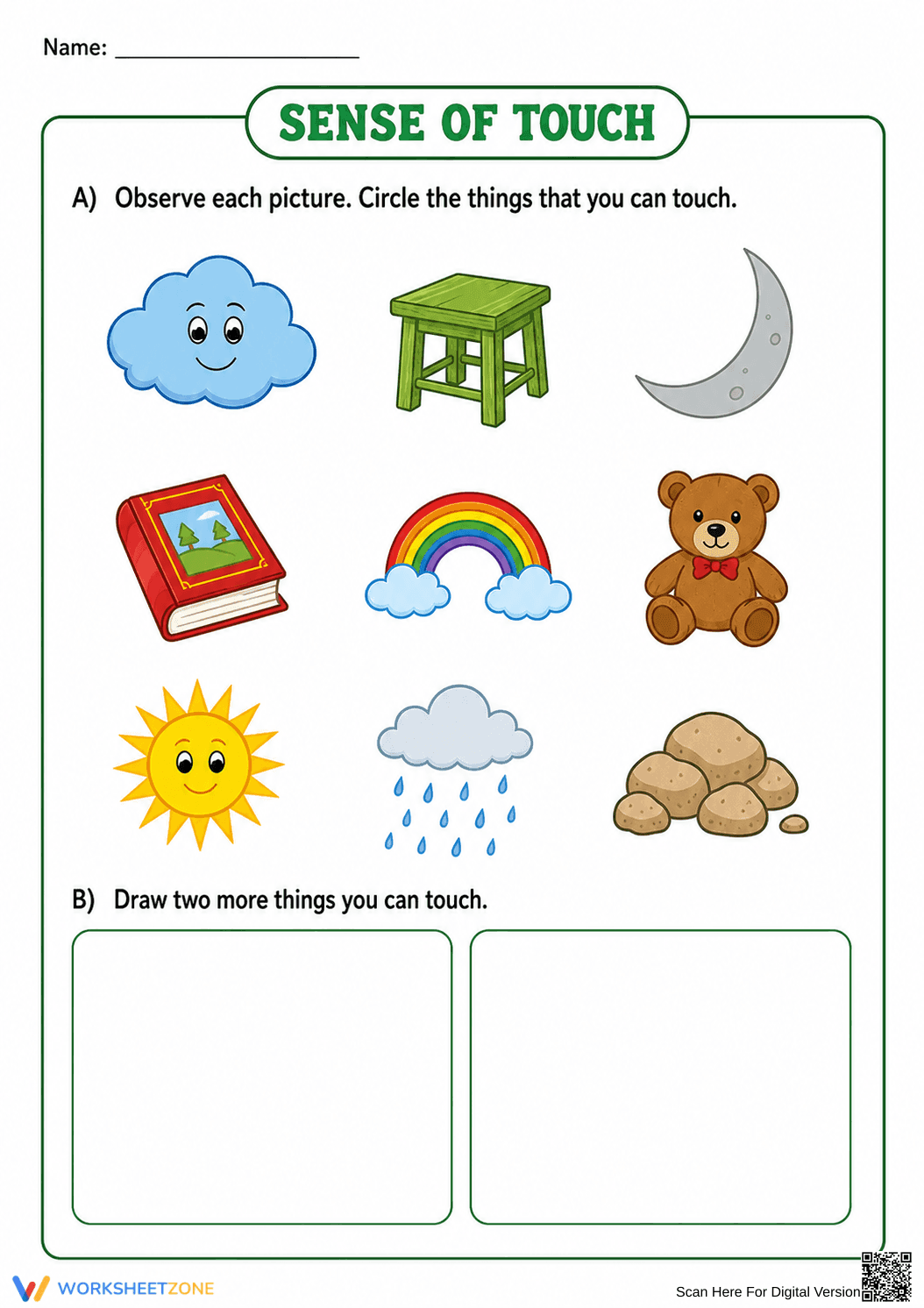

Sense of Touch Worksheet | Grade K-1 Printable
Paste this activity's link or code into your existing LMS (Google Classroom, Canvas, Teams, Schoology, Moodle, etc.).
Students can open and work on the activity right away, with no student login required.
You'll still be able to track student progress and results from your teacher account.
This Kindergarten and Grade 1 science worksheet introduces students to the sense of touch by distinguishing between tangible objects and intangible phenomena. Students develop observational skills by identifying items they can physically feel in their environment. This resource provides a clear, visual foundation for early biology and human body units.
At a Glance
- Grade: K-1 · Subject: Science
- Standard:
K-LS1-1— Use observations to describe patterns of what organisms need to survive- Skill Focus: Sense of Touch Identification
- Format: 1 page · 11 problems · Answer key included · PDF
- Best For: Early science centers and homework
- Time: 10–15 minutes
Inside this single-page PDF, you will find two distinct activity sections. Part A features nine high-quality illustrations where students must circle objects like rocks and teddy bears while ignoring intangible elements like rainbows or the sun. Part B encourages creative application by asking students to draw two original items they can touch, reinforcing the concept through artistic expression and personal connection.
Zero-Prep Workflow
- Print: Open the PDF and print the single-page worksheet for your entire class in under 30 seconds.
- Distribute: Hand out the sheets during your five senses unit or as a quiet morning work activity (1 minute).
- Review: Discuss the answers as a whole group to explain why we can touch a chair but not the rain or the moon (2 minutes).
This activity aligns with K-LS1-1, focusing on using observations to understand the world and the human body. By categorizing physical matter versus light or weather patterns, students build the prerequisite knowledge for later physical science standards regarding the properties of matter. Both standard codes can be copied directly into lesson plans, IEP goals, or district curriculum mapping tools.
Use this worksheet as a formative assessment after a "touch bag" mystery activity. It works best during the "Explore" or "Explain" phase of a 5E lesson model. Teachers should observe if students correctly distinguish between the moon (visible but not touchable) and the rock. Expected completion time ranges from 10 to 15 minutes depending on the drawing speed in Part B.
This resource is ideal for general education Kindergarten students, English Language Learners needing visual support, and Grade 1 students requiring a quick review. It pairs naturally with a classroom anchor chart about the five senses or a read-aloud book regarding human biology and sensory organs. The clear layout ensures it is also suitable for independent work or sub plans.
According to the RAND AIRS 2024 report on early childhood science, tactile-focused observation tasks are essential for developing the cognitive schemas required for scientific inquiry. This worksheet addresses the sense of touch through 11 specific tasks that bridge the gap between abstract concepts and concrete physical reality. By requiring students to both identify and generate examples of touchable objects, the resource supports the gradual release of responsibility. Research from Fisher & Frey (2014) emphasizes that visual non-examples, such as the rainbow or sun included here, are critical for refining student definitions of scientific categories. This printable ensures that Grade K-1 learners meet the K-LS1-1 standard by using their senses to gather data about their immediate environment. It provides a structured, low-stakes environment for students to practice the foundational skill of scientific observation while building confidence in their ability to categorize the natural world.


