


























Views
Downloads

Grade K Five Senses — Printable No-Prep Worksheet
Paste this activity's link or code into your existing LMS (Google Classroom, Canvas, Teams, Schoology, Moodle, etc.).
Students can open and work on the activity right away, with no student login required.
You'll still be able to track student progress and results from your teacher account.
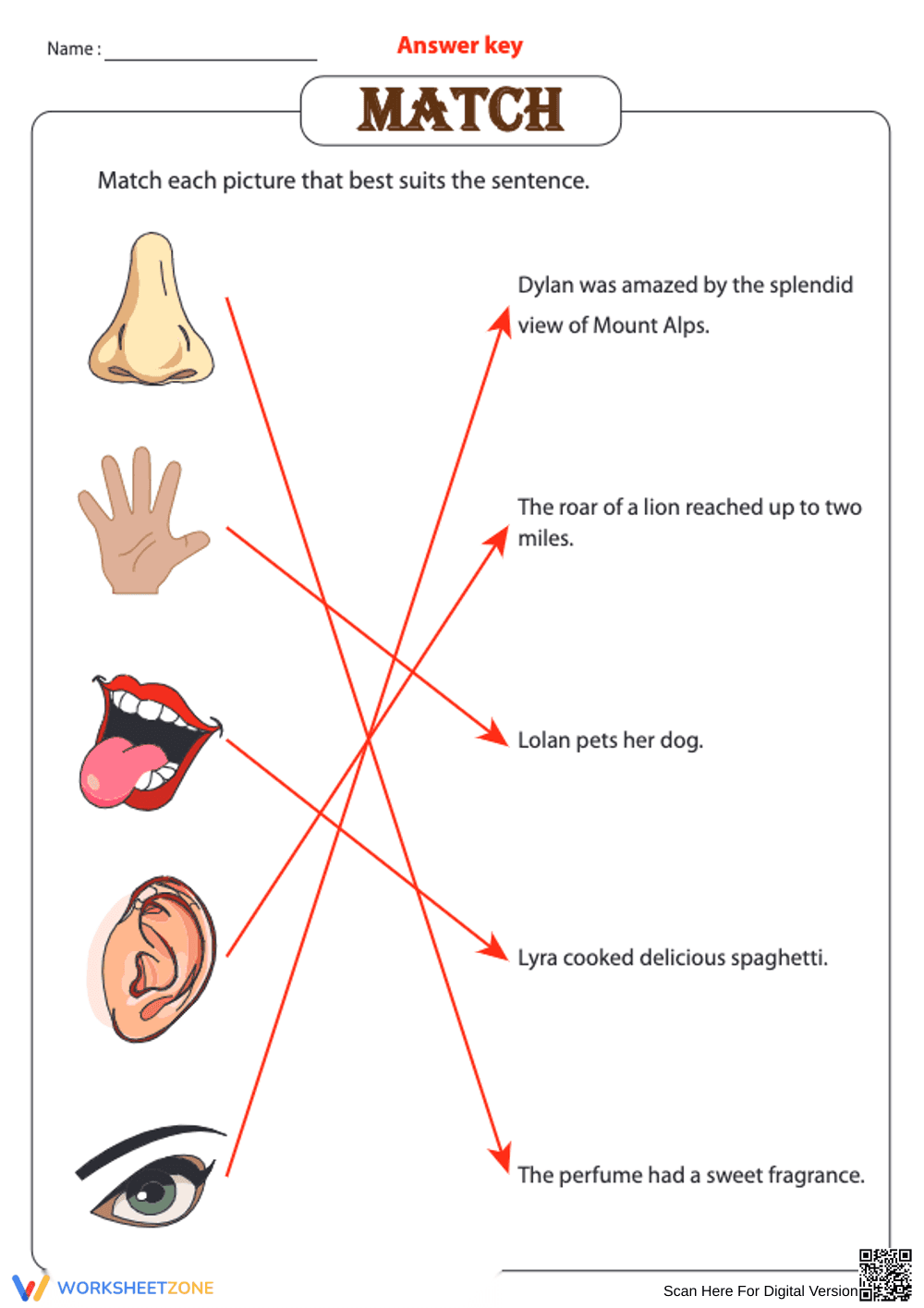
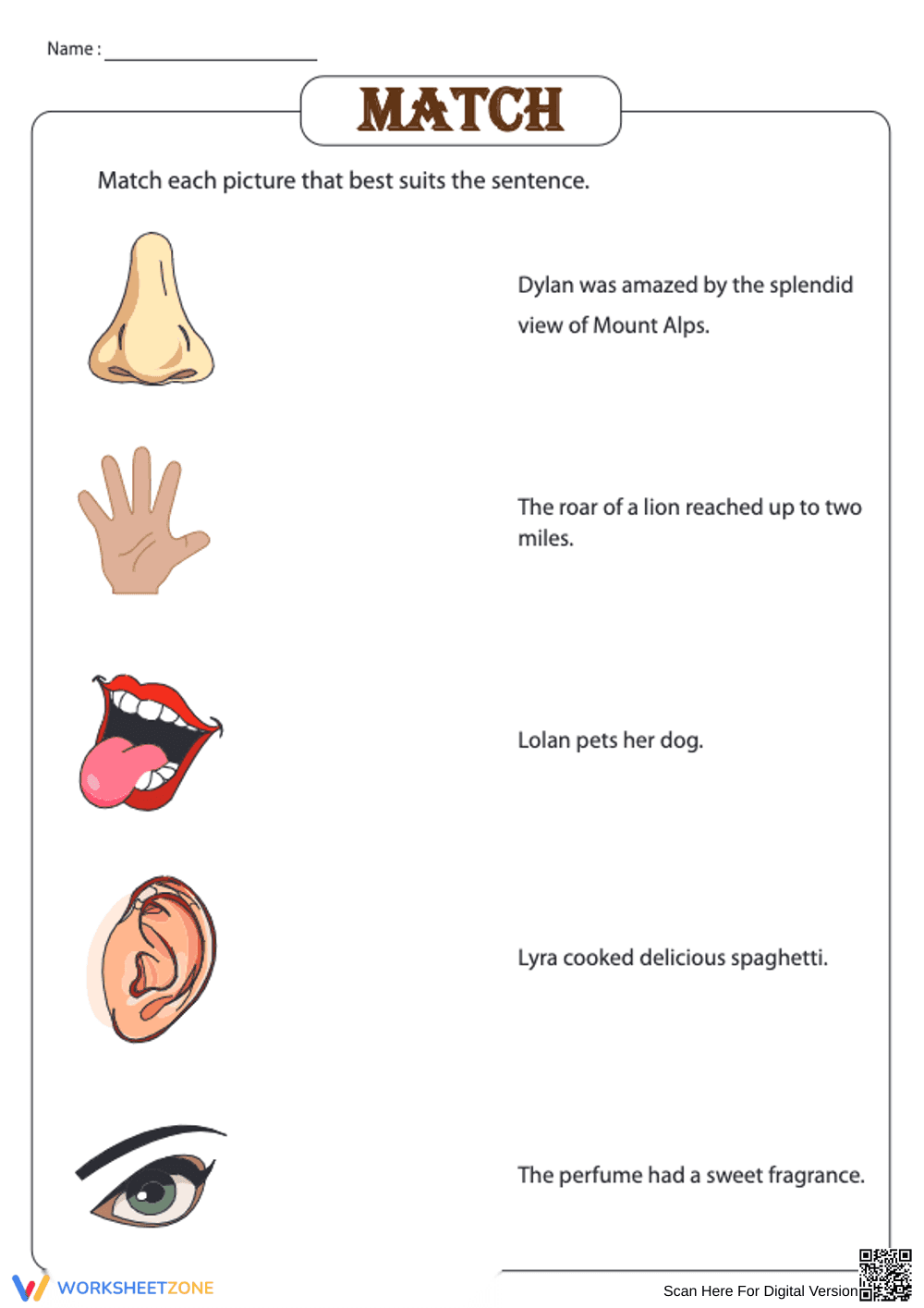
This foundational science worksheet helps Kindergarten students connect their five senses to real-world experiences. By matching sensory organs—like the eyes, ears, and nose—to descriptive sentences, young learners build critical observation skills. This simple, engaging activity reinforces how our bodies interact with and understand the surrounding environment.
At a Glance
- Grade: K · Subject: Science
- Standard:
K-LS1-1— Use observations to describe patterns in the natural world.- Skill Focus: Identifying the five senses
- Format: 2 pages · 5 problems · Answer key included · PDF
- Best For: Independent practice or morning work
- Time: 10–15 minutes
This resource includes a single-page matching activity featuring five distinct problems. Students will look at clear, colorful illustrations of the five sensory organs (nose, hand, mouth, ear, eye) and draw a line connecting each to a corresponding scenario, such as smelling perfume or hearing a lion roar. A complete, color-coded answer key is provided on the second page to ensure quick and accurate grading for educators or parents.
Designed for busy educators, this resource offers a zero-prep workflow:
- Print (1 min): Download the PDF and print the student page.
- Distribute (1 min): Hand out the worksheet. The intuitive format requires minimal explanation.
- Review (2 min): Use the visual answer key to quickly check student work.
With a total prep time under two minutes, this worksheet is excellent for sub plans.
This activity aligns with K-LS1-1, which encourages students to use observations to describe patterns of what plants and animals (including humans) need to survive. By understanding how sensory organs function, students develop the foundational skills necessary for making scientific observations. Both standard codes can be copied directly into lesson plans, IEP goals, or district curriculum mapping tools.
Use this worksheet as a formative assessment after a direct instruction lesson on the human body to gauge comprehension. Alternatively, place it in an independent science center where students can practice making logical connections. Observation tip: Ask students to point to their own sensory organs as they complete each match to reinforce the physical connection. Expected completion time is 10 to 15 minutes.
This resource is primarily designed for Kindergarten students beginning their exploration of life sciences and the human body. The visual nature of the matching task makes it highly accessible for English Language Learners (ELLs) and students requiring visual scaffolds. It pairs perfectly with a read-aloud book about the five senses or a hands-on sensory bin activity, bridging the gap between abstract concepts and concrete understanding.
Developing early observation skills through the five senses is a critical component of early childhood science education. This worksheet aligns with K-LS1-1, focusing on the ability to use observations to describe patterns in the natural world. According to a 2024 report by EdReports, integrating visual matching tasks with descriptive language significantly enhances vocabulary acquisition and conceptual retention in early elementary science curricula. By explicitly linking sensory organs to specific environmental stimuli—such as matching an ear to the sound of a roaring lion or a nose to the scent of sweet perfume—students build the cognitive frameworks required for more advanced scientific inquiry. This resource provides a structured, evidence-based opportunity for young learners to practice these essential observation skills in a low-stakes, highly visual format, ensuring foundational mastery of human body concepts and scientific observation.


