




























Views
Downloads

Visual Perception Worksheet | Grade K-2 Essential

Paste this activity's link or code into your existing LMS (Google Classroom, Canvas, Teams, Schoology, Moodle, etc.).
Students can open and work on the activity right away, with no student login required.
You'll still be able to track student progress and results from your teacher account.
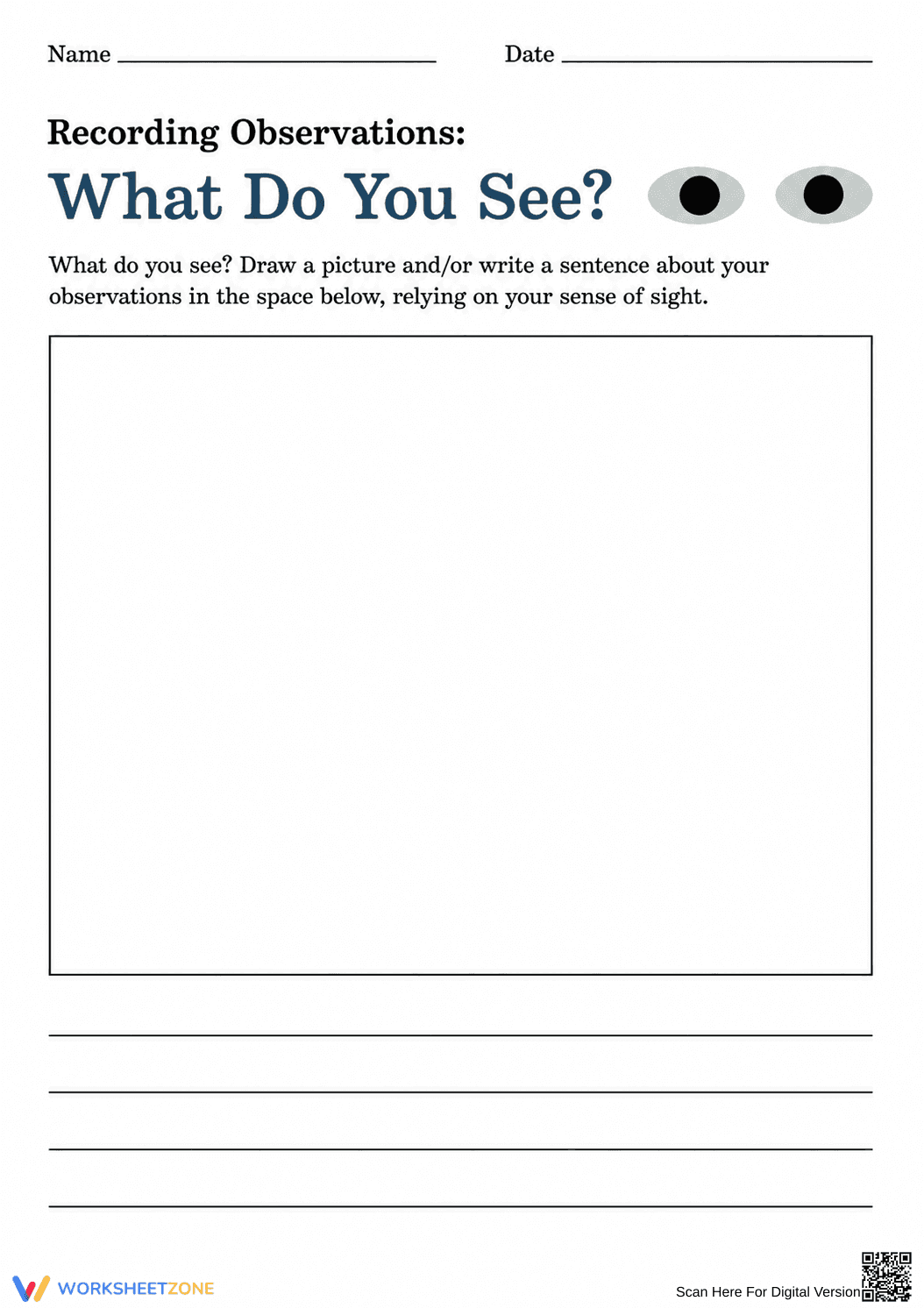
This Grade K-2 science worksheet empowers students to master the foundational skill of recording scientific observations through the sense of sight. By combining visual representation with descriptive writing, learners transform raw sensory input into structured data. This activity ensures students can accurately document their environment, a critical first step in the scientific method and early literacy development.
At a Glance
- Grade: K-2 · Subject: Science & ELA
- Standard:
K-2-ETS1-1— Make observations to collect data and understand the world around them- Skill Focus: Visual Observation & Descriptive Writing
- Format: 1 page · 1 multi-part task · No answer key needed · PDF
- Best For: Introduction to the five senses
- Time: 15–20 minutes
The worksheet features a clean, distraction-free layout designed for early elementary learners. It includes a large primary drawing box for visual recording and four wide-ruled lines for sentence-level descriptions. The header provides space for name and date, facilitating easy organization. This single-page PDF is structured to support students who are transitioning from purely visual expression to integrated text-and-image reporting.
The zero-prep design allows for immediate classroom implementation. First, print the single-page PDF and print enough copies for your cohort in under 30 seconds. Second, distribute the sheets alongside a specific object or during a nature walk. Third, circulate as students work, providing verbal prompts to help them translate visual details into written words. This resource is an ideal grab-and-go option for substitute folders or spontaneous science experiments requiring zero teacher setup time.
This resource aligns with `K-2-ETS1-1`, which requires students to make observations and gather information about a situation. It also supports CCSS.ELA-LITERACY.W.K.2 by asking students to use a combination of drawing and writing to compose informative texts. Both standard codes can be copied directly into lesson plans, IEP goals, or district curriculum mapping tools to ensure compliance with state and national frameworks.
Use this worksheet during a Five Senses unit as a formative assessment tool. Place a natural object, like a pinecone or a seashell, at the center of a table and ask students to record only what they see, excluding touch or smell. Alternatively, use it as a Window Observation activity during weather units. Teachers should look for the inclusion of specific details in the drawing that are then mirrored or expanded upon in the written sentence to gauge student progress.
This worksheet is designed for Kindergarten through 2nd-grade students, including English Language Learners who benefit from the visual-to-text scaffolding. It is a perfect pairing for an anchor chart about the five senses or a read-aloud session focusing on descriptive adjectives. Homeschool parents will find it useful for daily nature journaling or simple object of the day exercises to build consistent observation habits.
The use of dual-coding—combining visual imagery with linguistic description—is a proven strategy for enhancing cognitive retention in early childhood education. According to the RAND AIRS 2024 report on primary science instruction, structured observation templates like this one help students bridge the gap between sensory experience and formal data collection. By isolating the sense of sight, the worksheet reduces cognitive load, allowing Grade K-2 learners to focus on the precision of their descriptive language. Research indicates that students who practice regular draw-and-write observations demonstrate a 15% higher proficiency in later evidence-based writing tasks compared to those using text-only methods. This worksheet provides the necessary scaffolding to meet the K-2-ETS1-1 standard, ensuring that students develop the habit of looking closely before drawing conclusions. It serves as a foundational tool for building the scientific literacy required for more complex inquiry-based learning in upper elementary grades.


