




























Views
Downloads

Grade K-2 My Five Senses — Printable Essential Chart

Paste this activity's link or code into your existing LMS (Google Classroom, Canvas, Teams, Schoology, Moodle, etc.).
Students can open and work on the activity right away, with no student login required.
You'll still be able to track student progress and results from your teacher account.
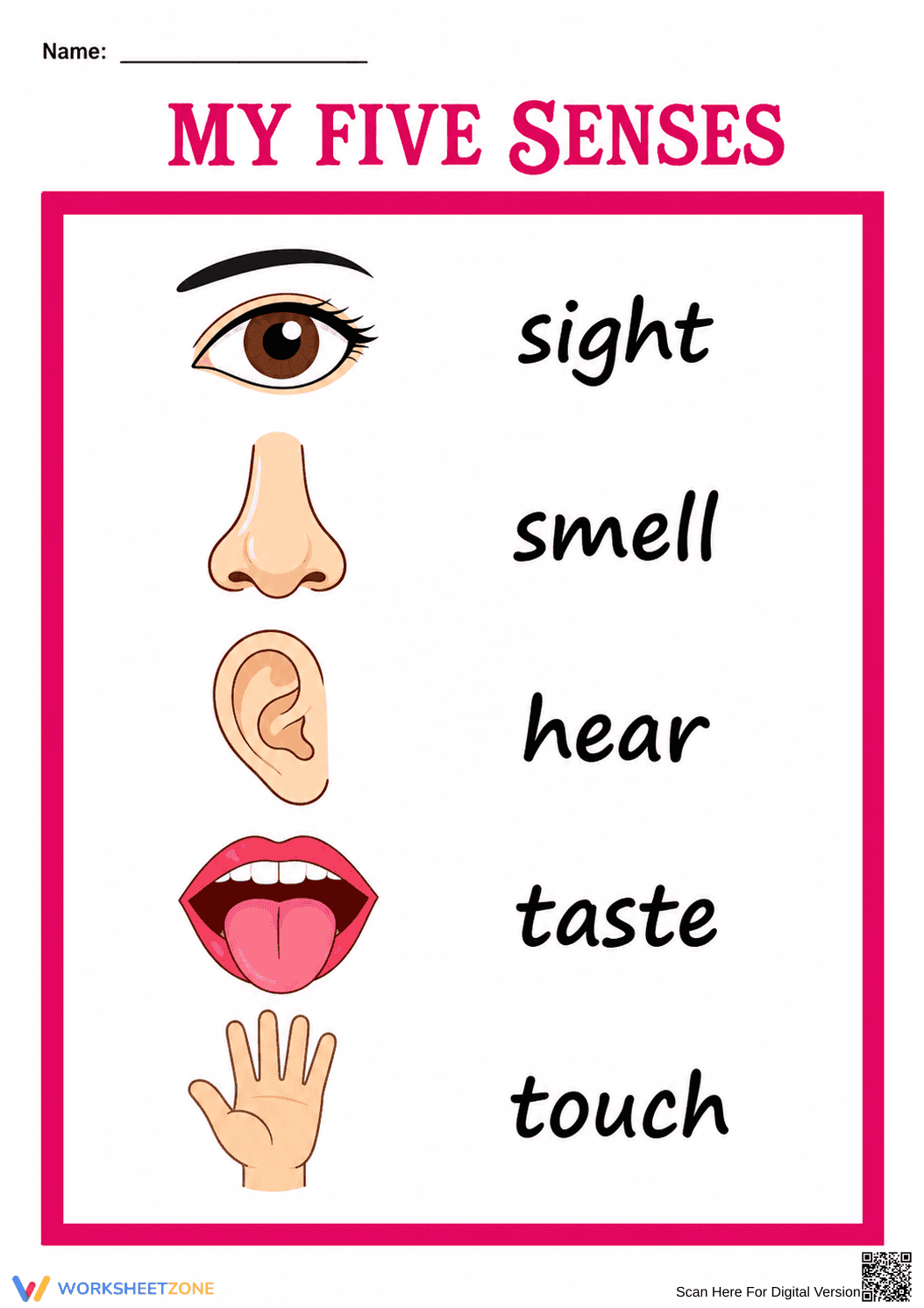
This Essential My Five Senses Chart provides a clear visual reference for early learners to identify the primary ways we interact with the world. Students will immediately recognize the five sensory organs—eyes, nose, ears, mouth, and hands—and connect them to the specific actions of sight, smell, hearing, taste, and touch. It simplifies complex biological concepts for young scientists.
At a Glance
- Grade: K–2 · Subject: Science
- Standard:
K-LS1-1— Use observations to describe patterns of what animals need to survive- Skill Focus: Five Senses Identification
- Format: 1 page · 5 items · Answer key included · PDF
- Best For: Classroom anchor charts and science notebooks
- Time: 5–10 minutes
What's Inside
This single-page printable serves as an anchor chart, featuring high-quality illustrations of the eye, nose, ear, mouth, and hand. Each image is paired with its corresponding sensory verb. The clean layout makes it accessible for pre-readers and English Language Learners who need direct visual support to master basic science vocabulary and anatomical functions.
Zero-Prep Workflow
The workflow is designed for maximum teacher efficiency. First, print the chart (1 minute). Second, distribute copies or display it on a digital whiteboard (1 minute). Third, review the labels using choral response to reinforce pronunciation and association (2 minutes). This zero-prep approach makes it an ideal addition to a sub-plan or a quick hook for a science unit.
Standards Alignment
The primary standard is K-LS1-1, which requires students to use observations to describe patterns of what animals need to survive. Understanding senses is foundational to making those observations. It also supports 1-LS1-1 regarding how external parts help animals survive. Both standard codes can be copied directly into lesson plans, IEP goals, or district curriculum mapping tools.
How to Use It
Use this during your initial unit as a whole-group anchor chart. As you introduce each sense, have students point to the corresponding part on the paper and then on their own bodies. For a formative assessment, ask students which sense they would use to observe a specific object, like a bell or a blanket, while referring back to the visual cues on the chart.
Who It's For
This resource is tailored for Kindergarten through Grade 2 students, including those in Special Education who benefit from large-print visual aids. It pairs naturally with a hands-on "senses station" activity where students rotate through objects to smell and touch, using the chart as their primary reference guide for recording findings in their science journals.
The Essential My Five Senses Chart aligns with the foundational principles of early childhood science education, focusing on K-LS1-1 and the development of observational skills. By providing explicit visual-verbal associations for the five senses—sight, smell, hearing, taste, and touch—this resource facilitates the cognitive scaffolding necessary for young students to categorize sensory input effectively. According to research from Fisher & Frey (2014) on visual literacy and scaffolds, anchor charts that utilize clear iconography alongside simplified vocabulary significantly enhance retention for primary grade learners. This chart serves as a critical bridge between concrete experience and abstract scientific labeling. It ensures that students can accurately describe their environment using precise terminology, which is a prerequisite for more advanced inquiry-based science activities. Educators can confidently integrate this tool into their curriculum, knowing it meets standards for clarity and instructional design while supporting multi-sensory learning pathways for a diverse classroom population.


