


























Views
Downloads

Printable Five Senses Cut and Paste Worksheet | Grade K-2
Paste this activity's link or code into your existing LMS (Google Classroom, Canvas, Teams, Schoology, Moodle, etc.).
Students can open and work on the activity right away, with no student login required.
You'll still be able to track student progress and results from your teacher account.
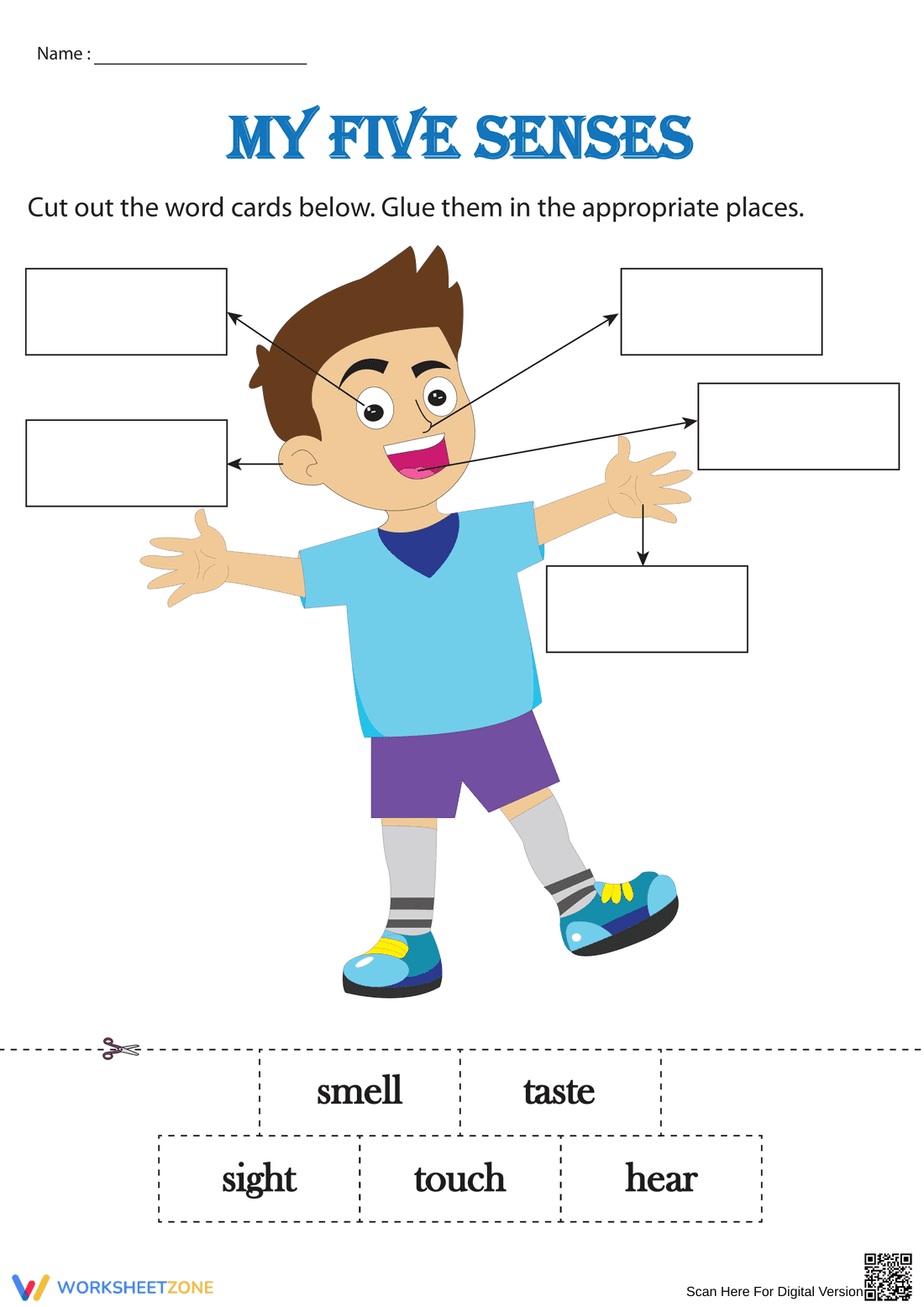
This interactive five senses worksheet helps early learners identify and label the primary sensory organs. By connecting physical body parts to the concepts of sight, smell, taste, touch, and hearing, students build a foundational understanding of how humans interact with their environment. It is an essential tool for early childhood science observation.
At a Glance
- Grade: Kindergarten · Subject: Science
- Standard:
K-LS1-1— Use observations to describe patterns of what humans need to survive- Skill Focus: Identifying five senses
- Format: 1 page · 5 problems · Answer key included · PDF
- Best For: Independent practice or science centers
- Time: 10–15 minutes
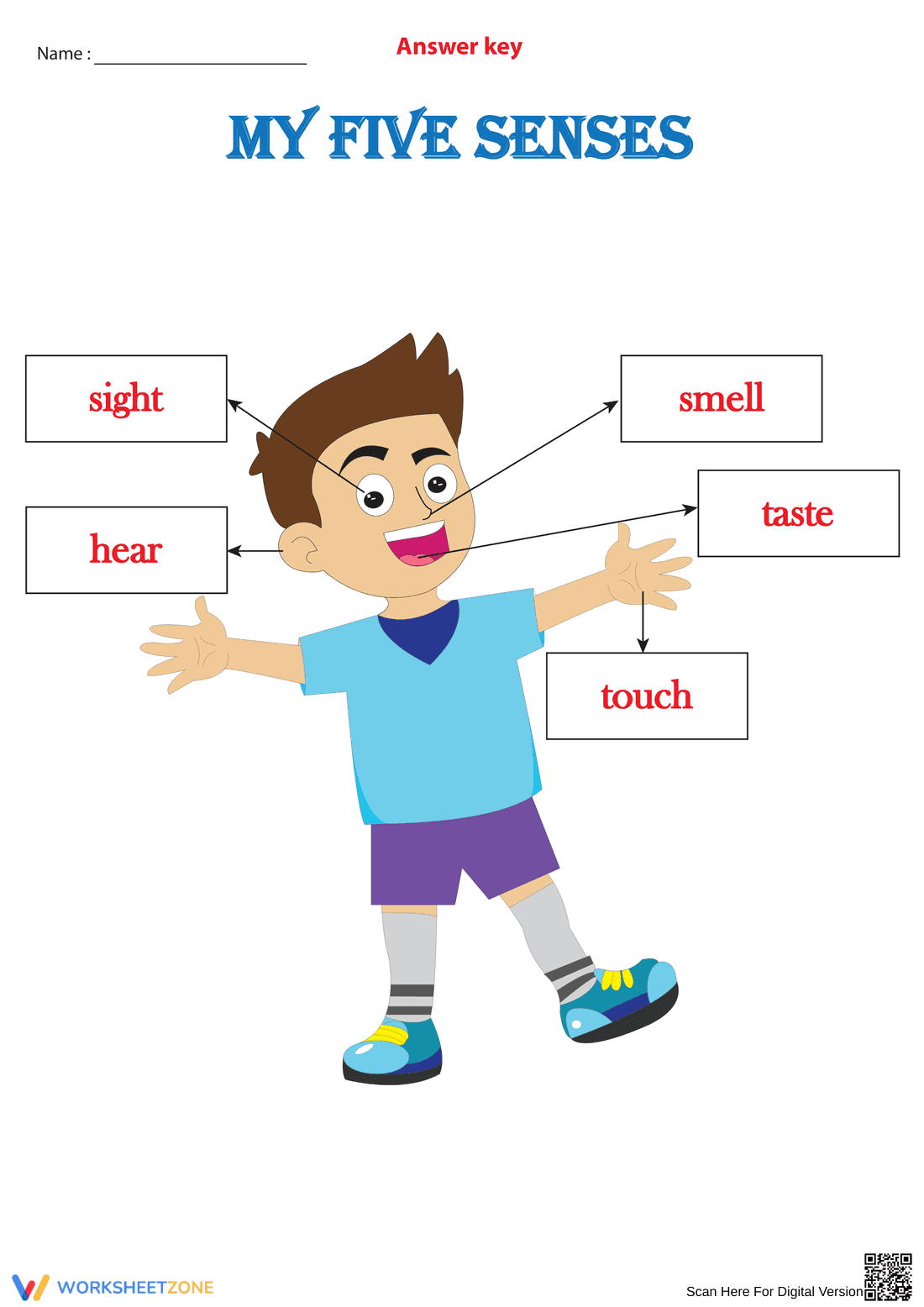
This resource consists of a single-page activity featuring a clear illustration of a child with directional arrows pointing to the eyes, nose, mouth, ears, and hands. At the bottom of the page, students will find five dashed-line word cards: smell, taste, sight, touch, and hear. The layout ensures young students can easily navigate the cutting and gluing tasks. A full-color answer key is provided to facilitate quick grading or student self-correction.
The zero-prep design allows for immediate classroom implementation. First, print the single-page PDF. Second, distribute the sheets; clear visual cues allow students to work with minimal instructions. Finally, review the diagrams as a group to reinforce vocabulary. Total teacher preparation time is under 2 minutes, making this an ideal choice for busy mornings or emergency sub plans.
This worksheet aligns with K-LS1-1, which requires students to use observations to describe patterns in the natural world. By correctly identifying the organs responsible for sensory input, students demonstrate an understanding of the biological structures humans use to gather information about their surroundings. This foundational knowledge supports later inquiry into how organisms survive and respond to stimuli. Standard codes can be copied directly into lesson plans or curriculum mapping tools.
Use this worksheet as a formative assessment after a direct instruction lesson on the human body. Circulate to observe fine motor skills and conceptual understanding during the activity. It also serves as an excellent exit ticket to verify that students can distinguish between the sense of hearing and the sense of sight before moving on to more complex biological topics. Expected completion time is 10 to 15 minutes.
This activity is tailored for Kindergarten and First Grade students who are developing both scientific literacy and fine motor coordination. It is particularly effective for English Language Learners (ELLs) because the visual associations provide strong context for new vocabulary. Pair this worksheet with an anchor chart or a hands-on mystery box activity where students guess objects using only their sense of touch.
This worksheet utilizes the gradual release of responsibility model (Fisher & Frey, 2014) by providing a framework where students apply vocabulary to a visual model. Research indicates that kinesthetic activities, such as cutting and pasting, improve retention of scientific terminology in learners aged 5 to 7. By mapping the five senses to specific anatomical locations, this resource addresses the K-LS1-1 requirement for observational data collection. The inclusion of an answer key allows for immediate feedback, which is critical for early childhood development. This resource serves as a reliable bridge between abstract sensory concepts and physical biological structures.


