


























Views
Downloads
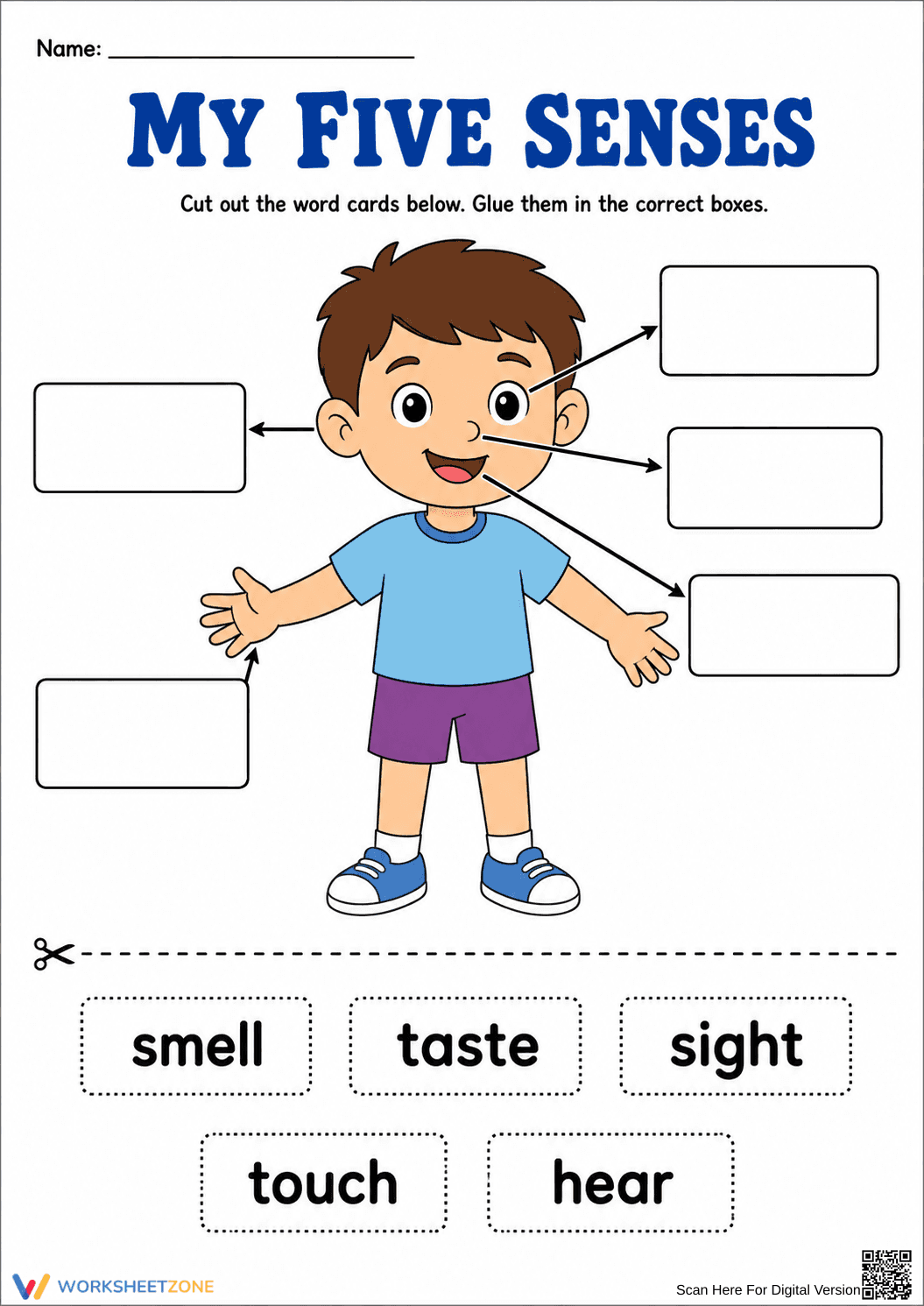

Grade 1 Five Senses — Printable No-Prep Worksheet
Paste this activity's link or code into your existing LMS (Google Classroom, Canvas, Teams, Schoology, Moodle, etc.).
Students can open and work on the activity right away, with no student login required.
You'll still be able to track student progress and results from your teacher account.
This print-and-go Grade 1 Science worksheet helps students identify and label the five human senses through an engaging cut-and-paste activity. By matching sensory words to the correct body parts, young learners develop a foundational understanding of how humans perceive the world around them.
At a Glance
- Grade: 1 · Subject: Science
- Standard:
1-LS1-1— Identify external body parts and their sensory functions.- Skill Focus: Labeling the five senses
- Format: 1 page · 5 problems · Answer key included · PDF
- Best For: Zero-prep independent practice
- Time: 10–15 minutes
This 1-page resource features a clear illustration of a child with arrows pointing to the primary sensory organs: eyes, ears, nose, mouth, and hands. At the bottom of the page, students will find five dotted-line word cards containing the terms sight, smell, touch, hear, and taste. The layout is specifically designed for easy cutting by early elementary students, and a dedicated space at the top allows for quick name entry. A complete answer key is provided to ensure fast and accurate grading.
Teachers can implement this zero-prep activity in under two minutes. Step 1: Print the worksheet directly from the PDF file (30 seconds). Step 2: Distribute the sheets to students along with scissors and glue sticks (30 seconds). Step 3: Review the completed work by checking the correctly pasted labels against the provided answer key (1 minute). This highly efficient workflow makes it an ideal resource for emergency sub plans, quick bell-ringer activities, or independent science centers.
This resource is aligned to 1-LS1-1, which requires students to understand how humans use their external parts to meet their needs and survive. Understanding the five senses is a critical prerequisite for analyzing how humans perceive and interact with their environment. Both standard codes can be copied directly into lesson plans, IEP goals, or district curriculum mapping tools.
Use this worksheet as a formative assessment mid-unit to identify which students may need additional support distinguishing between the physical organ and the sense itself. Have students complete the activity independently while you circulate to observe their fine motor skills and conceptual understanding of sensory organs. Alternatively, use it as a summative assessment after a direct instruction lesson on the human body. Students should be able to complete the matching tasks within a 10 to 15-minute timeframe.
Designed for Grade 1 students, this activity is also suitable for Kindergarten enrichment or Grade 2 review. It serves as an excellent resource for English Language Learners (ELL) due to its visual-heavy design and clear, minimal labeling requirements. Pair this worksheet with a short reading passage about the five senses or a tactile mystery bag science experiment to deepen student engagement and reinforce the vocabulary.
The integration of tactile activities with vocabulary acquisition, as seen in this five senses worksheet, aligns with the findings in Fisher & Frey (2014) regarding the importance of multimodal learning in early childhood education. By engaging both fine motor skills and cognitive categorization, students are more likely to retain the 1-LS1-1 standard's requirements for identifying external body parts and their sensory functions. Interactive cut-and-paste models significantly improve spelling recall and conceptual mapping for scientific terminology among first-grade learners. This worksheet provides the structured practice necessary for building a foundational understanding of human biology while maintaining student interest through the physical manipulation of data points. Teachers can confidently utilize this resource to meet core science requirements while ensuring students meet developmental milestones in both literacy and scientific inquiry.


