


























Views
Downloads
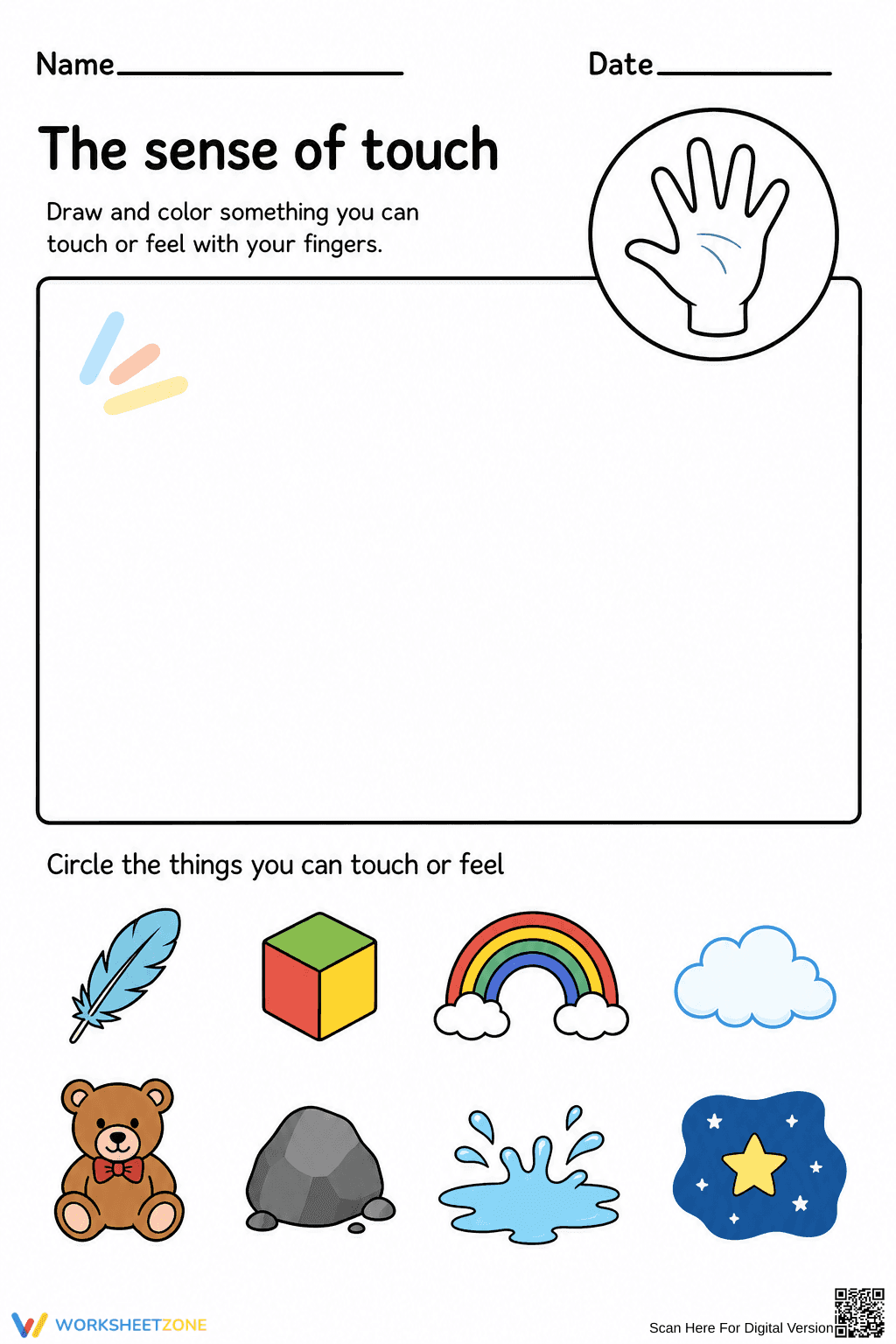

Essential Sense of Touch Worksheet | Grade 1 Science
Paste this activity's link or code into your existing LMS (Google Classroom, Canvas, Teams, Schoology, Moodle, etc.).
Students can open and work on the activity right away, with no student login required.
You'll still be able to track student progress and results from your teacher account.
This Grade 1 science worksheet helps students identify and categorize objects based on the sense of touch. By engaging in both creative drawing and analytical circling tasks, learners connect physical sensations to real-world items. It provides a clear, focused way for young scientists to explore how their bodies interact with the environment through tactile feedback.
At a Glance
- Grade: 1 · Subject: Science
- Standard:
1-LS1-1— Use body parts and senses to gather information about the world- Skill Focus: Sense of touch identification
- Format: 1 page · 2 problems · Answer key included · PDF
- Best For: Introduction to the five senses
- Time: 10–15 minutes
This single-page PDF features two distinct activities designed for early learners. The first section provides a large drawing area for students to illustrate a tactile object, encouraging creative expression. The second section contains 8 colorful icons where students must discriminate between tangible objects and intangible phenomena, such as a rainbow. A clear header for name and date is included for easy classroom organization.
Zero-Prep Workflow
Teachers can implement this resource in under 2 minutes. First, print the single-page PDF for your class. Second, distribute it to students during your science block or as a transition activity. Third, review the answers as a whole group to spark discussion about textures. The intuitive layout requires no prior explanation, making it an ideal choice for emergency sub plans or quick morning work transitions.
Standards Alignment
This resource aligns with `1-LS1-1`, which focuses on how organisms use their external parts to help them survive and grow. By identifying objects that can be touched, students demonstrate an understanding of how sensory organs provide vital information about their surroundings. This standard code can be copied directly into lesson plans, IEP goals, or district curriculum mapping tools.
How to Use It
Use this worksheet during the explore phase of a 5 Senses unit. After a brief discussion about skin and fingers, have students complete the circling task to check for understanding. It also serves as a great formative assessment; observe if students correctly identify that a rainbow cannot be touched to gauge their grasp of physical properties. Completion typically takes 12 minutes.
Who It's For
This activity is tailored for first-grade students but is also suitable for Kindergarteners or English Language Learners (ELLs) due to the heavy use of visual icons. It pairs naturally with a touch box classroom activity where students feel hidden objects, providing a written record of their sensory learning and helping to bridge the gap between physical experience and academic documentation.
According to the RAND AIRS 2024 report on early childhood science education, multi-modal activities that combine drawing with categorization significantly improve retention of biological concepts in primary grades. This worksheet leverages those findings by requiring students to both visualize and select items related to the sense of touch, reinforcing the 1-LS1-1 standard. By isolating the tactile sense, the resource helps students build a foundational understanding of how sensory input informs human interaction with the physical world. Research from Fisher & Frey (2014) suggests that such focused, scaffolded tasks are essential for the gradual release of responsibility, moving students from guided observation to independent identification. This 1-page document provides the necessary structure for Grade 1 learners to master sensory identification without cognitive overload. It is a reliable tool for educators seeking to meet NGSS requirements while maintaining high student engagement through visual and creative tasks.


