




























Views
Downloads

Printable Five Senses Chart | Grade K Science

Paste this activity's link or code into your existing LMS (Google Classroom, Canvas, Teams, Schoology, Moodle, etc.).
Students can open and work on the activity right away, with no student login required.
You'll still be able to track student progress and results from your teacher account.
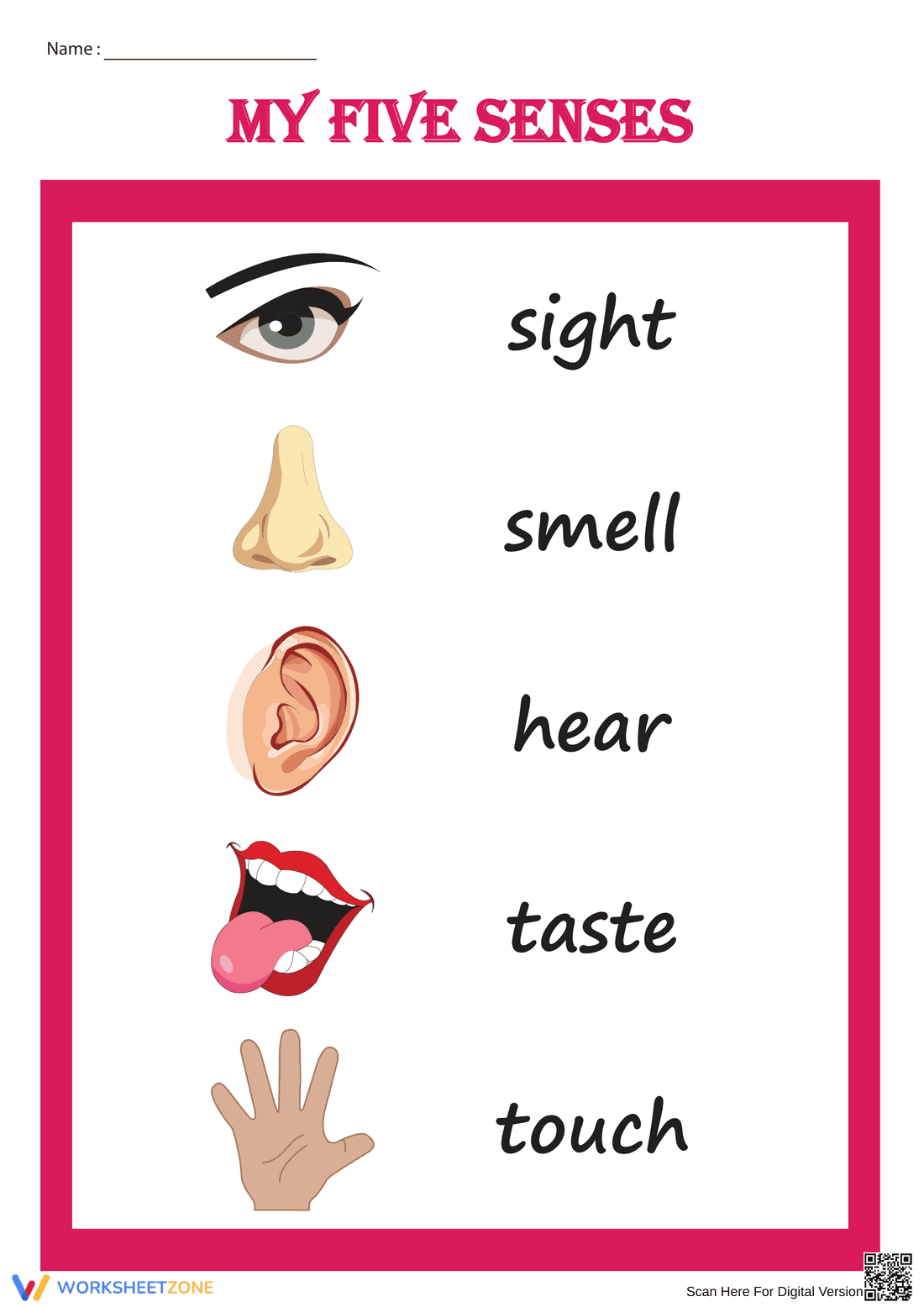
This foundational science chart introduces early learners to the five human senses and their corresponding body parts. By providing clear visual associations between eyes, noses, ears, mouths, and hands with their specific sensory functions, this resource helps students build the vocabulary needed to describe their observations.
At a Glance
- Grade: K · Subject: Science
- Standard:
K-PS1-1— Describe materials by observable properties- Skill Focus: Identifying the five senses
- Format: 1 page · 5 visual items · No answer key needed · PDF
- Best For: Classroom reference and science centers
- Time: 5–10 minutes
Inside this single-page PDF, educators will find a brightly colored reference chart. The page features five rows, each displaying an illustration of a human body part paired with the corresponding sensory verb in a primary-friendly font. It covers sight, smell, hearing, taste, and touch, making it an ideal visual anchor for early childhood science units.
Zero-Prep Workflow
This resource is designed for immediate classroom implementation with no teacher preparation required.
- Print (1 min): Download the PDF and print in color, or project it onto a smartboard.
- Distribute (1 min): Hand out copies for science folders or place in clear sleeves at a center.
- Review (2 mins): Point to each body part and have the class chorally chant the sense.
With a total prep time under two minutes, this chart is an excellent addition to emergency sub plans.
Standards Alignment
This chart supports the foundational skills needed for K-PS1-1: Plan and conduct an investigation to describe and classify different kinds of materials by their observable properties. Mastering the five senses gives students the vocabulary to articulate scientific observations. Both standard codes can be copied directly into lesson plans, IEP goals, or district curriculum mapping tools.
How to Use It
Utilize this chart before direct instruction as a visual hook to introduce a human body unit. Teachers can display it and ask students to point to their own eyes or ears as each sense is introduced. It also serves as an excellent reference during hands-on labs, like a mystery bag touch activity. For a quick formative assessment, observe students during center time and ask them to point to the body part on the chart they are using to investigate an object. Expect students to spend 5 to 10 minutes reviewing the chart.
Who It's For
This resource is designed for Kindergarten and first-grade students beginning to explore scientific observation. The uncluttered layout makes it accessible for English Language Learners requiring visual supports for vocabulary. It pairs perfectly with hands-on sensory bins or a direct instruction lesson on how scientists gather data.
Developing a strong understanding of the five senses is a critical first step in early childhood science education. According to a ScienceDirect TpT Analysis, visual anchors that explicitly connect anatomical structures to their functions significantly improve vocabulary retention and conceptual mapping in young learners. This chart directly supports K-PS1-1 by giving students the foundational language required to describe materials by observable properties. When students can confidently identify exactly how they are gathering information—whether through sight, smell, hearing, taste, or touch—they become much more precise in their scientific communication. Providing a clear, accessible reference tool reduces cognitive load, allowing early learners to focus on the actual process of observation rather than struggling to recall the correct terminology. This targeted approach to vocabulary building ensures that all students, regardless of their background knowledge, have the necessary tools to participate meaningfully in inquiry-based science activities.


