


























Views
Downloads
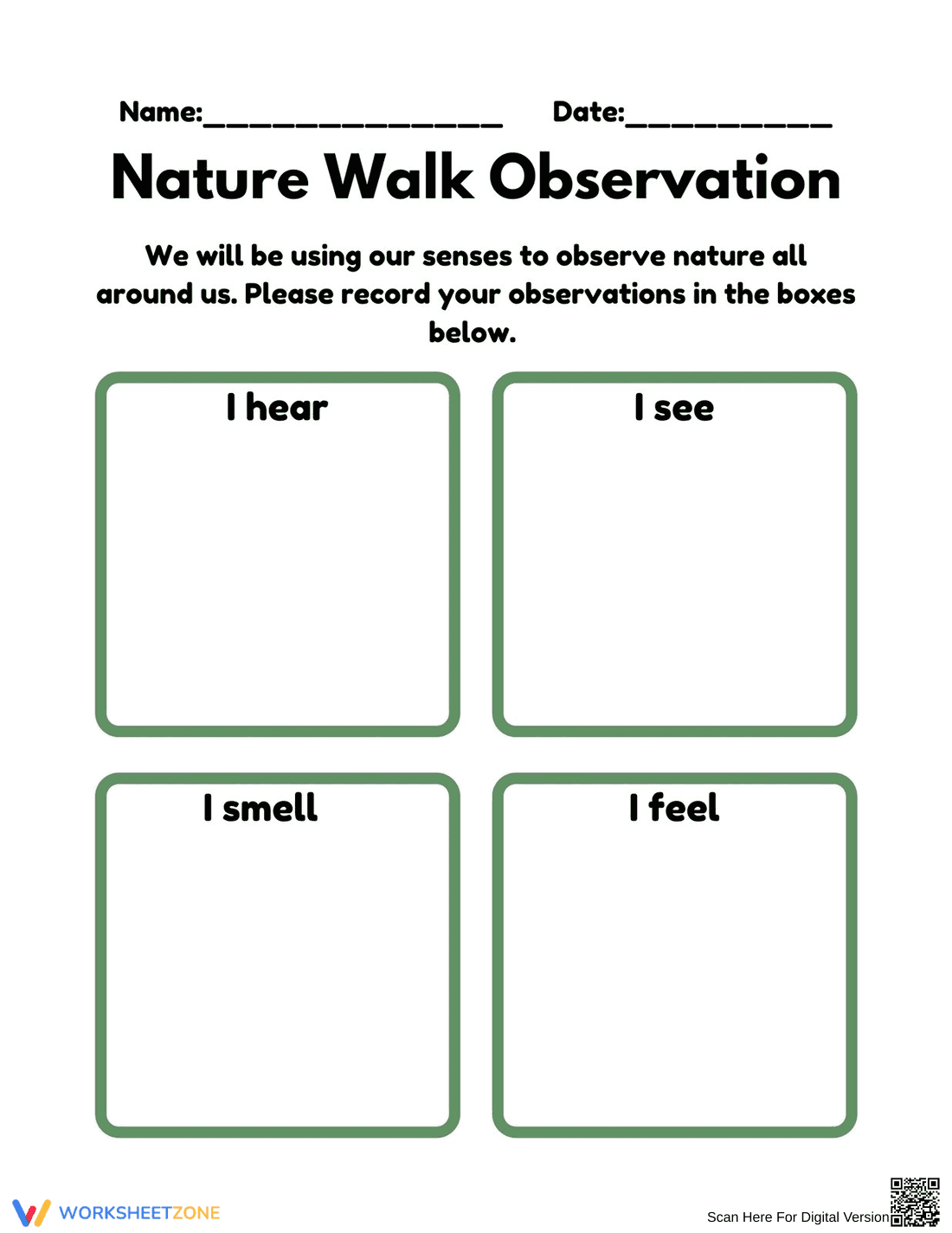

Printable Nature Walk Observation Worksheet | Grade K
Paste this activity's link or code into your existing LMS (Google Classroom, Canvas, Teams, Schoology, Moodle, etc.).
Students can open and work on the activity right away, with no student login required.
You'll still be able to track student progress and results from your teacher account.
This Grade K science worksheet prompts young learners to actively engage with their environment by recording sensory details during an outdoor excursion. By focusing on what they hear, see, smell, and feel, students practice foundational data collection skills while connecting to the natural world.
At a Glance
- Grade: K · Subject: Science
- Standard:
K-LS1-1— Use observations to describe patterns in nature- Skill Focus: Sensory observation
- Format: 1 page · 4 problems · No answer key · PDF
- Best For: Outdoor learning activities
- Time: 15–20 minutes
This single-page resource features a clean layout designed for early childhood learners. It includes four recording boxes labeled with the primary senses: "I hear," "I see," "I smell," and "I feel." The open-ended format allows students to draw pictures or write simple words to document findings. Because this is an experiential activity, an answer key is not required.
Zero-Prep Workflow
This resource requires minimal teacher preparation before heading outside.
- Print (1 minute): Print the single-page PDF for each student.
- Distribute (1 minute): Hand out sheets and clipboards as students line up.
- Review (3 minutes): Briefly explain the four sensory boxes before stepping outside.
With under two minutes of total teacher prep time, this worksheet is an excellent addition to a science sub plan.
Standards Alignment
This activity aligns with K-LS1-1, asking students to use observations to describe patterns of what plants and animals need to survive. By documenting sensory inputs, students gather observational data to understand natural patterns. Both standard codes can be copied directly into lesson plans, IEP goals, or district curriculum mapping tools.
How to Use It
Use this worksheet during a guided outdoor nature walk or schoolyard scavenger hunt. It works well as a mid-unit activity when discussing the five senses. As a formative assessment observation tip, watch whether students accurately categorize a bird's song under "I hear" rather than "I see." Expect the observation portion to take 15 to 20 minutes.
Who It's For
This resource is designed for Kindergarten students developing foundational scientific observation skills. The large boxes provide built-in differentiation, allowing pre-writers to sketch findings while advanced learners write descriptive labels. It pairs perfectly with a direct instruction lesson on the five human senses.
Early childhood science education relies heavily on experiential learning and direct observation of the natural world. Engaging students in structured outdoor activities using tools like this worksheet supports the development of critical scientific inquiry skills. According to Fisher & Frey (2014), providing young learners with graphic organizers during experiential learning significantly increases their ability to categorize and retain new vocabulary. By utilizing the K-LS1-1 standard to use observations to describe patterns in nature, educators help students bridge the gap between abstract scientific concepts and tangible, real-world phenomena. The structured format of the four sensory boxes ensures that students remain focused on specific data collection tasks rather than becoming overwhelmed by the outdoor environment. This targeted approach to sensory observation fosters a deeper cognitive connection to life science principles, laying a robust foundation for future scientific exploration and environmental literacy.


