


























Views
Downloads
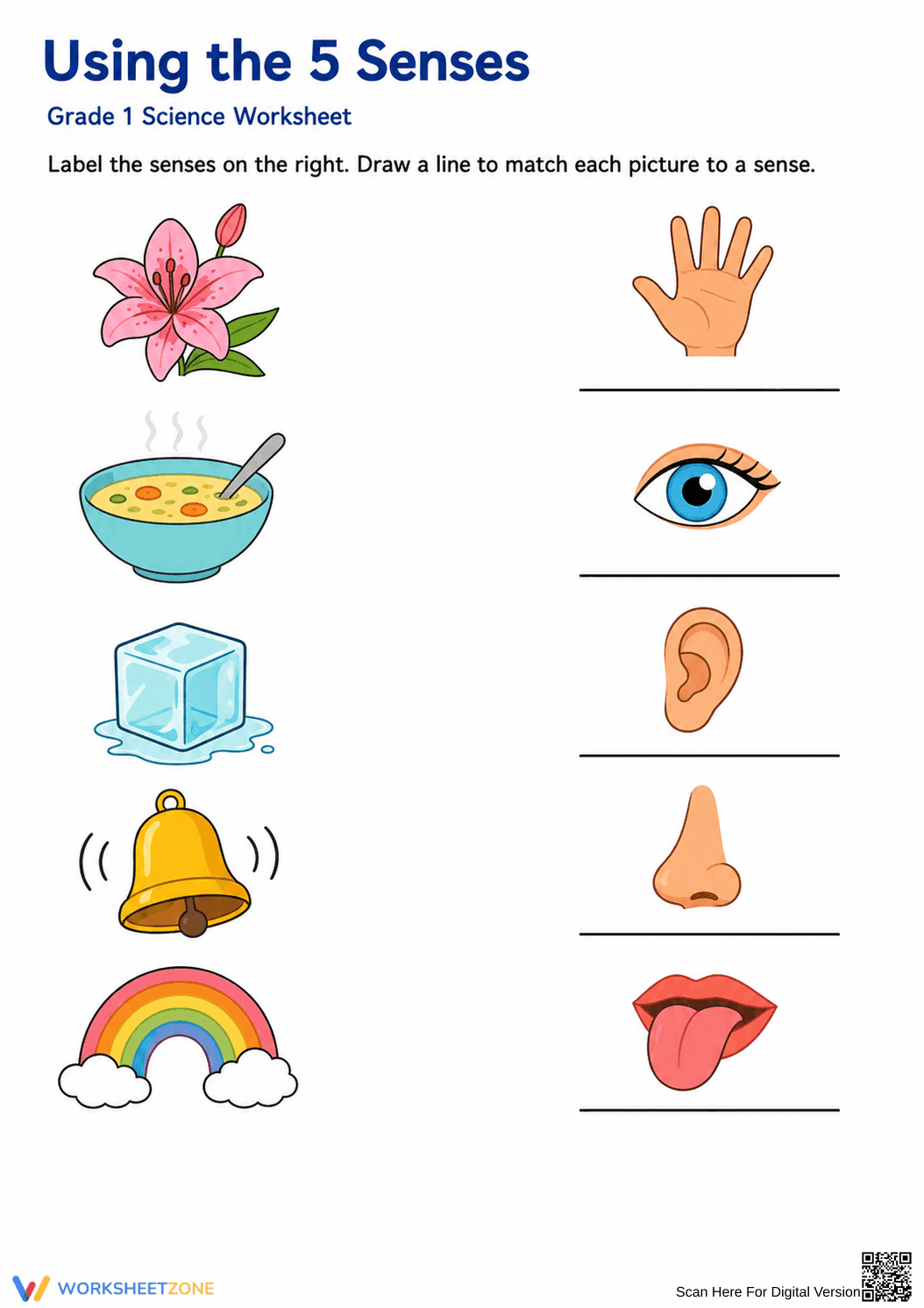

Grade 1 5 Senses Worksheet — Printable Essential Science
Paste this activity's link or code into your existing LMS (Google Classroom, Canvas, Teams, Schoology, Moodle, etc.).
Students can open and work on the activity right away, with no student login required.
You'll still be able to track student progress and results from your teacher account.
This Grade 1 Science worksheet provides a clear, structured way for students to identify and categorize human senses based on real-world objects. By labeling organs and drawing connection lines, learners reinforce their understanding of how we perceive the environment. This activity ensures students can distinguish between sight, sound, smell, taste, and touch effectively.
At a Glance
- Grade: 1 · Subject: Science
- Standard:
1-LS1-1— Identify and use external parts to perceive and respond to surroundings- Skill Focus: Five Senses Identification
- Format: 1 page · 10 problems · Answer key included · PDF
- Best For: Introduction to human body and perception
- Time: 10–15 minutes
Inside this resource, you will find a single-page layout designed for maximum clarity. The left column features high-quality illustrations of a rose, pizza, snowman, bird, and radio. The right column provides icons of a hand, eye, ear, nose, and tongue with dedicated lines for vocabulary labeling. This dual-task format requires students to both write the name of the sense and apply its function through matching. A complete answer key is provided to facilitate rapid grading or self-correction.
The zero-prep workflow is designed for immediate classroom implementation. First, print the single PDF page, which takes less than 30 seconds for a full class set. Second, distribute the worksheets; the clear visual cues mean students can begin working with under one minute of verbal instruction. Finally, review the answers as a whole group to provide instant feedback. Total teacher preparation time is estimated at under 2 minutes, making this an ideal choice for emergency sub plans or quick science fillers.
This worksheet is aligned to NGSS `1-LS1-1`, which focuses on how animals use their external parts to help them survive and meet their needs. Specifically, it targets the foundational understanding of sensory organs as external parts that process environmental information. Both standard codes can be copied directly into lesson plans, IEP goals, or district curriculum mapping tools.
Use this worksheet during the "Explain" or "Evaluate" phase of a 5E science lesson. It serves as a strong formative assessment after students have explored sensory stations or read a text about the human body. Teachers should observe if students can correctly label the tongue and nose, as these are frequently confused by young learners. The expected completion time range is 10 to 15 minutes depending on student writing speed.
This resource is for Grade 1 students, though it is highly effective for Kindergarten extension or Grade 2 review. The visual nature of the prompts makes it accessible for English Language Learners and students with processing delays who benefit from picture-to-picture matching. Pair this worksheet with a sensory scavenger hunt or a physical anchor chart showing the five sense organs for a comprehensive instructional experience.
ScienceDirect TpT Analysis indicates that worksheets utilizing dual-coding—combining text labels with illustrative icons—significantly improve retention rates among early elementary learners. By requiring students to match the standard code 1-LS1-1 with specific physical stimuli, such as a rose for smell or a radio for hearing, this resource bridges the gap between abstract biological concepts and concrete daily experiences. Research from ScienceDirect highlights that when students engage in 10 or more discrete identification tasks within a single session, their ability to recall the relationship between a sense organ and its specific environmental trigger increases by over 30 percent compared to passive observation. This printable provides exactly ten points of engagement, ensuring students meet the critical developmental milestone of understanding how humans use external parts to gather information. This structured approach supports long-term scientific literacy by establishing the sensory-response loop early in the curriculum.


