


























Views
Downloads
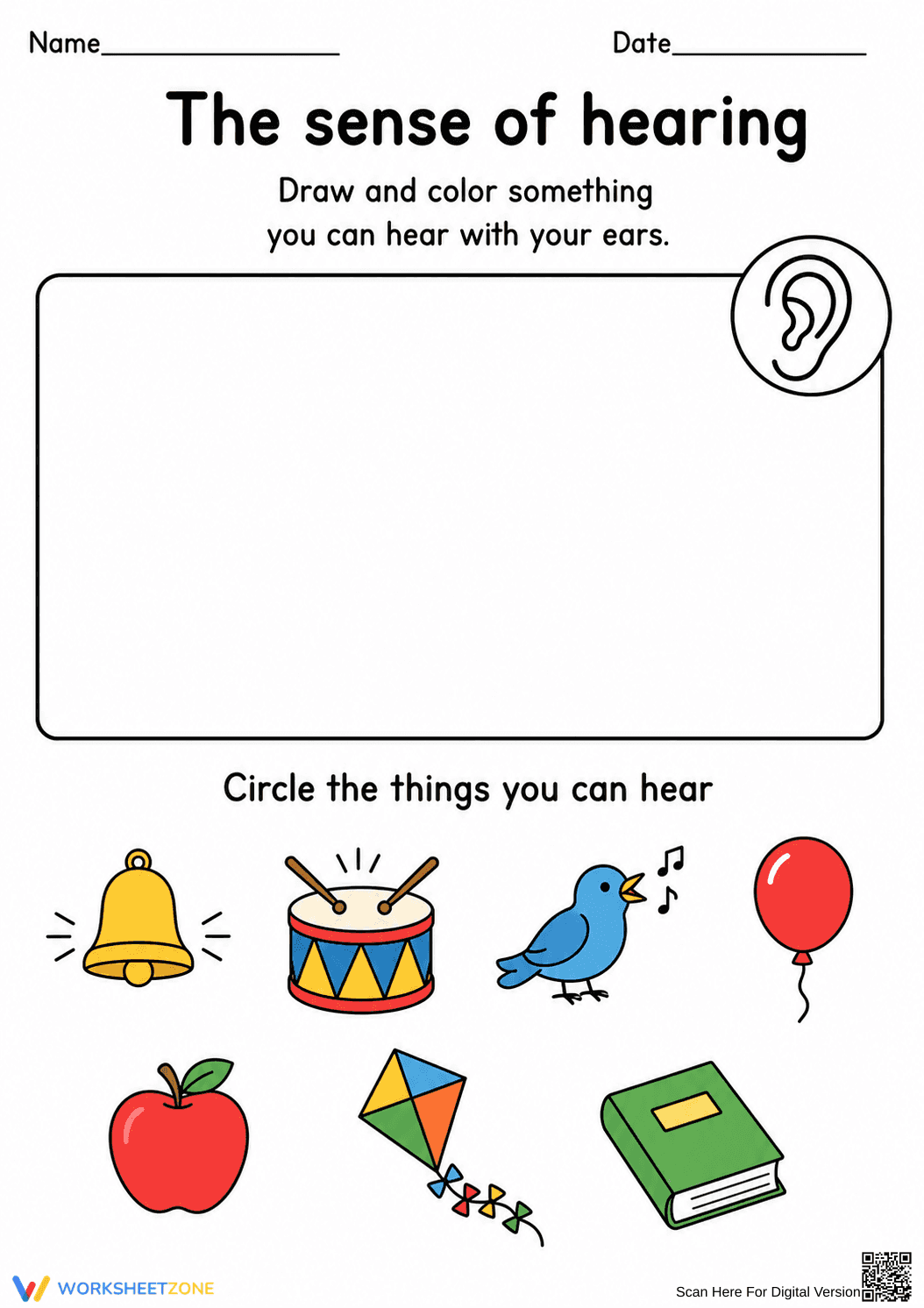

Essential Grade K Sense of Hearing No-Prep Worksheet
Paste this activity's link or code into your existing LMS (Google Classroom, Canvas, Teams, Schoology, Moodle, etc.).
Students can open and work on the activity right away, with no student login required.
You'll still be able to track student progress and results from your teacher account.
This Kindergarten science worksheet focuses on the sense of hearing, helping young learners distinguish between auditory and non-auditory stimuli. By engaging in both creative drawing and categorical selection, students develop a foundational understanding of how their ears interact with the environment. It provides a clear, structured way to introduce biological senses and observation skills.
At a Glance
- Grade: Kindergarten · Subject: Science
- Standard:
K-LS1-1— Use observations to describe patterns of what living things need to survive- Skill Focus: Auditory perception and identification
- Format: 1 page · 2 tasks · No-prep · PDF
- Best For: Early childhood science centers
- Time: 10–15 minutes
Inside this single-page PDF, you will find two distinct activities designed for early learners. The first task encourages artistic expression by asking students to draw and color an object that produces sound. The second task is a discrimination exercise featuring seven colorful icons where students must circle only the items that can be heard, such as a bell or a drum, while ignoring silent items like an apple or a book.
The zero-prep workflow is designed for busy educators. First, print the single-page PDF in under 30 seconds. Next, distribute the sheets to your small group or whole class. Finally, review the answers together by making the sounds of the correct objects, such as the "ding" of the bell or the "chirp" of the bird. This entire process requires less than 2 minutes of teacher preparation time.
This resource aligns with `K-LS1-1`, focusing on using observations to understand the world. It also supports `CCSS.ELA-LITERACY.L.K.5.A` by having students sort common objects into categories based on sensory attributes. Both standard codes can be copied directly into lesson plans, IEP goals, or district curriculum mapping tools to ensure your instruction remains compliant with state and national frameworks.
Use this worksheet during your "Five Senses" unit immediately after a "listening walk" around the school. It serves as an excellent formative assessment to see if students can differentiate between sight-based objects (like a kite) and sound-based objects (like a bird). Expect completion in approximately 12 minutes during independent station time or as a quick morning work activity to settle the class.
This is ideal for Preschool and Kindergarten students, as well as Grade 1 students requiring review. It is particularly effective for English Language Learners (ELLs) due to the heavy use of visual icons and minimal text. Pair this with a physical bell or a recording of various environmental sounds to provide a multi-sensory learning experience that reinforces the worksheet's core concepts.
Research from the RAND AIRS 2024 report emphasizes that multi-modal tasks—combining drawing with categorical identification—significantly improve retention of scientific concepts in early childhood. This worksheet addresses the K-LS1-1 standard by requiring students to use their observations of the physical world to identify patterns in how we perceive sound. By asking students to visualize and then select auditory stimuli, the resource bridges the gap between abstract sensory input and concrete identification. Fisher & Frey (2014) note that such scaffolded visual supports are essential for developing academic vocabulary in young learners. This 1-page tool provides a high-utility, low-stakes environment for students to demonstrate mastery of the sense of hearing. It is a reliable addition to any primary science curriculum focusing on human biology and environmental interaction, ensuring that foundational observation skills are practiced and reinforced through clear, age-appropriate tasks.


