


























Views
Downloads
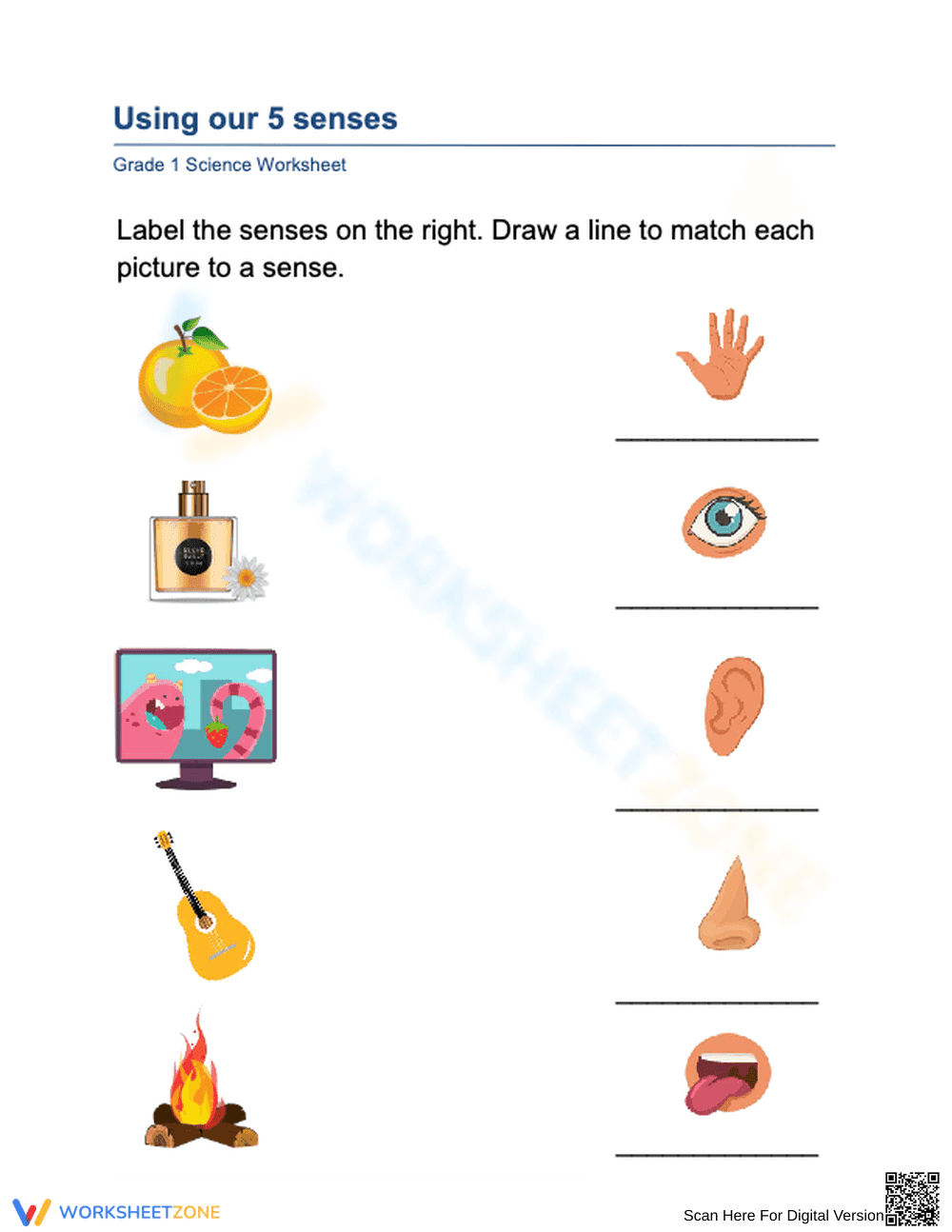

5 Senses Matching Worksheet | Grade 1 Science Essential
Paste this activity's link or code into your existing LMS (Google Classroom, Canvas, Teams, Schoology, Moodle, etc.).
Students can open and work on the activity right away, with no student login required.
You'll still be able to track student progress and results from your teacher account.
This Grade 1 science worksheet helps students master the five senses by connecting sensory organs to real-world objects. By labeling and matching, learners develop a concrete understanding of how sight, smell, hearing, taste, and touch function. It provides a clear, visual framework for early biological observation and health education.
At a Glance
- Grade: 1 · Subject: Science
- Standard:
1-LS1-1— Use external parts to help humans meet their needs and survive- Skill Focus: Sensory Identification
- Format: 2 pages · 10 tasks · Answer key included · PDF
- Best For: Introduction to human body systems
- Time: 10–15 minutes
What's Inside
The resource consists of a two-page PDF. The first page features five high-quality illustrations of common items—oranges, perfume, a television, a guitar, and a campfire—paired with five sensory organ icons. Students must write the correct sense name on provided lines and draw lines to create matching pairs. The second page is a full-color answer key for immediate feedback.
Zero-Prep Workflow
This worksheet is designed for a zero-prep classroom environment. First, print the single-page activity for your class, which takes less than one minute. Second, distribute the sheets during your science block; the intuitive layout requires only thirty seconds of explanation. Finally, review the answers as a whole group using the provided key in under five minutes. It is an ideal resource for emergency sub plans.
Standards Alignment
This activity aligns with 1-LS1-1, focusing on how humans use their external parts to perceive and interact with their environment. By identifying sensory inputs, students build the foundation for understanding structure and function in living organisms. This standard code can be copied directly into lesson plans, IEP goals, or district curriculum mapping tools.
How to Use It
Use this worksheet as a formative assessment after a hands-on sensory lesson. As students work, observe if they can distinguish between the organ and the action. It also serves as an excellent independent center activity or a quick exit ticket to gauge individual mastery of the five senses vocabulary. Expected completion time is between 10 and 15 minutes.
Who It's For
This resource is tailored for first-grade students but is also appropriate for kindergarteners needing a challenge or second graders requiring a review. It pairs naturally with a sensory anchor chart or a read-aloud about the human body. The visual nature of the tasks supports English Language Learners and students with IEPs by providing clear pictorial cues.
Research from Fisher & Frey (2014) emphasizes the importance of visual scaffolding in early childhood science to bridge the gap between vocabulary acquisition and conceptual understanding. This worksheet utilizes dual-coding theory by pairing text labels with clear icons, which reduces cognitive load for Grade 1 learners. By focusing on the 1-LS1-1 standard, the activity ensures that students are not just memorizing body parts but are understanding the functional relationship between their senses and the world around them. According to NAEP data, early mastery of basic biological concepts like the five senses is a strong predictor of later success in complex life science units. This printable resource provides the structured practice necessary to solidify these foundational skills through a 10-task matching and labeling sequence that is both efficient and effective for diverse classroom settings. It supports long-term retention by connecting abstract sensory concepts to concrete, everyday objects like oranges and musical instruments.


