Uppercase W is one of the harder letters for kindergartners to master because it combines four diagonal strokes with no curves to rely on for muscle memory. Unlike C, O, or S, which flow in one continuous motion, W demands that a child stop, change direction, and restart four separate times while keeping the strokes even in height and width. For a five- or six-year-old whose hand muscles are still developing, that stop-and-start pattern is genuinely demanding. Letter W handwriting worksheets for kindergarten give students repeated, low-pressure practice with this exact motion, which is why they belong in nearly every early literacy rotation.
Building The Diagonal Stroke Motor Pattern
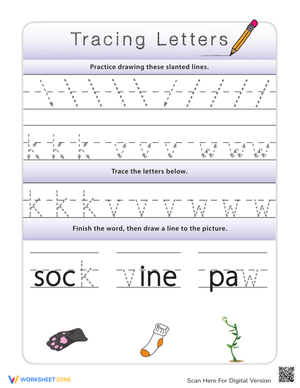
Diagonal lines are typically among the last stroke types kindergartners master, arriving after vertical and horizontal lines and often after simple curves. A worksheet sequence that isolates diagonal practice before asking students to combine four of them into a W gives struggling writers a fair on-ramp. Look for worksheets that start with single diagonal lines, move to zig-zag patterns, and only then introduce the full uppercase and lowercase letter forms. This scaffolded approach mirrors how fine motor skills develop generally: small, repeatable movements before complex, multi-part ones.
Fine motor and writing tasks occupy an estimated 30-60% of a kindergartner's classroom time, with writing itself the most common of these activities. That statistic matters for planning: if handwriting already consumes a sizable share of the school day, the worksheets chosen for letter W practice need to be efficient, targeted, and diagnostic rather than filler pages that simply ask for repetition without feedback.
Sequencing Letter W Worksheets In A Literacy Block
Most kindergarten classrooms rotate through literacy centers, and letter W worksheets fit naturally into a handwriting or fine motor station. A practical sequence looks like this: a brief whole-group demonstration of stroke order on a whiteboard, five to ten minutes of independent tracing at a center, and a quick partner check where students name letters they wrote correctly. Keeping the independent practice short protects attention and hand fatigue, since young writers lose accuracy quickly once their hand muscles tire.
- Whole-group modeling of uppercase W stroke order, about 2-3 minutes
- Independent tracing practice at a literacy center, 5-10 minutes
- Partner or teacher check for reversals and spacing
- Quick verbal review pairing the letter with the /w/ sound
Using Directional Cues To Prevent Reversals
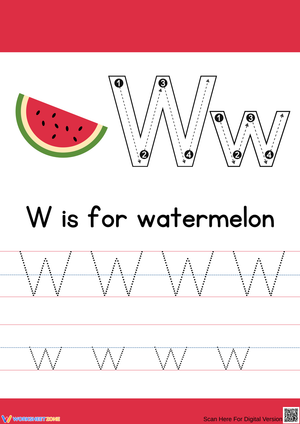
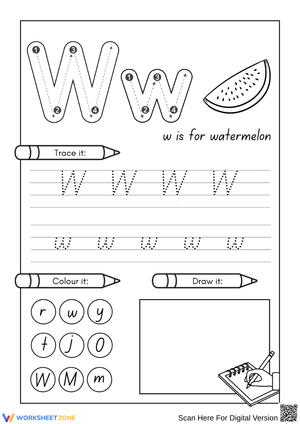
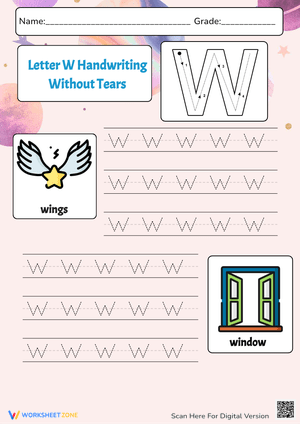
Reversals and inconsistent stroke order are common at this age, and letter W is particularly prone to both because there is no single correct starting point unless one is taught explicitly. Worksheets with numbered arrows and a clear start dot remove the guesswork, showing students exactly where to place their pencil first and which direction each diagonal should travel. Over several weeks, fading these cues, first removing the numbers, then the arrows, then the start dot, helps students transition from guided tracing to independent formation without losing accuracy.
Frequently Asked Questions
1. What is the correct stroke order for writing an uppercase W and lowercase w?
Most handwriting programs teach uppercase W as four connected diagonal strokes starting at the top left: down, up, down, up, ending at the top right. Lowercase w follows the same zig-zag pattern at a smaller scale, typically starting on the baseline rather than a top line. Worksheets with numbered start dots make this sequence explicit for young writers.
2. How much time should kindergarten teachers dedicate to letter W handwriting practice each week?
Short, frequent sessions work better than long ones. Practice guidance from early-childhood handwriting resources recommends about five to ten minutes, two to three times per week, which is usually enough repetition to build motor memory for a single letter like W without causing fatigue.
3. How can teachers tell if a student is developmentally ready for letter formation practice?
Readiness signs include a stable pencil grip, the ability to copy simple vertical and horizontal lines, and interest in mark-making activities. Since readiness climbs sharply between the start and middle of the kindergarten year, teachers should expect a wide range of ability in early fall and plan for more guided support during that window.
4. What classroom activities pair well with letter W tracing worksheets to reinforce the /w/ sound?
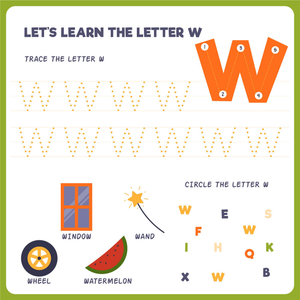
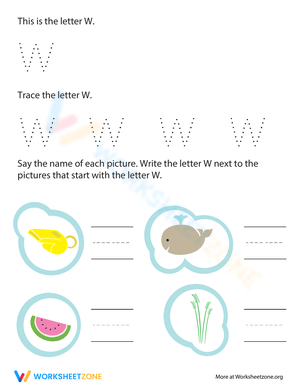
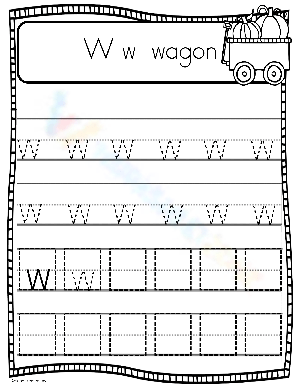
Pairing a worksheet with a short picture sort of /w/ words, such as wagon, web, and whale, reinforces the sound-symbol connection. Having students say the sound aloud while tracing each stroke also links the motor task directly to phonics instruction rather than treating handwriting as a separate skill.
5. How do letter W worksheets support fine motor and pre-writing skill development?
Because W requires coordinated diagonal strokes and direction changes, it exercises finer hand control than simpler letters. Since fine motor skills at kindergarten age are associated with later reading and math performance, worksheets that build this control serve a purpose well beyond simply learning one letter of the alphabet.