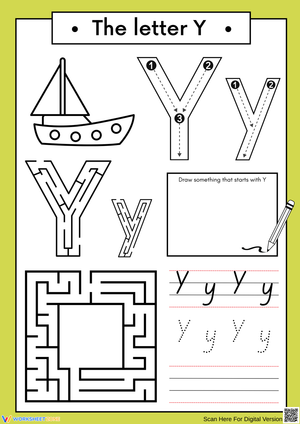
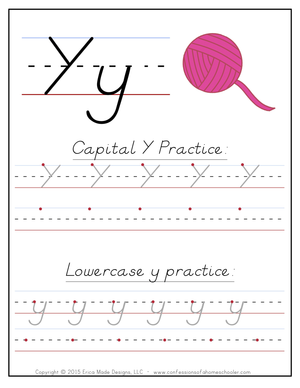
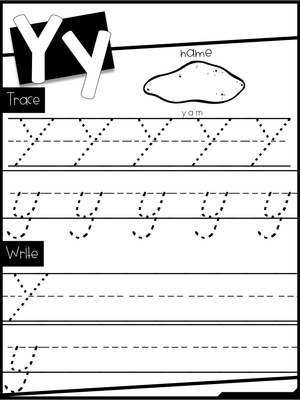
Letter Y handwriting worksheets for kindergarten do more than round out an alphabet unit. Lowercase y is one of the first descender letters most kindergartners meet, which means the pencil has to travel below the baseline instead of stopping at it. That single change asks young writers to plan a stroke path they have not used before, and it is a common point where handwriting practice slows down.
For a kindergarten teacher building a scope and sequence, letter Y often lands after simpler round or single-stroke letters like c, o, and l. By the time students reach Y, they already know how to hold a pencil and trace a basic shape. Letter Y adds a new layer: finishing the shape with control below the writing line rather than on it.
Stroke Order for Uppercase Y and Lowercase y
Clear stroke order matters more for letter Y than for many other letters because the lowercase form is genuinely more complex. Teaching both forms with a consistent verbal script helps students build reliable motor memory.
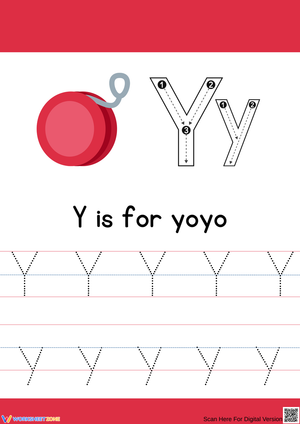
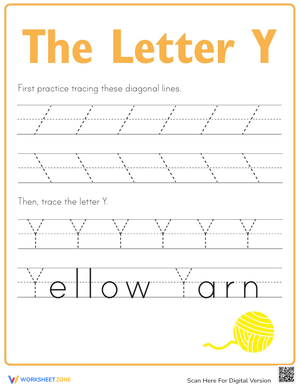
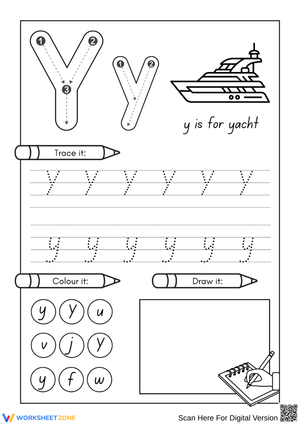
- Uppercase Y: diagonal line down and to the left from the top, diagonal line down and to the right from the top, then a short vertical line down from where the two diagonals meet.
- Lowercase y: start with a shape similar to a v, then continue the second stroke into a diagonal tail that descends below the baseline.
Saying the stroke steps out loud while students trace, such as slant down, slant down, tail below the line, gives them a repeatable routine they can use independently once the worksheet scaffolding is removed.
Visual-Motor Integration and Legibility Outcomes
Copying and tracing letter shapes draws on what researchers call visual-motor integration, or VMI: the ability to translate what the eyes see into a controlled hand movement. Stronger VMI skills in kindergarten are linked to better handwriting legibility later on, which is part of why consistent tracing practice with letters like Y is worth protecting in a daily schedule rather than treating as filler.
Research summary: A frequently cited line of early handwriting research found that visual-motor integration tasks performed in kindergarten, including copying simple shapes and letters, correlate with legibility outcomes measured later in the school year, suggesting that consistent tracing practice supports durable gains in letter formation, according to early childhood handwriting studies referenced by Zaner-Bloser.
Common Letter Y Formation Mistakes to Watch For
Because lowercase y is more complex than single-stroke letters, a handful of errors show up again and again in kindergarten writing samples.
- Reversing the diagonal direction so the shape leans the wrong way.
- Stopping the tail at the baseline instead of extending it below the line.
- Rounding the v-shape into a curve instead of keeping it angular.
- Losing consistent letter size when the descender throws off spacing on the line.
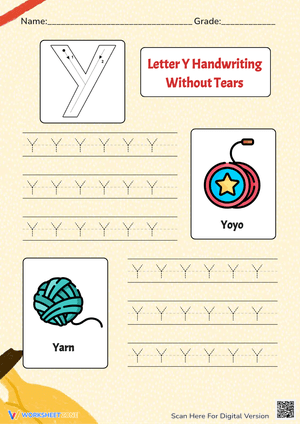
Worksheets that use dotted guide lines with a clear below-baseline zone give students a visual boundary for the tail, which reduces guesswork and cuts down on reversal errors over repeated practice.
Classroom Implementation
Letter Y worksheets work well in several kindergarten routines rather than as a single standalone lesson.
- Literacy centers: place letter Y tracing sheets at a writing center alongside letter tiles or magnetic letters for students who need a hands-on preview before pencil work.
- Morning work: a short letter Y sheet as part of daily arrival routines keeps handwriting practice consistent without taking time from core instruction blocks.
- Small-group stations: during guided practice, a teacher can watch individual pencil grip and stroke direction up close, which is harder to catch during whole-group instruction.
- Formative checks: collecting completed letter Y worksheets across a week gives a quick, low-stakes way to see which students need more repetitions before moving to the next letter.
Some students will need extra guided repetitions before the descender stroke feels automatic, and that is expected for a letter of this complexity. Brief, targeted practice on just the tail stroke, separate from the full letter, can help before returning to the complete worksheet.
Frequently Asked Questions
1. What is the correct stroke order for writing uppercase and lowercase letter Y?
Uppercase Y uses two diagonal lines meeting at a point followed by a short vertical line down. Lowercase y starts with a v-like shape and continues into a diagonal tail that descends below the baseline in one motion.
2. Why is lowercase y harder for kindergartners to write than letters like c or o?
Lowercase y is a descender letter, meaning part of the stroke must travel below the baseline. That requires more planning and pencil control than single-stroke letters that stay entirely on the writing line.
3. How many letter Y practice sessions does a kindergartner typically need before mastering the shape?
Most students benefit from two to three short, guided sessions across a week, with tracing support gradually reduced as the descender stroke becomes more automatic.
4. What words should teachers use to reinforce the letter Y sound alongside handwriting practice?
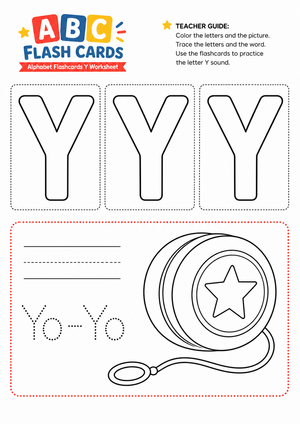
Simple, familiar words like yak, yarn, yellow, and yo-yo work well because they let students connect the /y/ sound to the letter shape while they trace.
5. How can teachers tell if a student is struggling with the descender stroke in lowercase y?
Watch for the tail stopping at the baseline instead of extending below it, pencil lifts mid-stroke, or a rounded v-shape instead of an angular one. These patterns signal the student needs more guided repetitions before moving on.