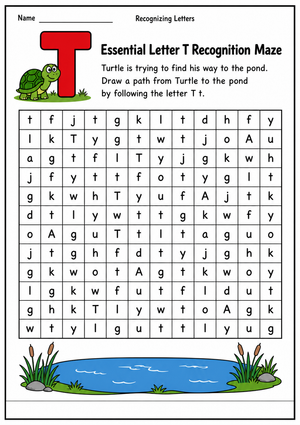
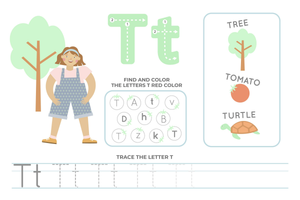
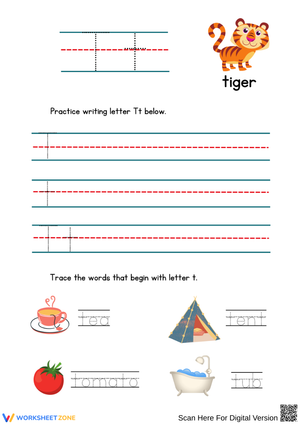
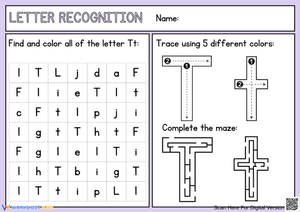
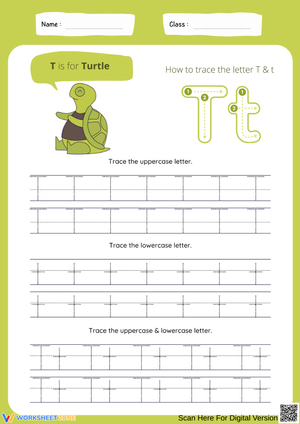
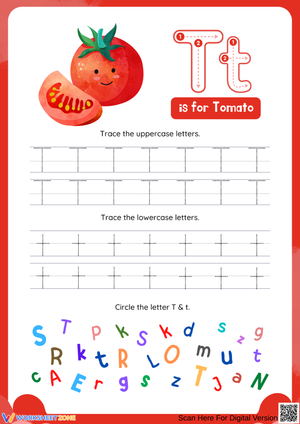
Kindergarten teachers building an alphabet handwriting sequence often start with letters that use straight lines before moving into curves. Letter T fits that plan well. It is formed with just two strokes, a vertical line down and a horizontal line across, so students who are still developing pencil control can succeed with it early in the year. Placing letter T worksheets near the front of a handwriting rotation gives students a quick early win, which matters for kids who are nervous about writing on lined paper for the first time.
Aligning Letter T Practice with Kindergarten Writing Standards
Letter formation practice in kindergarten is not just a fine motor exercise, it is tied directly to literacy expectations. By the end of kindergarten, students are expected to print many upper- and lowercase letters, and letter T worksheets give teachers a concrete, gradeable artifact to track that progress. Using a consistent worksheet format across the alphabet also makes it easier to compare a student's letter T work in October to their letter T work in April, which supports report card conversations and IEP progress notes.
Kindergarten classrooms spend a notable share of the instructional day on paper-and-pencil tasks, and research indicates that 30-60% of elementary classroom time involves fine motor or writing activities in some form. That range is wide because it depends on how much of the day is devoted to centers versus whole-group instruction, but it tells teachers that handwriting worksheets are not a side activity squeezed into transitions. They are part of the core instructional block, and letter T practice should be scheduled with the same intention as a phonics lesson.
Correct Stroke Order for Uppercase and Lowercase T
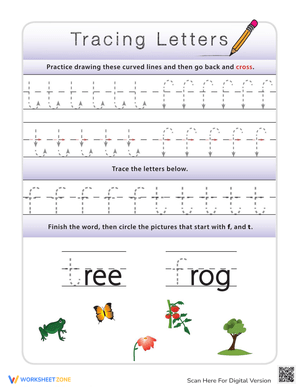
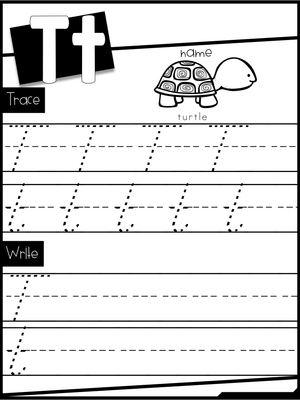
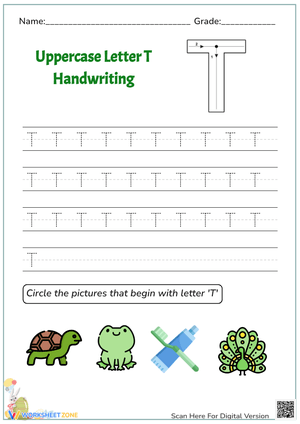
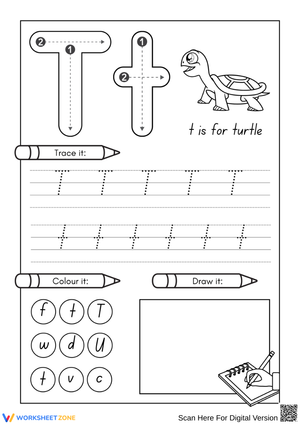
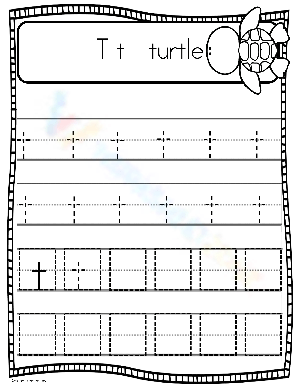
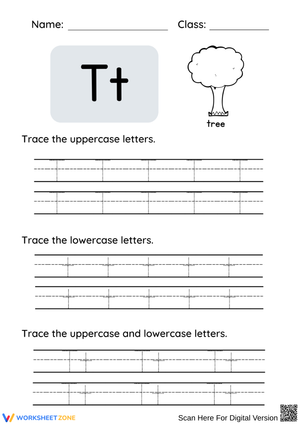
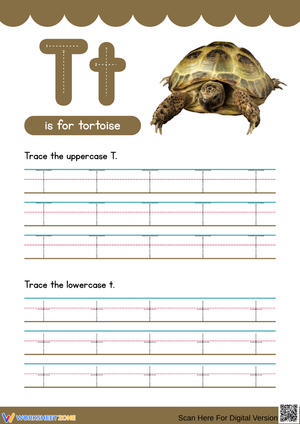
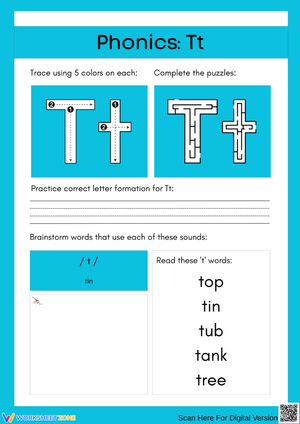
Uppercase T starts with a horizontal line across the top, then a vertical line down the middle, starting at the left end of the top line. Lowercase t starts with a vertical line from just below the top guideline down to the baseline, then a short horizontal crossbar added partway down. Worksheets that show numbered arrows for each stroke, rather than just a dotted outline, help students internalize the motion instead of just tracing a shape. Consider these points when choosing or building a worksheet:
- Arrows should show top-to-bottom and left-to-right direction, matching how English is read and written.
- Starting dots should sit exactly where the pencil should first touch the paper.
- Lined paper with a midline (dashed) helps students see where the lowercase crossbar belongs.
- Repetition rows should shrink in guide support, moving from full tracing to partial dots to blank lines.
Common Letter T Errors and How Worksheets Correct Them
Most letter T mistakes at this age fall into a few predictable categories: crossing the vertical line too high or too low, drawing the horizontal line at an angle instead of straight, or reversing stroke order so the vertical line comes first without a clear starting point. A worksheet with a self-check box at the end of each row, where a student circles their best-formed letter, builds early self-monitoring skills. Teachers can scan those self-checks during a quick walk-through and flag students who consistently pick a poorly formed letter as their best one, which often signals a visual discrimination issue worth a closer look.
Guild For Teacher To Use These Worksheets
A simple weekly rhythm works well for letter T and the rest of the alphabet sequence. Introduce the letter with a whole-group demonstration on the board, modeling the stroke order out loud while students trace in the air. Move into independent worksheet practice, then close with a quick partner check where students compare their best-formed letter to a partner's. For students who need more repetition, keep a folder of extra letter T pages available at a writing center rather than assigning a whole separate worksheet to the entire class. Rotate letter T worksheets back into review folders a few weeks after the initial lesson, since a single exposure rarely leads to lasting retention for five- and six-year-olds. Keep pencil grip checks part of the routine too, since a correct grip makes every later stroke easier to control.
Frequently Asked Questions
1. What is the correct stroke order for writing uppercase and lowercase letter T?
Uppercase T is a horizontal top line followed by a vertical line down the center. Lowercase t is a vertical line from near the top guideline to the baseline, followed by a short horizontal crossbar.
2. How much handwriting practice time should kindergarten teachers schedule daily?
Many classrooms schedule a short, focused block of ten to fifteen minutes daily, often paired with phonics or literacy center time, rather than one long session once a week.
3. How do letter T worksheets support both fine motor development and literacy standards?
They give students repeated, guided practice forming precise strokes while also supporting the expectation that kindergartners print many upper- and lowercase letters by the end of the year.
4. What are signs a kindergartner needs more support before moving to more complex letters?
Frequent stroke-order confusion, inconsistent letter size, or trouble copying a modeled T shape are signals that a student may need more guided tracing before independent practice.
5. How can teachers use letter T worksheets alongside phonics instruction?
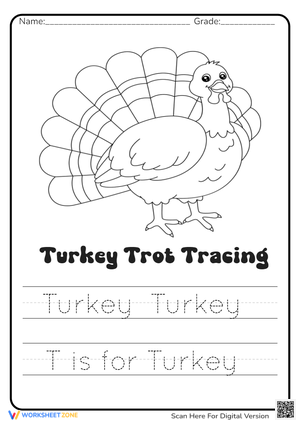
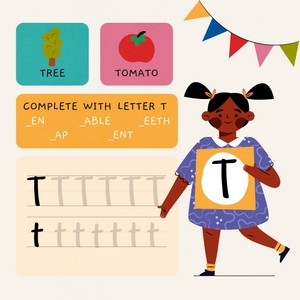
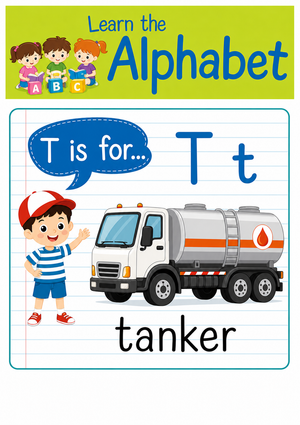
Add picture prompts of T words next to the tracing lines so students connect the letter shape to its initial sound while they practice forming it.