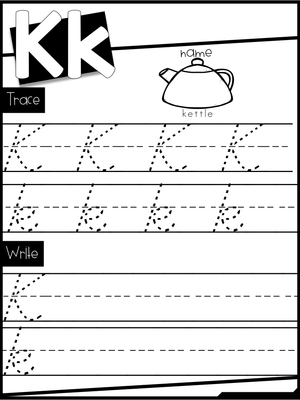
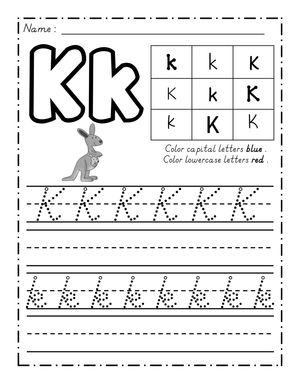
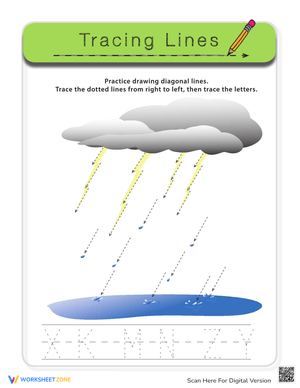
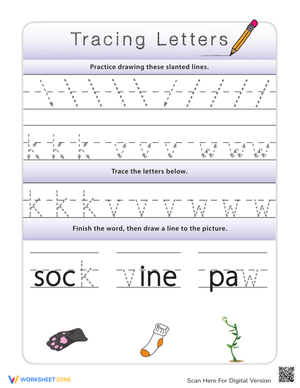
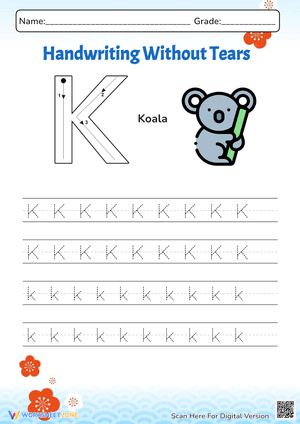
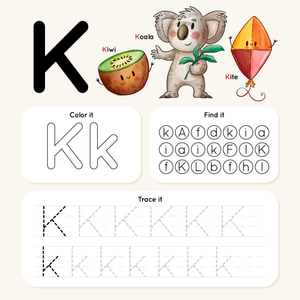
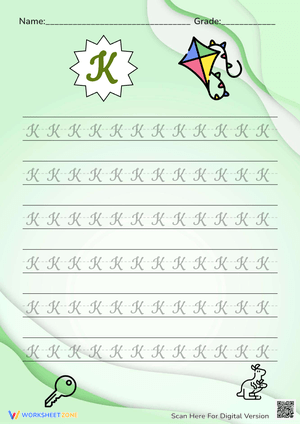
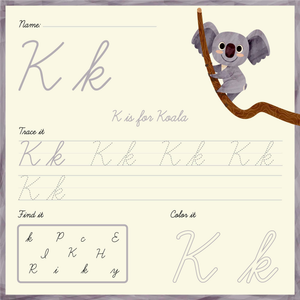
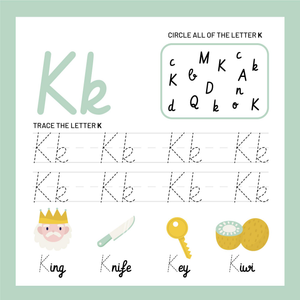
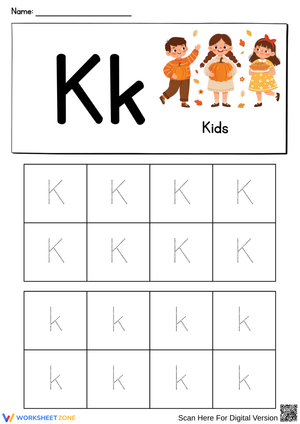
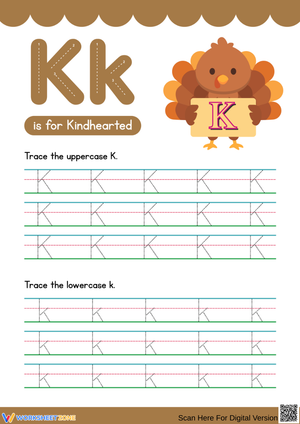
Most kindergartners breeze through straight-line letters like L or T long before they can form a clean letter K. That is because K asks a five-year-old hand to manage three separate strokes: one vertical line and two diagonals that must meet at a single point along that line. For a writer who is still building basic line control, this is a big jump in complexity. Letter K handwriting worksheets for kindergarten give students the repeated, low-stakes practice they need to internalize where those diagonal lines start, where they meet, and how far they should extend.
Uppercase K and lowercase k share the same tricky midpoint junction, which means students who struggle with one will usually struggle with the other. Worksheets that isolate letter K rather than folding it into a full alphabet packet let teachers spend extra guided time on this one letter without slowing down the rest of the class.
Stroke-by-Stroke Formation for Uppercase K and Lowercase k
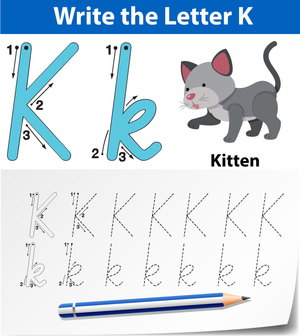
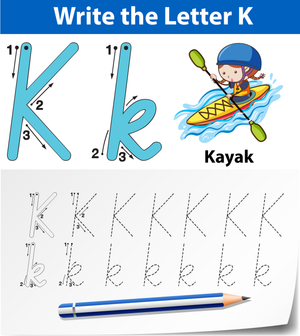
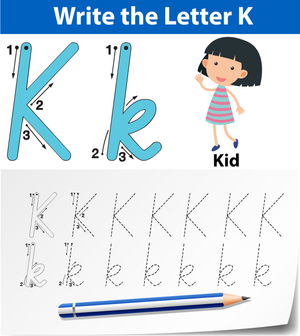
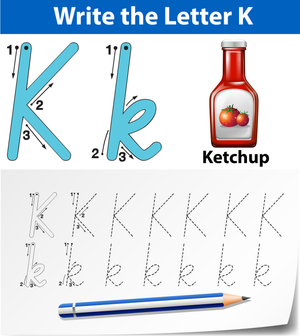
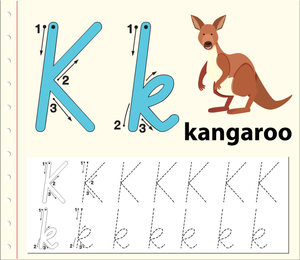
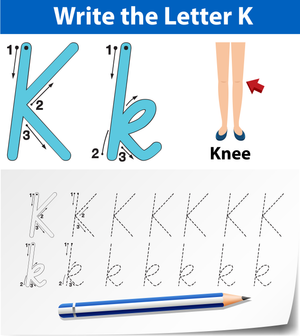
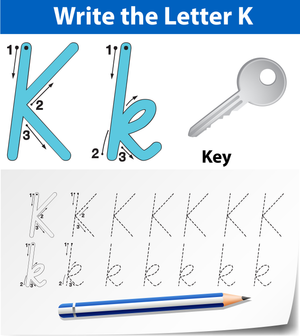
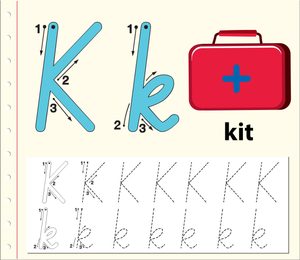
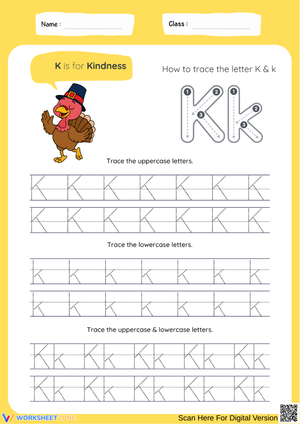
Uppercase K starts with a top-to-bottom vertical line. The second stroke begins near the middle of that line and angles up to the top right corner. The third stroke starts at the same middle point and angles down to the bottom right corner. Lowercase k follows a similar pattern but starts taller, at the top line, drops straight down through the baseline, then adds a smaller diagonal-in and diagonal-out stroke higher up on the body of the letter.
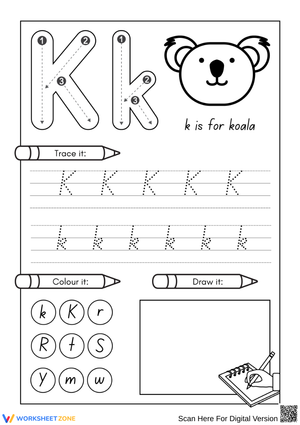
Worksheets that number each stroke and show directional arrows help kindergartners build a consistent motor pattern instead of guessing at stroke order every time. Consistency matters more than speed at this stage, since a wobbly but correctly sequenced K will straighten out with practice, while a K formed with random stroke order tends to stay inconsistent into first grade.
Building Fine Motor Readiness Before the Worksheet
Handing a child a pencil and a letter K worksheet is not always the first step. Six recognized prerequisites for handwriting include small muscle development, eye-hand coordination, tool manipulation, basic stroke formation, letter recognition, and orientation to written language, and letter K worksheets are most effective once those foundations are at least partly in place.
Kindergartners spend nearly half of their school day engaged in fine motor activities, and a large share of that time is spent on paper-and-pencil tasks specifically. That volume of practice is not incidental; research links finger accuracy and in-hand manipulation skills directly to how clearly and consistently young writers can form letters like K, where two diagonal strokes have to land in the same spot every time.
Before a worksheet ever comes out, a few minutes of playdough rolling, clothespin pinching, or bead stringing can prime the small hand muscles K formation depends on. Air-writing the letter with a whole-arm motion, or tracing a large K in a sand tray, also builds the movement memory that later transfers to pencil and paper.
Classroom Implementation
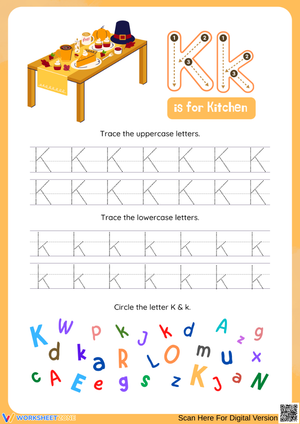
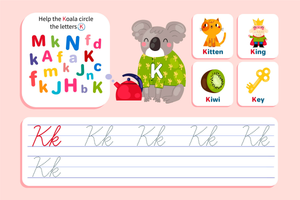
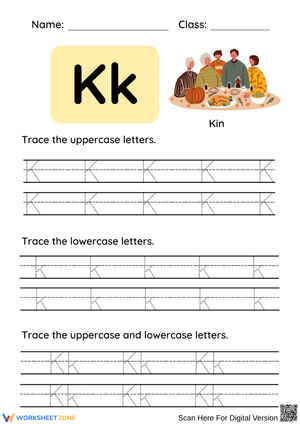
A simple three-step routine keeps letter K practice consistent across a classroom. First, model the letter on a whiteboard while narrating each stroke out loud, using consistent language such as down, up-diagonal, down-diagonal. Second, have students trace the letter in the air or on a partner's back before touching a worksheet, so the motor pattern is rehearsed without the added pressure of pencil control. Third, move to the worksheet itself, starting with guided dotted-line tracing and finishing with a few independent attempts in blank space.
Keep individual practice sessions short. Five to seven focused minutes on letter K, repeated across two or three days, tends to produce better formation than one long session. Rotating letter K worksheets into weekly review folders also gives teachers an easy way to track formation progress over the semester without adding extra grading time.
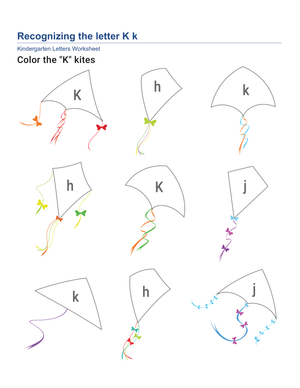
Pair the worksheet with vocabulary the class already knows, such as kite, kangaroo, or king, so students connect the written letter to words they can say and picture. This keeps the activity from feeling like isolated pencil drill and ties it back to the phonics instruction happening elsewhere in the day.
Frequently Asked Questions
1. How many times should kindergartners practice writing letter K before it is mastered
There is no single magic number, but most kindergartners need repeated, short practice sessions across several days rather than one long session. Spacing five- to seven-minute sessions across a week tends to produce steadier formation than a single extended drill.
2. What is the correct stroke order for uppercase K and lowercase k
Uppercase K begins with a top-to-bottom vertical line, followed by a diagonal from the midpoint up to the top right, then a diagonal from the same midpoint down to the bottom right. Lowercase k follows the same general pattern on a shorter, taller starting line.
3. How can teachers tell if a student needs extra fine motor support with letter K
Look for consistent reversals, diagonals that never meet at the same point, unusually heavy pencil pressure, or visible fatigue after a few letters. These signs suggest a student may benefit from additional fine motor warm-ups before returning to the worksheet.
4. How do letter K worksheets fit into daily kindergarten handwriting instruction
They work well in morning work bins, literacy center rotations, and small-group handwriting time, especially when paired with phonics practice on the /k/ sound so students connect the letter shape to its sound.
5. What common mistakes do kindergartners make when forming letter K
The most frequent issues are starting the diagonal strokes from the wrong end, missing the shared midpoint where both diagonals should meet, and reversing the letter's overall orientation on the page.