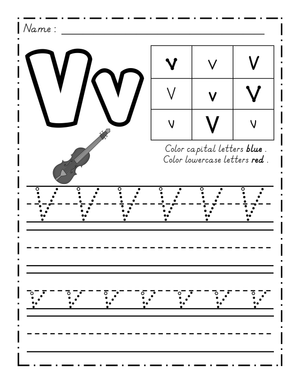
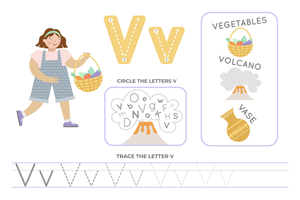
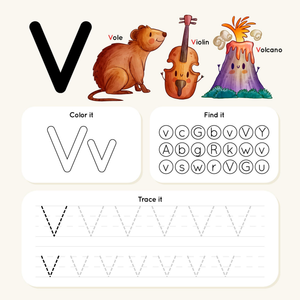
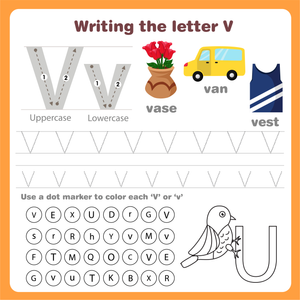
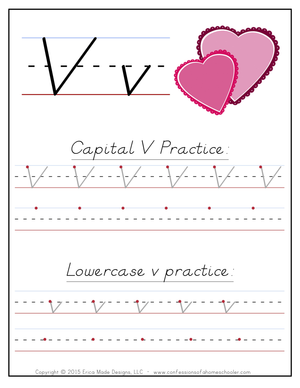
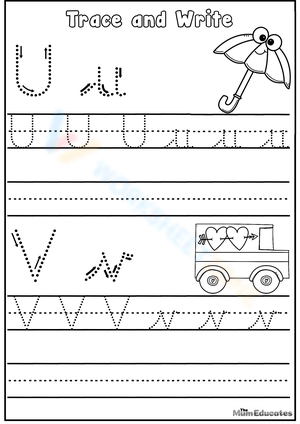
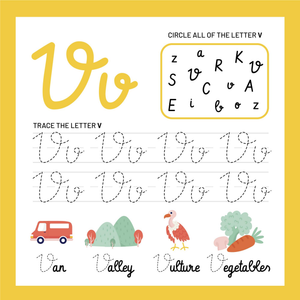
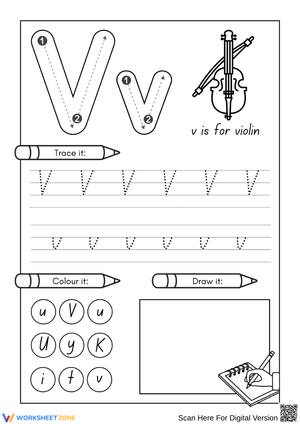
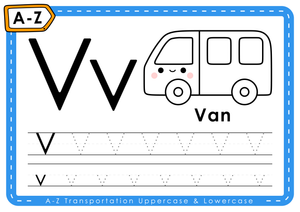
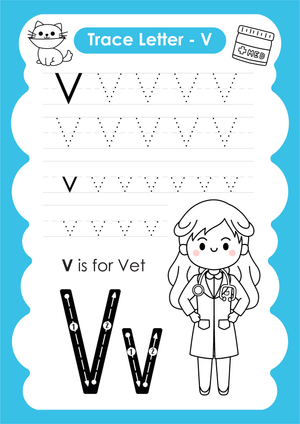
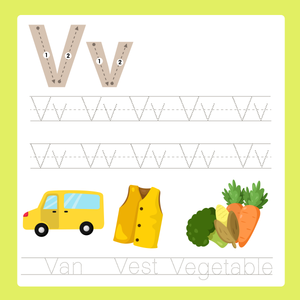
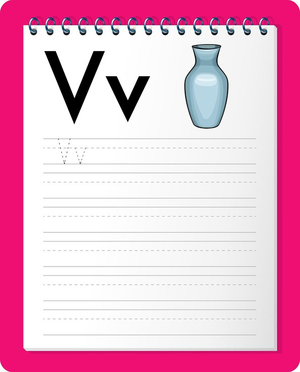
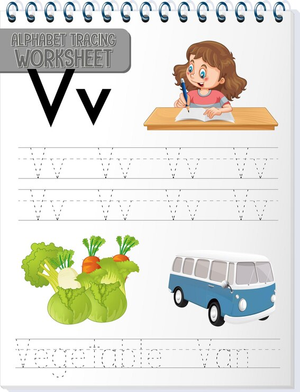
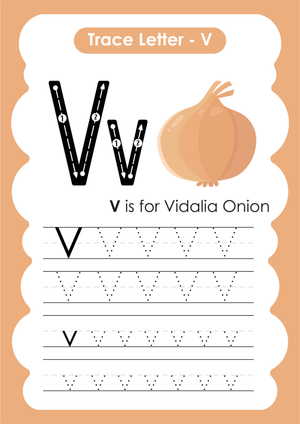
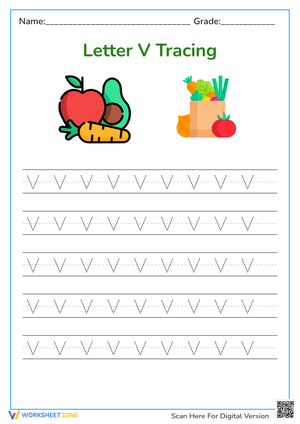
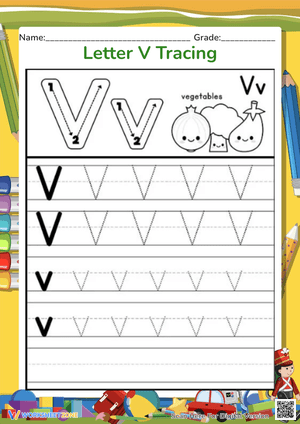
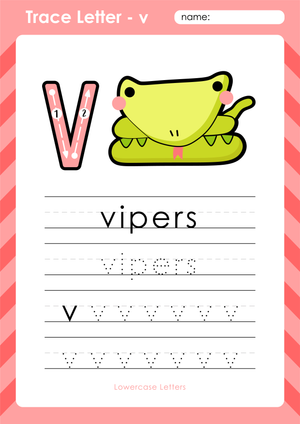
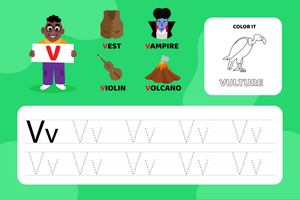
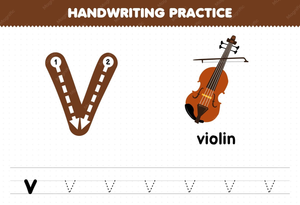
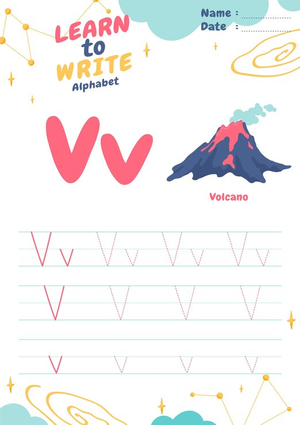
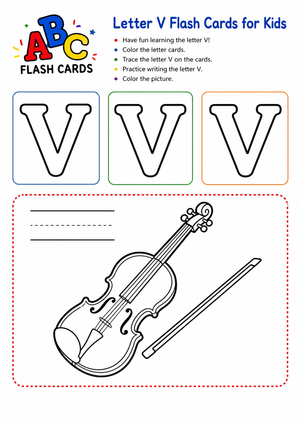
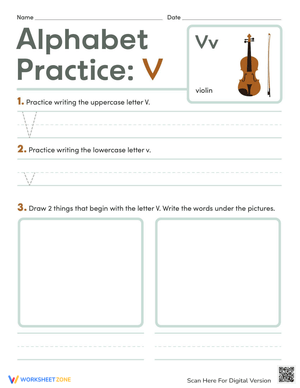
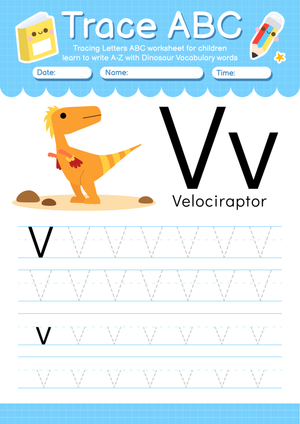
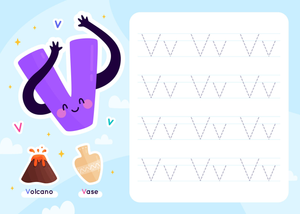
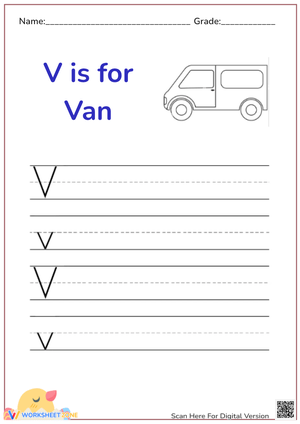
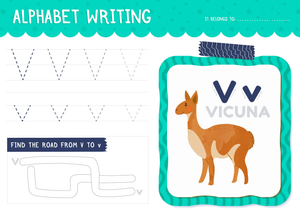
Letter V looks simple on a page, but for a five- or six-year-old hand, it asks for something harder than it appears: two diagonal strokes that meet cleanly at a single point. Kindergarten teachers planning a letter-of-the-week rotation often notice that V trips up students who have otherwise handled straight-line letters like L, T, and I without much trouble. A dedicated letter V handwriting worksheet gives students repeated, low-pressure reps at that diagonal-to-point motion before they are asked to use it in real writing.
Kindergarten language standards call for students to print many upper- and lowercase letters, and L.K.1.a specifically frames printing as an expected skill for this grade band. Worksheets built around a single letter give teachers a concrete, checkable way to show progress toward that standard during literacy block or morning work, without turning handwriting into a stand-alone subject that eats into reading time.
What Makes Letter V Tricky for Young Writers
The most common error on letter V worksheets is not a reversal, as many teachers expect, but a rounded bottom point that turns the letter into something closer to a U. This happens because young writers have more practice with curved strokes from letters like C and O than with the sharp directional change V requires. Worksheets that isolate the point-and-turn motion, rather than just the overall letter shape, target this specific error directly instead of relying on general tracing repetition.
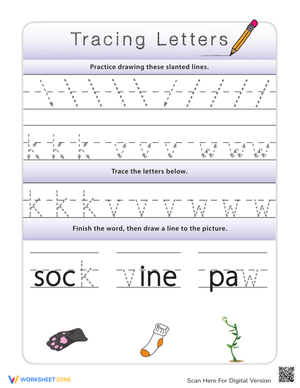
A second frequent issue is uneven stroke length, where one diagonal is noticeably longer or shorter than the other, throwing off the letter's symmetry. Guided dot-to-dot or arrow-cued worksheets help students self-correct this before the pattern becomes a habit that is harder to unteach later in the year.
Building the Motor Skills Behind Letter Formation
Handwriting research consistently ties legible letter formation to underlying fine motor and visuomotor skills rather than to letter recognition alone. Small muscle control in the fingers, accurate eye-hand coordination, and comfortable tool manipulation all show up as prerequisites before a child can form V cleanly and consistently. This matters for worksheet design: a page that only shows the letter shape without any warm-up stroke practice skips a step that many kindergartners still need.
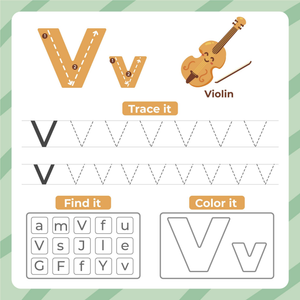
Recognized readiness prerequisites for handwriting include small muscle development, eye-hand coordination, pencil and tool manipulation, basic stroke formation, letter recognition, and orientation to print. A strong letter V worksheet set touches several of these at once by pairing large starting strokes with smaller, more controlled tracing further down the page.
Using These Worksheets In Kindergarten Handwriting Practice Sessions
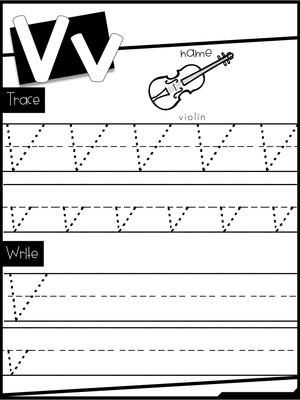
Letter V worksheets work well across a few different classroom structures. In a whole-group setting, teachers can model the two-stroke motion on a whiteboard, count out loud (down, up) as students trace the first few letters, then release students to complete the rest of the page independently. In a literacy center or handwriting station, the same worksheet becomes a self-directed task once students have seen the modeling once or twice.
Teachers running small-group stations for students who need more repetition often find that a single worksheet page, used three to four times across a week with brief teacher feedback each time, produces steadier formation than one long practice session. Short, spaced practice appears to support motor memory better than a single extended drill, which matches broader findings on skill practice in young children.
- Model the letter on a large surface before handing out the worksheet.
- Use verbal cues like down-slant, up-slant, point to reinforce the stroke sequence.
- Rotate worksheet use between whole group, centers, and morning work so practice stays varied.
- Pair the worksheet with a quick multisensory extension, such as air writing or finger tracing in a shallow tray, for students who need an additional sensory step.
Frequently Asked Questions
1. When should kindergarten teachers introduce letter V formation?
Many teachers place letter V in the second half of an alphabet unit, often clustered near W, once students have already practiced at least one other diagonal-stroke letter such as A or K. This ordering lets students build on a motor pattern they already know rather than learning it cold.
2. How many worksheet sessions does it typically take for students to master letter V?
Most kindergartners need three to five short practice sessions, ideally spaced across a week rather than completed all at once, to form the letter consistently without heavy teacher prompting.
3. What is the most common mistake kindergartners make with letter V?
The most frequent error is rounding the bottom point so the letter resembles a U. Worksheets that isolate the sharp point-and-turn motion, rather than only offering full-letter tracing, address this directly.
4. How can teachers connect letter V worksheets to phonics instruction?
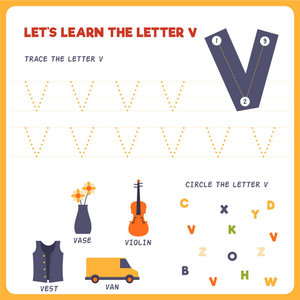
Pairing the worksheet with picture-vocabulary words like van, vest, or volcano lets teachers reinforce the letter-sound relationship at the same time students practice the physical shape, which supports both goals in one activity.
5. What classroom tools pair well with a letter V handwriting station?
A whiteboard for modeling, a shallow tray of sand or rice for multisensory tracing, and picture-vocabulary cards all extend the worksheet without requiring extra prep time.