


























Views
Downloads
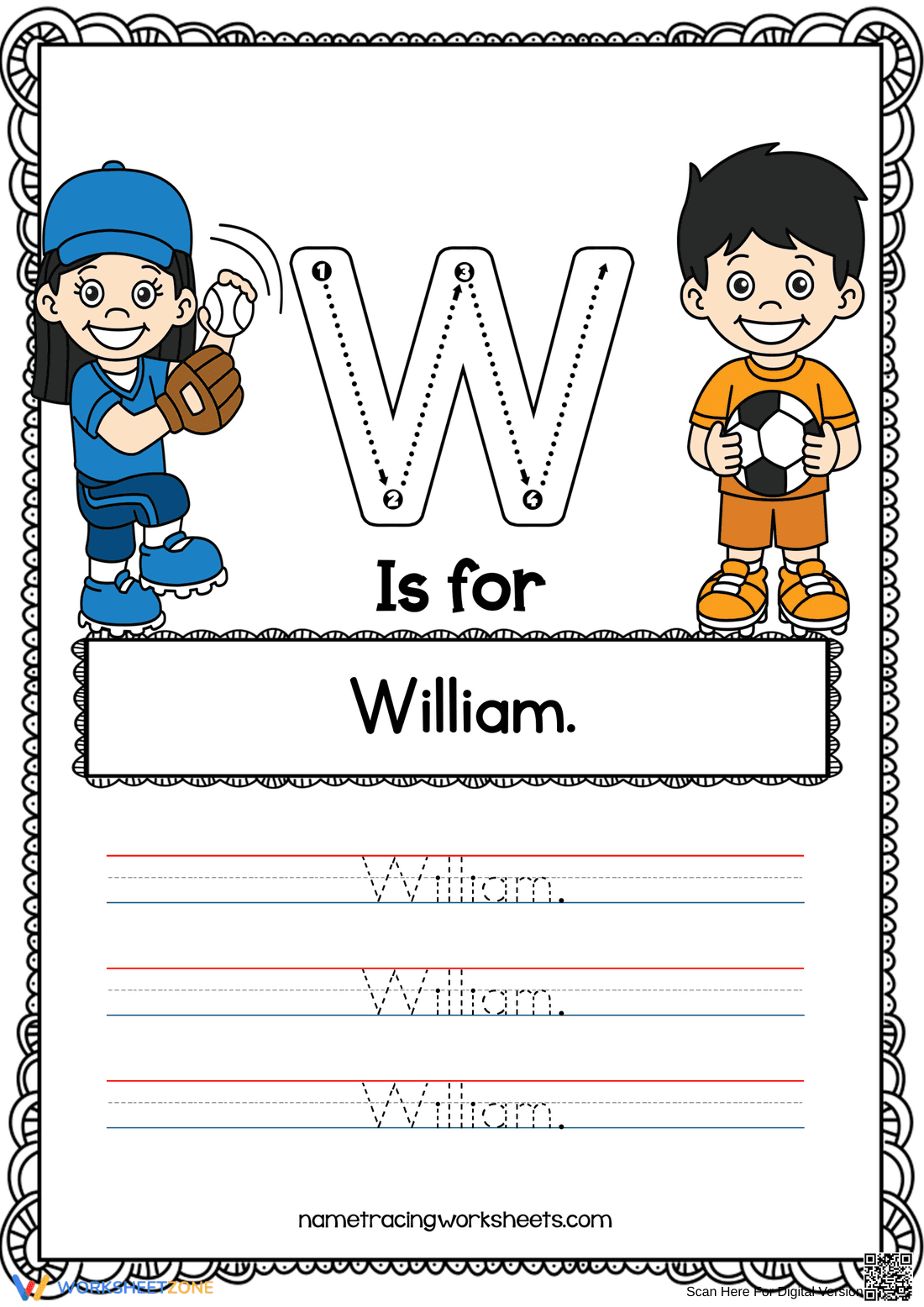

Tracing Name William | Essential Grade K-1 Worksheet
Paste this activity's link or code into your existing LMS (Google Classroom, Canvas, Teams, Schoology, Moodle, etc.).
Students can open and work on the activity right away, with no student login required.
You'll still be able to track student progress and results from your teacher account.
This name tracing worksheet helps young learners master the letter W and the specific spelling of the name William. By combining large-scale letter formation with repetitive line tracing, students develop the muscle memory needed for legible handwriting. It provides a clear, structured path from recognizing the initial letter to writing a full name independently.
At a Glance
- Grade: K-1 · Subject: Handwriting
- Standard:
CCSS.ELA-LITERACY.L.K.1.A— Print many upper- and lowercase letters correctly- Skill Focus: Letter W and Name Tracing
- Format: 1 page · 4 tasks · No-prep · PDF
- Best For: Morning work or name recognition practice
- Time: 5–10 minutes
Inside this resource, you will find a single-page PDF focused on the name William. It features a large uppercase W with numbered directional arrows to guide proper stroke order. Below the header, three primary-ruled lines provide dashed-line tracing practice for the full name, ensuring students maintain proper letter height and spacing throughout the exercise.
The zero-prep workflow is designed for busy educators. First, print the single-page PDF (30 seconds). Second, distribute the sheets to students during morning arrival or center rotations (1 minute). Third, review the stroke order for the letter W as a whole-class "air writing" exercise before students begin (30 seconds). Total teacher preparation time is under 2 minutes, making it a perfect sub-plan addition.
This worksheet aligns with CCSS.ELA-LITERACY.L.K.1.A, which requires students to print many upper- and lowercase letters. It specifically targets the uppercase W and the lowercase letters required to spell William. This standard code can be copied directly into lesson plans, IEP goals, or district curriculum mapping tools to document foundational writing progress and fine motor development.
Use this worksheet as a formative assessment during the first weeks of school to gauge fine motor control. It is best assigned after direct instruction on the letter W. Observe students to see if they follow the numbered arrows on the large W; this provides immediate insight into their understanding of top-to-bottom writing conventions. Completion typically takes 5 to 10 minutes depending on the student's level.
This resource is ideal for Kindergarten and first-grade students who are learning to identify and write their own names. It serves as an excellent differentiation tool for students needing extra fine motor support or letter-spacing practice. Pair this worksheet with a "Letter W" anchor chart or a name-recognition pocket chart activity for a comprehensive literacy lesson.
Handwriting remains a critical foundational skill in early literacy development. According to Fisher & Frey (2014), the gradual release of responsibility—moving from guided tracing to independent production—is essential for mastering complex motor tasks like letter formation. This worksheet utilizes that principle by providing a large, numbered model of the letter W followed by three lines of supported name tracing for the name William. Aligned with CCSS.ELA-LITERACY.L.K.1.A, the activity ensures students practice printing letters correctly within a meaningful context. Research from the NAEP suggests that early fluency in handwriting is a strong predictor of later writing quality and length, as it reduces the cognitive load on young writers. By focusing on a specific name, this resource increases student engagement and personal relevance while building the fine motor control necessary for academic success in Kindergarten and Grade 1.


