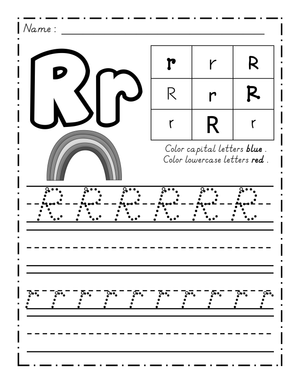
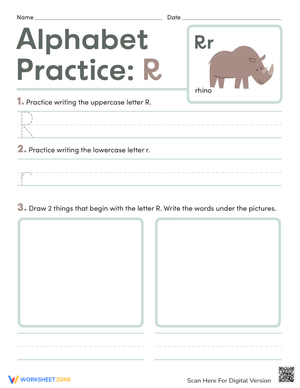
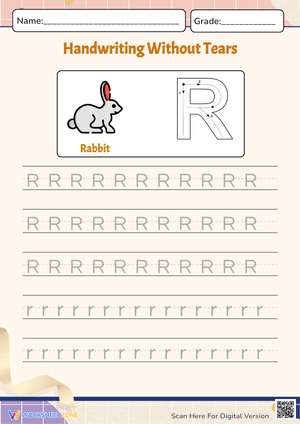
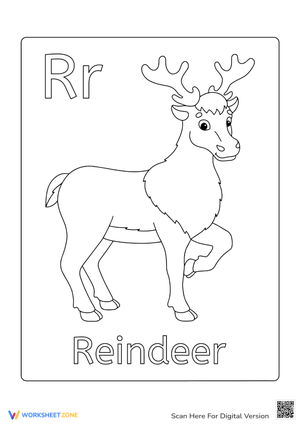
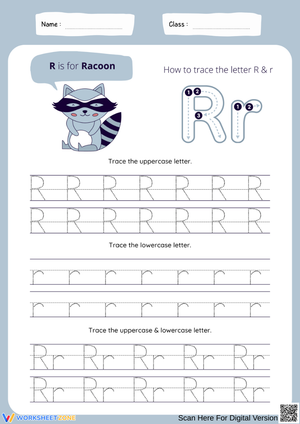
Letter R is one of the trickier letters for young writers because it combines a straight vertical stroke with a curved bump and a diagonal leg. Kindergarten teachers often notice students reversing the letter, drawing the curve too low, or skipping the diagonal entirely. A dedicated set of letter R handwriting worksheets for kindergarten gives students repeated, structured practice with both the uppercase R and lowercase r, which helps build the fine motor control and visual memory needed for consistent letter formation.
Handwriting practice at this age is not just about neat penmanship. It directly supports early reading. When a child traces and copies a letter repeatedly, that motor memory reinforces the visual shape the child needs to recognize instantly while decoding text. For a letter like R, which appears in common early vocabulary such as rabbit, red, and rain, strong formation practice pays off quickly in both writing and reading tasks.
Correct Stroke Order for Uppercase R and Lowercase r
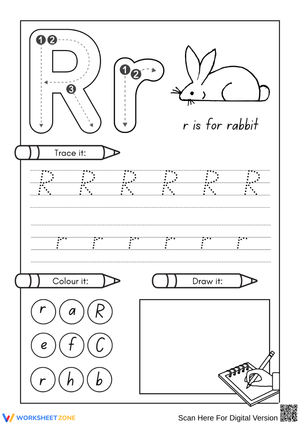
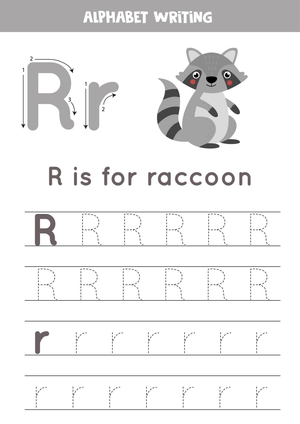
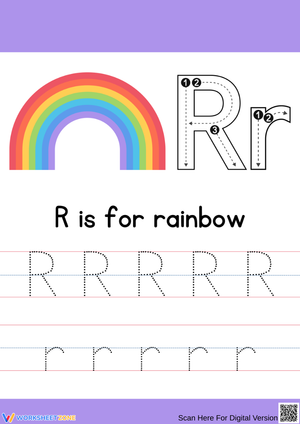
Consistent stroke order matters more than many teachers realize. Uppercase R begins with a top-to-bottom vertical line, followed by a curve that starts at the top and loops down to meet the middle of the line, then finishes with a diagonal stroke kicking out to the bottom right. Lowercase r is simpler: a short vertical line followed by a small curve at the top that hooks to the right, similar to a tiny flag.
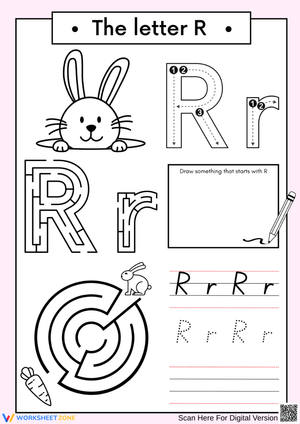
Worksheets that include numbered arrows and starting-point dots are especially useful for kindergarten because they remove the guesswork. Students who are shown exactly where to start and which direction to move tend to internalize the pattern faster than students who are only shown a finished model letter. Pairing each stroke with a verbal cue, such as saying down, curve, kick for uppercase R, gives auditory learners another way to anchor the sequence.
Sequencing a Letter R Lesson from Modeling to Independent Writing
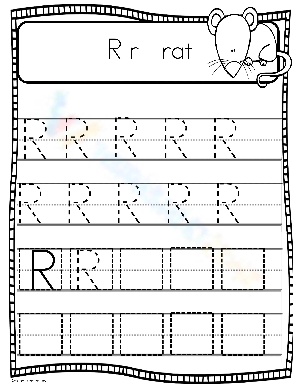
A well-paced Letter R lesson usually moves through four stages inside a fifteen to twenty minute block. First, the teacher introduces the letter sound and shows several R words on a chart or whiteboard. Second, the teacher models the stroke order on a large surface while narrating each movement. Third, students trace guided letters on the worksheet, often using a highlighted or dotted path. Finally, students attempt several rows of independent writing, comparing their letters to the model at the top of the page.
This gradual release format, sometimes summarized as I do, we do, you do, keeps kindergartners engaged without overwhelming them. Because attention spans are short at this age, splitting the lesson into these clear stages also makes it easier to pull a small group aside for extra modeling without disrupting the rest of the class.
Classroom Implementation For Kindergarten Classes
Letter R worksheets fit naturally into several parts of a kindergarten schedule. Many teachers use them during a literacy center rotation, morning work time, or as a five-minute warm-up before a full writing block. Because the practice does not require heavy supervision once students understand the routine, it works well as an independent station while the teacher runs a guided reading group.
- Keep daily letter practice short, around five to ten minutes, rather than one long weekly session.
- Store completed worksheets in a simple folder so students and families can see formation progress over the unit.
- Offer a slightly larger-lined version of the same worksheet for students who need more space, without turning this into a separate lesson.
- Use a quick partner check where students point to the starting dot on a friend's paper before beginning independent rows.
Some classrooms briefly adjust the number of guided rows a student completes based on how steady their pencil control looks that day, but this stays a light, in-the-moment adjustment rather than a separate program.
Frequently Asked Questions
1. How should teachers introduce the Letter R to kindergartners before handing out worksheets?
Start with the sound and a few familiar R words, then model the stroke order on a large surface while narrating each movement before students pick up a pencil.
2. How often should kindergarten students practice letter formation like Letter R each week?
Short daily sessions of five to ten minutes tend to work better than one long weekly session, since brief, repeated practice builds motor memory more reliably.
3. What is the correct stroke order for writing uppercase R and lowercase r?
Uppercase R starts with a vertical line, adds a top curve down to the middle, then finishes with a diagonal kick to the bottom right; lowercase r is a short vertical line with a small curved hook at the top.
4. How can teachers tell if a kindergartner is ready to move from tracing to independent writing of Letter R?
Watch for consistent starting points and proportion during guided tracing; once a student reliably starts in the right place without prompting, they are usually ready for independent rows.
5. What are simple ways to adjust a Letter R worksheet activity within a whole-class lesson?
Offer a version with larger lines for students who need more space, and let students who finish early underline their best-formed letters rather than rushing ahead to new material.