


























Views
Downloads
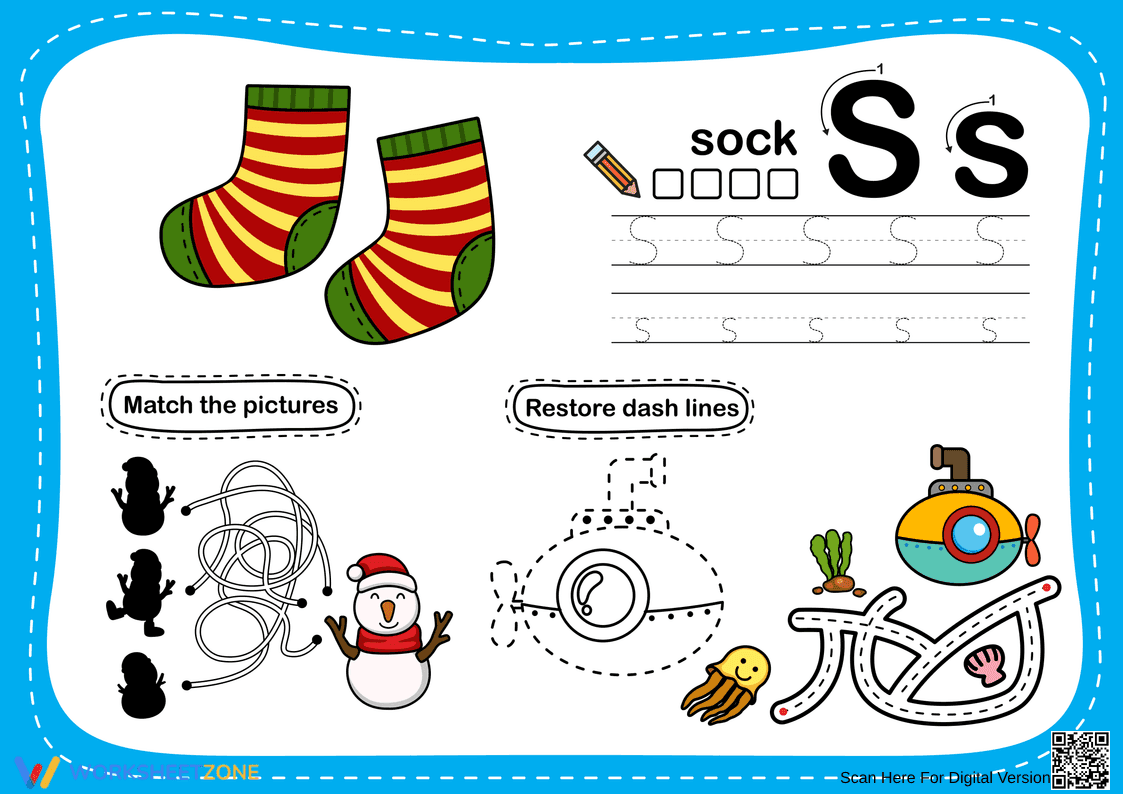

Letter S Alphabet Tracing Worksheet | Essential Grade K
Paste this activity's link or code into your existing LMS (Google Classroom, Canvas, Teams, Schoology, Moodle, etc.).
Students can open and work on the activity right away, with no student login required.
You'll still be able to track student progress and results from your teacher account.
This Letter S alphabet tracing worksheet helps early learners master uppercase and lowercase letter formation while building phonemic awareness. Students engage with the letter S through handwriting practice, visual discrimination tasks, and fine motor tracing. By connecting the letter shape to familiar objects like socks and snowmen, children solidify their foundational literacy skills effectively.
At a Glance
- Grade: Kindergarten · Subject: ELA
- Standard:
CCSS.ELA-LITERACY.RF.K.1.D— Recognize and name all upper- and lowercase letters of the alphabet- Skill Focus: Letter S formation and recognition
- Format: 1 page · 12 tasks · Answer key included · PDF
- Best For: Morning work or literacy centers
- Time: 10–15 minutes
This comprehensive single-page resource features two rows of guided tracing for both "S" and "s," providing 10 specific handwriting opportunities. Beyond simple penmanship, the worksheet includes a "Match the pictures" shadow-matching activity to sharpen visual discrimination and a "Restore dash lines" submarine illustration to strengthen fine motor control. The layout is clean, using high-contrast visuals to support young learners.
The zero-prep workflow is designed for busy educators. First, print the single-page PDF (30 seconds). Second, distribute to students during independent work blocks or as a quiet morning arrival activity (1 minute). Finally, review the completed shadow matches and tracing lines to check for grip strength and letter orientation (1 minute). This resource is an ideal sub-plan addition for early childhood classrooms.
This activity aligns with `CCSS.ELA-LITERACY.RF.K.1.D`, which requires students to recognize and name all upper- and lowercase letters. It also supports RF.K.3.A by linking the letter S to its primary phoneme through visual cues like the sock and snowman. Both standard codes can be copied directly into lesson plans, IEP goals, or district curriculum mapping tools.
Use this worksheet during the "You Do" phase of a gradual release model after introducing the letter S sound. It serves as an excellent formative assessment tool; observe if students start their "S" at the top or bottom to identify those needing corrective intervention. It typically takes 10 to 15 minutes for a kindergarten student to complete the entire page independently.
This resource is designed for preschool, kindergarten, and first-grade students who are developing letter-sound correspondence. It is particularly helpful for English Language Learners (ELLs) who benefit from the pictorial representations of "sock" and "snowman." Pair this worksheet with a tactile sand tray or an alphabet anchor chart for a multi-sensory learning experience that reinforces the lesson.
Research from RAND AIRS 2024 emphasizes that early handwriting practice is not merely a motor task but a critical component of orthographic mapping. When students trace the letter S while simultaneously viewing images that represent its sound, they create stronger neural pathways for reading readiness. This worksheet facilitates that connection by integrating 12 distinct tasks that move from isolated letter formation to contextual visual matching. Systematic exposure to letter shapes in various formats—such as the shadow matching and dashed-line restoration included here—prevents letter reversal and improves overall letter naming fluency. According to the NAEP, early mastery of the alphabet is one of the strongest predictors of later reading success. By providing structured, printable practice that requires minimal teacher intervention, this resource ensures that students receive the high-frequency exposure necessary for mastery of the CCSS.ELA-LITERACY.RF.K.1.D standard in a classroom setting.


