


























Views
Downloads
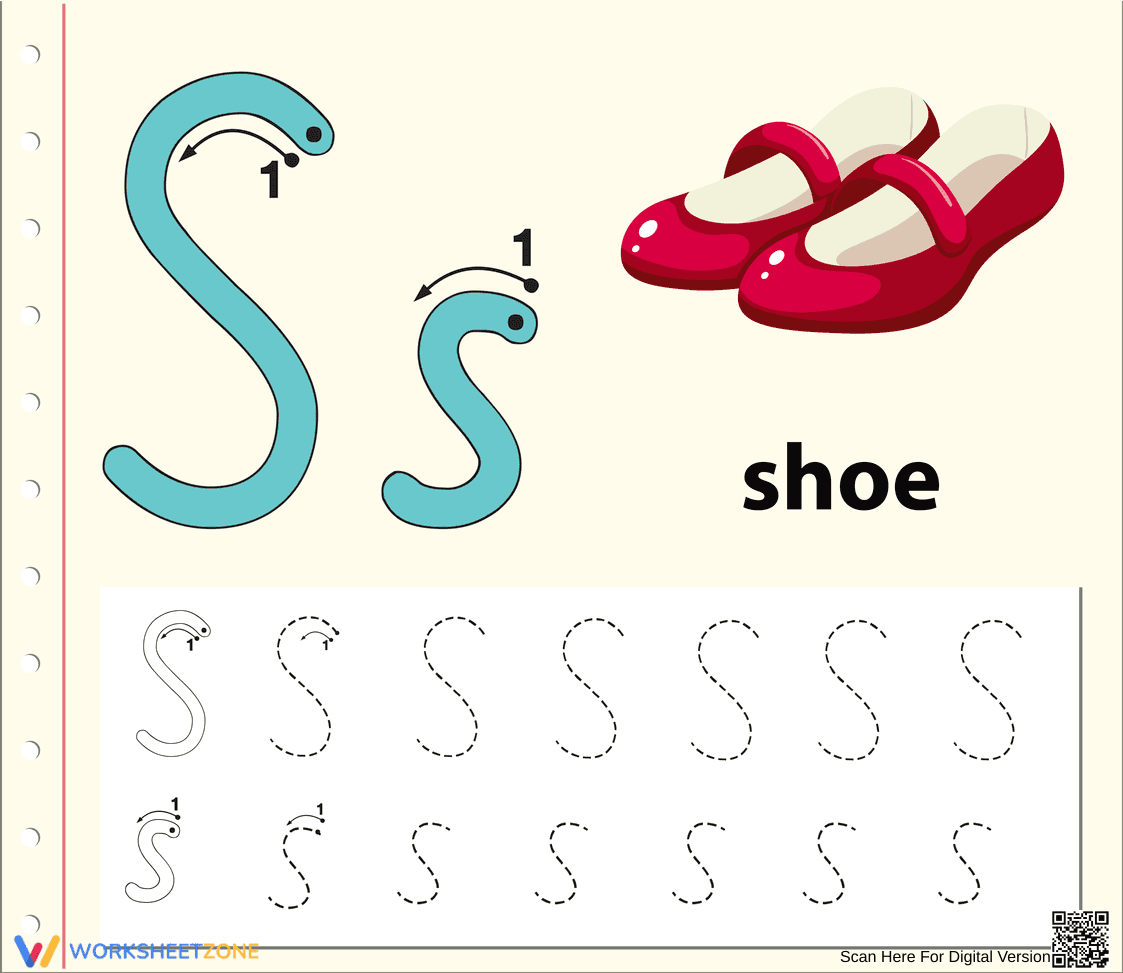

Printable Letter S Tracing Worksheet | Grade K
Paste this activity's link or code into your existing LMS (Google Classroom, Canvas, Teams, Schoology, Moodle, etc.).
Students can open and work on the activity right away, with no student login required.
You'll still be able to track student progress and results from your teacher account.
This foundational handwriting worksheet helps early learners master the letter S through guided tracing. By following clear stroke order arrows, students develop fine motor control and proper letter formation for upper and lowercase letters, ensuring confident handwriting as they begin their literacy journey.
At a Glance
- Grade: Kindergarten · Subject: Handwriting
- Standard:
CCSS.ELA-LITERACY.L.K.1.A— Print many upper- and lowercase letters- Skill Focus: Letter S Tracing
- Format: 1 page · 14 problems · Answer key included · PDF
- Best For: Independent practice centers
- Time: 10–15 minutes
This single-page resource features a large model of the uppercase and lowercase letter S with numbered directional arrows to guide stroke order. Alongside a visual cue of a shoe to reinforce phonetic connection, the page provides 14 dashed tracing models. The structured layout ensures ample repetition to build muscle memory. A completed reference model serves as the answer key.
Zero-Prep Workflow
This worksheet is designed for immediate classroom implementation.
- Print (1 minute): Simply print the PDF file.
- Distribute (1 minute): Hand out the sheets with pencils. The visual instructions are self-explanatory.
- Review (1 minute): Quickly check student work against the stroke models.
With a total teacher prep time of under 2 minutes, this resource is highly suitable for emergency sub plans or morning work.
Standards Alignment
This resource is directly aligned to CCSS.ELA-LITERACY.L.K.1.A, which requires students to print many upper- and lowercase letters. By providing explicit stroke order guidance, the worksheet ensures students meet foundational handwriting expectations. Both standard codes can be copied directly into lesson plans, IEP goals, or district curriculum mapping tools.
How to Use It
Use this tracing sheet during small group literacy centers after direct instruction, allowing students to practice independently. Alternatively, assign it as targeted morning work. As a formative assessment observation tip, watch closely to ensure students start strokes from the top and follow the numbered arrows. Expected completion time ranges from 10 to 15 minutes.
Who It's For
This resource is primarily designed for Kindergarten students developing foundational fine motor skills. It is also effective for first-grade students needing remedial practice. To differentiate, provide textured materials over the large models for tactile learners. This worksheet pairs perfectly with a direct instruction lesson on the /s/ sound or an alphabet anchor chart.
Mastering proper letter formation is a critical stepping stone in early literacy development. Aligned with CCSS.ELA-LITERACY.L.K.1.A, this resource helps students print many upper- and lowercase letters accurately. According to a comprehensive ScienceDirect TpT Analysis, explicit handwriting instruction that incorporates directional arrows and structured tracing significantly improves both legibility and writing fluency in early elementary students. When children internalize correct stroke order, they reduce the cognitive load required for physical writing, freeing up mental resources for higher-order tasks like spelling and composition. By providing clear visual models and repetitive practice, this worksheet supports the development of automaticity in fine motor skills. Consistent practice with guided tracing paths ensures that students build the necessary muscle memory to transition smoothly from tracing to independent letter production, laying a strong foundation for future academic success.


