


























Views
Downloads

Lowercase Letter s Worksheet | Printable Grade K ELA
Paste this activity's link or code into your existing LMS (Google Classroom, Canvas, Teams, Schoology, Moodle, etc.).
Students can open and work on the activity right away, with no student login required.
You'll still be able to track student progress and results from your teacher account.
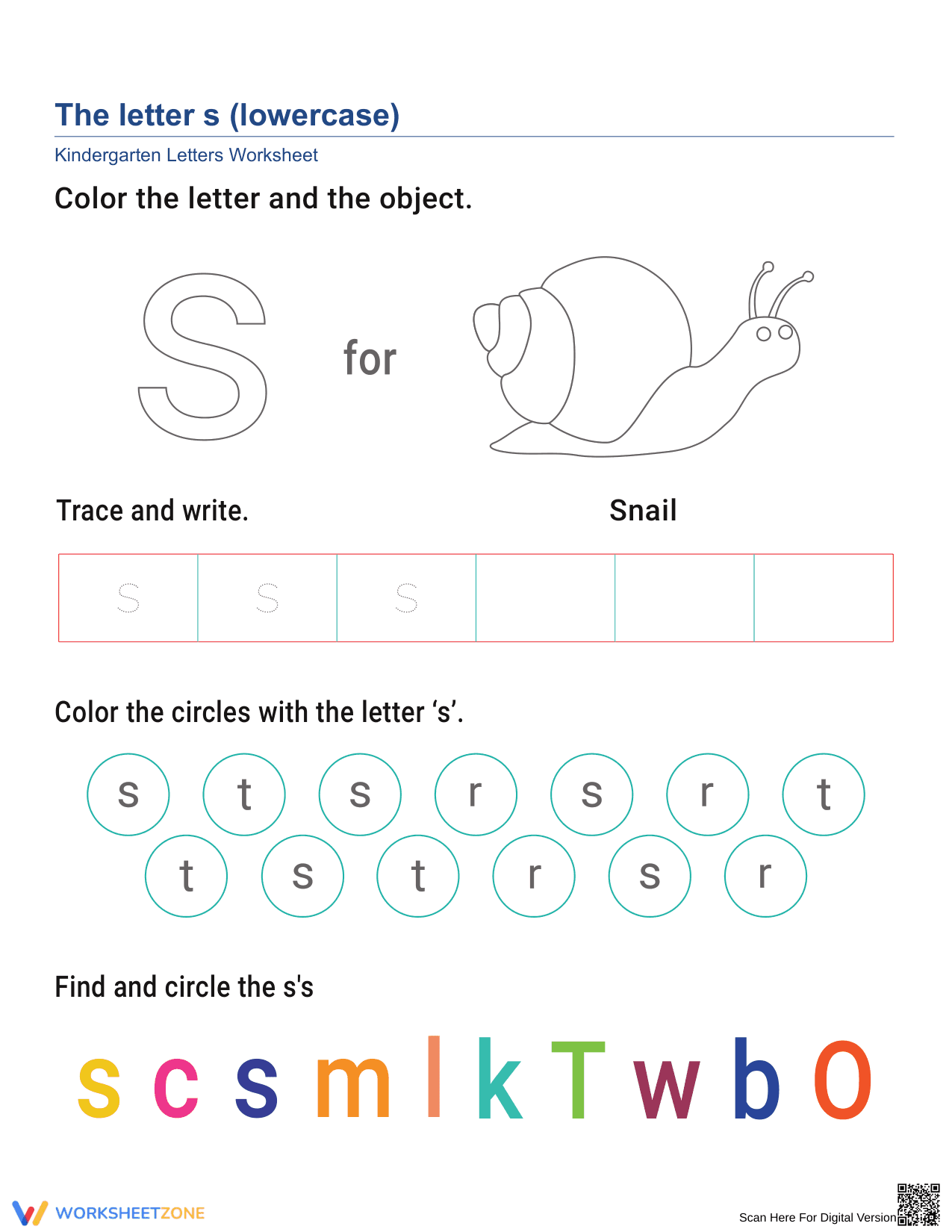
This foundational lowercase letter s worksheet helps early learners build essential alphabet recognition and handwriting skills. By engaging with targeted tracing and visual discrimination activities, students develop the fine motor control and letter-sound correspondence necessary for fluent reading and writing.
At a Glance
- Grade: Kindergarten · Subject: ELA
- Standard:
CCSS.ELA-LITERACY.RF.K.1.D— Recognize and name all lowercase letters- Skill Focus: Lowercase letter s recognition
- Format: 1 page · 4 problems · No answer key · PDF
- Best For: Independent practice
- Time: 10–15 minutes
This single-page resource features four distinct activity zones designed to reinforce letter mastery. Students begin by coloring a large letter 's' alongside a corresponding snail illustration to build phonetic connections. Next, a tracing section provides guided handwriting practice with dotted lines and blank spaces. The bottom half includes two visual discrimination tasks: coloring specific circles containing the target letter among distractors, and finding the letter 's' hidden within a colorful sequence of mixed alphabet characters.
Zero-Prep Workflow
- Print (1 minute): Simply download the PDF and print the single-page layout. No special cutting or laminating is required.
- Distribute (1 minute): Hand out the sheets along with crayons and pencils. The visual instructions are intuitive for early learners.
- Review (3 minutes): Quickly scan student work to check for proper letter formation and accurate identification among the distractor letters.
With a total teacher preparation time of under two minutes, this resource is highly suitable for morning work, literacy centers, or emergency substitute plans.
Standards Alignment
This activity aligns directly with CCSS.ELA-LITERACY.RF.K.1.D, requiring students to recognize and name all upper- and lowercase letters of the alphabet. It also supports foundational handwriting skills by having students form the letter independently. Both standard codes can be copied directly into lesson plans, IEP goals, or district curriculum mapping tools.
How to Use It
Deploy this worksheet during morning arrival as a quiet, focused task, or integrate it into small-group literacy centers after direct instruction on the /s/ sound. As students complete the visual discrimination sections, observe whether they confuse the lowercase 's' with similarly shaped letters or if they struggle with the left-to-right tracing motion. This formative assessment tip helps identify students needing targeted handwriting intervention. Expected completion time ranges from 10 to 15 minutes.
Who It's For
This resource is designed primarily for preschool and kindergarten students mastering the alphabet. For students requiring additional support, provide a tactile sand tray for tracing before they attempt the pencil-and-paper task. Advanced learners can be challenged to write words starting with 's' on the back of the page. Pair this worksheet with a read-aloud book focusing on the /s/ sound or a classroom alphabet anchor chart.
Mastering alphabet knowledge, specifically the ability to recognize and name all lowercase letters as outlined in CCSS.ELA-LITERACY.RF.K.1.D, is a critical predictor of later reading success. According to a comprehensive EdReports 2024 analysis of foundational literacy programs, explicit instruction combined with immediate, varied practice opportunities significantly improves letter-sound retention in early childhood settings. This worksheet provides that essential varied practice by combining fine motor tracing with visual discrimination tasks. When students actively search for the target letter among distractors, they strengthen their orthographic mapping capabilities. Providing young learners with structured, multimodal activities—such as coloring, tracing, and scanning—ensures that foundational skills are solidified before moving on to complex phonics instruction. Consistent exposure to these targeted exercises builds the automaticity required for fluent decoding and confident early writing.


