


























Views
Downloads

Letter S Tracing Worksheet | Printable Kindergarten
Paste this activity's link or code into your existing LMS (Google Classroom, Canvas, Teams, Schoology, Moodle, etc.).
Students can open and work on the activity right away, with no student login required.
You'll still be able to track student progress and results from your teacher account.
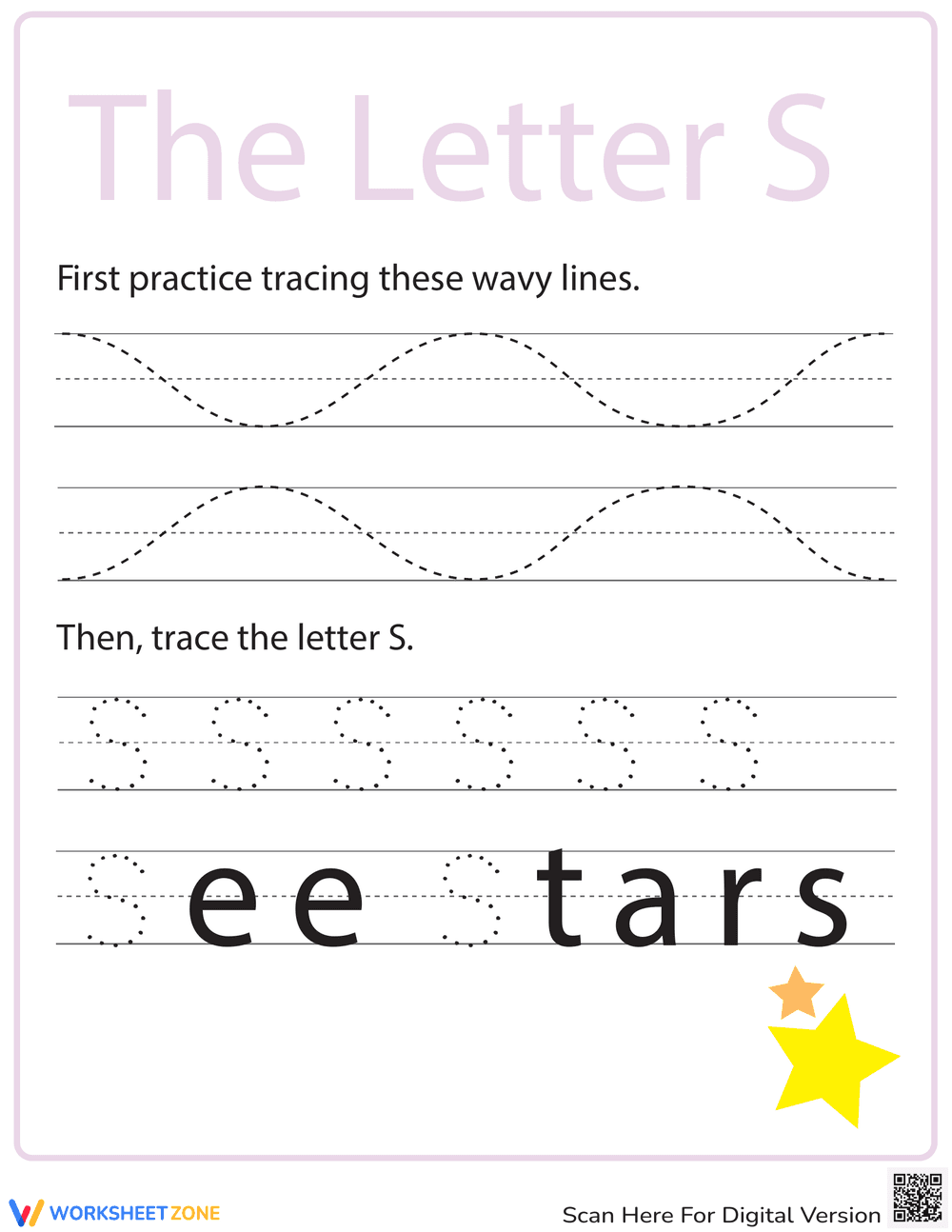
This printable Letter S worksheet builds early handwriting skills by guiding Pre-K and Kindergarten students through three progressive tracing tasks — wavy lines, the uppercase and lowercase letter S, and the sight phrase "see stars" — so young writers gain muscle memory for the S stroke before writing independently.
At a Glance
- Grade: Preschool–Kindergarten · Subject: Handwriting / ELA
- Standard:
CCSS.ELA-LITERACY.L.K.1a— Print many upper- and lowercase letters with correct formation- Skill Focus: Letter S stroke formation and tracing
- Format: 1 page · 3 tracing tasks · No answer key required · PDF
- Best For: Morning warm-up or literacy center work
- Time: 5–10 minutes
Inside: one page with three task rows. Row 1 traces wavy lines to warm up fine-motor control. Row 2 traces dotted uppercase and lowercase S letters across the full line. Row 3 traces the phrase "see stars" in manuscript print, reinforced by a fun star illustration that anchors the letter sound. No word bank or sentence frames needed — the visual cue does the work.
Zero-Prep Workflow
- Print (under 1 minute): Download PDF, print single-sided — one copy per student or laminate for reuse with dry-erase markers.
- Distribute (30 seconds): Hand out with a pencil or crayon. No cutting, folding, or assembly required.
- Review (1–2 minutes): Do a quick whole-class air-trace of the S stroke before students begin. Total teacher prep: under 2 minutes. Fully suitable for a substitute plan — no prior knowledge of the lesson sequence needed.
Standards Alignment
Primary standard: CCSS.ELA-LITERACY.L.K.1a — Print many upper- and lowercase letters. Supporting standard: CCSS.ELA-LITERACY.RF.K.1d — recognize and name all upper- and lowercase letters of the alphabet, reinforced by the letter-sound illustration. Both standard codes can be copied directly into lesson plans, IEP goals, or district curriculum mapping tools.
How to Use It
Use before direct instruction as a fine-motor warm-up: students trace wavy lines while the teacher models S formation on the board. Use during a literacy center as independent practice after whole-group letter introduction. Formative tip: watch pencil grip and stroke direction on Row 2 — students who reverse the S curve need immediate corrective modeling. Expected completion: 5–10 minutes for most Pre-K and Kindergarten writers.
Who It's For
Primary population: Pre-K and Kindergarten students in early letter-formation instruction. Works equally well for students needing handwriting remediation in Grade 1. Pairs naturally with an S anchor chart showing the verbal path check ("curve back, curve forward") and a read-aloud featuring the /s/ sound. Students with fine-motor delays benefit from the wavy-line warm-up row before attempting the letter itself.
Structured handwriting practice with progressive tracing tasks supports letter formation accuracy in early writers. CCSS.ELA-LITERACY.L.K.1a requires students to print upper- and lowercase letters correctly — a foundational skill that predicts later writing fluency. According to a ScienceDirect TpT Analysis of high-use early literacy resources, single-letter tracing worksheets with embedded phonics cues (such as an illustration anchoring the letter sound) rank among the most frequently assigned Pre-K and Kindergarten handwriting tools, reflecting teacher demand for focused, low-prep practice. This worksheet addresses that need with a three-task sequence — motor warm-up, letter tracing, word tracing — that mirrors gradual-release principles without requiring teacher facilitation beyond initial modeling. One page, one skill, measurable pencil-to-paper output.


