


























Views
Downloads
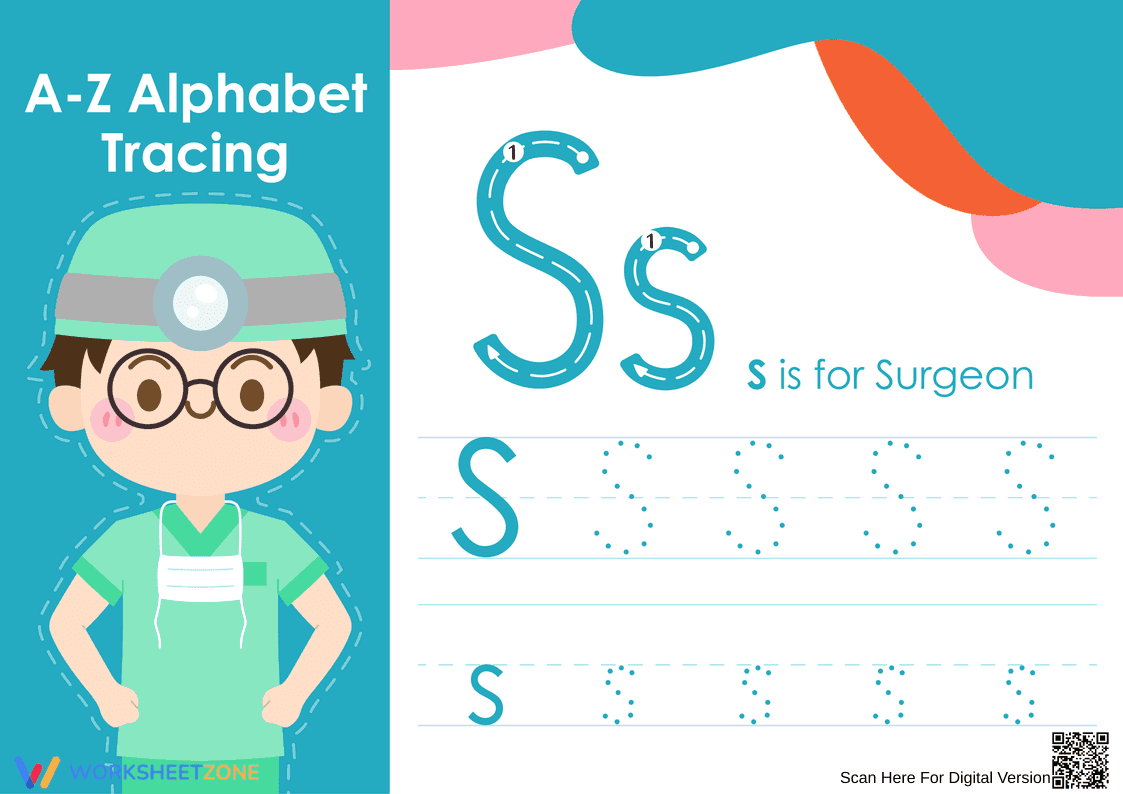

Letter S Tracing Worksheet | Essential Preschool ELA
Paste this activity's link or code into your existing LMS (Google Classroom, Canvas, Teams, Schoology, Moodle, etc.).
Students can open and work on the activity right away, with no student login required.
You'll still be able to track student progress and results from your teacher account.
This Letter S tracing worksheet helps early learners master uppercase and lowercase letter formation through guided penmanship practice. By connecting the letter 'S' to the "Surgeon" concept, students develop both fine motor skills and initial phonics awareness. It provides a structured path from visual recognition to independent printing.
At a Glance
- Grade: Preschool · Subject: ELA
- Standard:
CCSS.ELA-LITERACY.L.K.1.A— Print many upper- and lowercase letters of the alphabet- Skill Focus: Letter S Formation
- Format: 1 page · 10 tasks · No key needed · PDF
- Best For: Early literacy centers and handwriting practice
- Time: 10–15 minutes
What's Inside
Inside this single-page PDF, you will find large directional guide letters for both 'S' and 's' to show proper stroke order. The worksheet features two dedicated rows for tracing, containing 8 dotted-line practice opportunities. A colorful "S is for Surgeon" illustration provides a memorable mnemonic for phonemic awareness and vocabulary building.
Skill Progression
- Guided practice: Students begin by following numbered arrows on large-format letters to understand the "snake" curve of the letter S.
- Supported practice: 8 dotted-line letters provide a scaffold for students to trace the shape with decreasing visual assistance.
- Independent practice: The final section allows students to attempt the letter form within standard primary lines to ensure proper sizing.
This gradual-release approach moves students from observation to tactile mastery using the I Do, We Do, You Do model.
Standards Alignment
This resource aligns with CCSS.ELA-LITERACY.L.K.1.A, which requires students to print many upper- and lowercase letters. It also supports CCSS.ELA-LITERACY.RF.K.1.D by reinforcing letter recognition. Both standard codes can be copied directly into lesson plans, IEP goals, or district curriculum mapping tools.
How to Use It
Use this worksheet during your "Letter of the Week" curriculum as a morning work activity or a literacy center rotation. For formative assessment, observe the student's grip and stroke direction—ensure they start at the top. Completion typically takes 10 to 15 minutes depending on fine motor development.
Who It's For
This is designed for preschool and kindergarten students who are transitioning from basic line drawing to formal letter writing. It is an ideal pairing for alphabet anchor charts or phonics readers. The visual cues make it accessible for English Language Learners and students receiving occupational therapy support.
According to the RAND AIRS 2024 report, early tactile engagement with letter forms is a critical predictor of later reading fluency. This worksheet addresses the foundational need for orthographic mapping by combining visual letter recognition with the physical act of tracing. By focusing on the specific "S" sound through the "Surgeon" example, the resource bridges the gap between phonemic awareness and grapheme production. Research from Fisher & Frey (2014) emphasizes that repeated, scaffolded practice in letter formation reduces the cognitive load on young writers, allowing them to eventually focus on composition rather than mechanics. This printable provides 10 specific tracing tasks that align with evidence-based instructional strategies for early childhood literacy development. The inclusion of both cases ensures students recognize the letter in various textual contexts, meeting core kindergarten standards for alphabet mastery.


