


























Views
Downloads
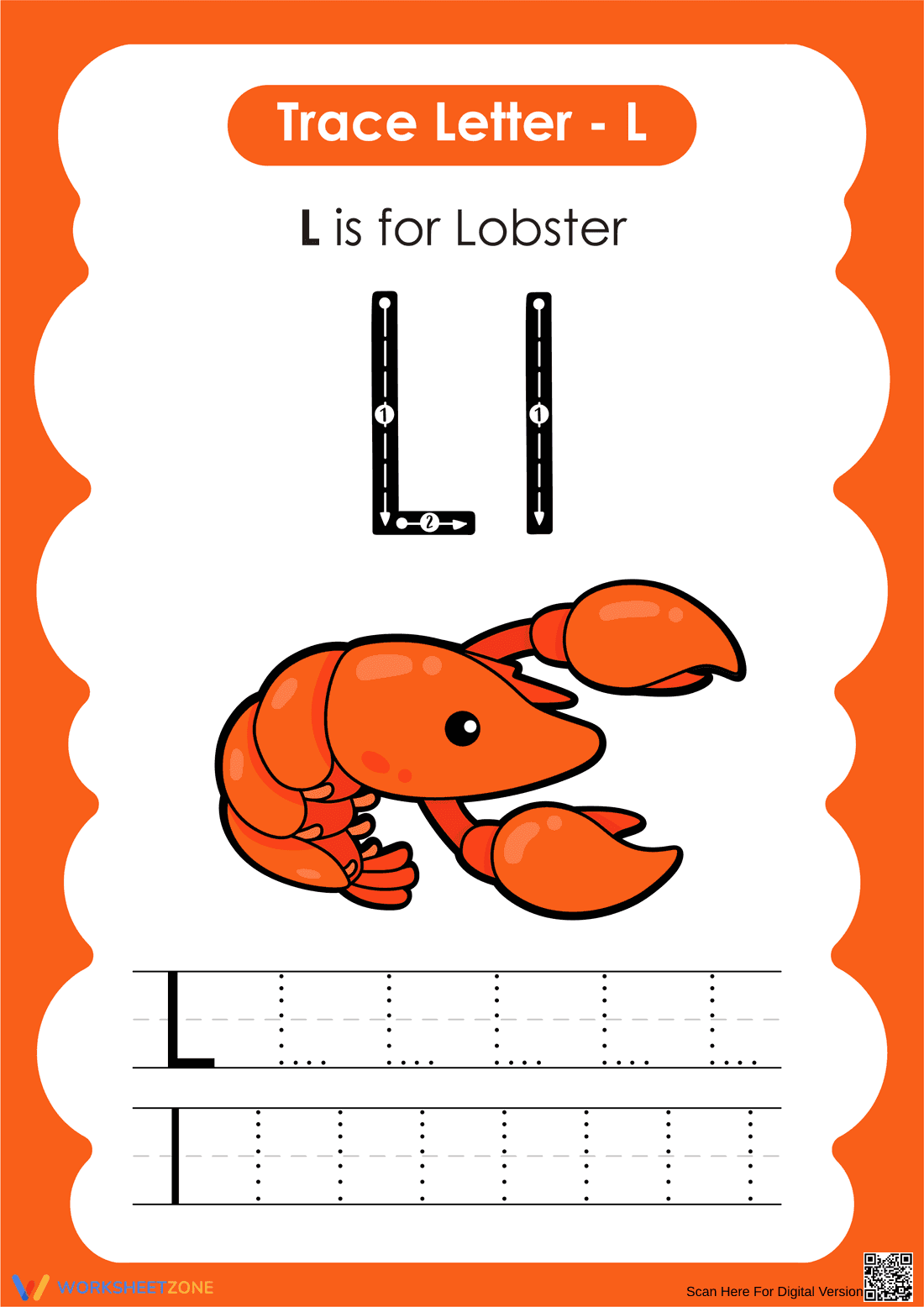

Printable Letter L Tracing Worksheet | Kindergarten ELA
Paste this activity's link or code into your existing LMS (Google Classroom, Canvas, Teams, Schoology, Moodle, etc.).
Students can open and work on the activity right away, with no student login required.
You'll still be able to track student progress and results from your teacher account.
This printable Letter L tracing worksheet helps early learners develop fine motor skills and alphabet recognition. Students practice forming both uppercase and lowercase letters using guided directional arrows and standard handwriting lines. This foundational activity builds confidence in early writing and connects the letter L to its phonetic sound through a fun lobster illustration.
At a Glance
- Grade: Kindergarten · Subject: ELA
- Standard:
CCSS.ELA-LITERACY.L.K.1.A— Print many upper- and lowercase letters- Skill Focus: Letter L formation and tracing
- Format: 1 page · 10 problems · No answer key · PDF
- Best For: Independent practice and centers
- Time: 5–10 minutes
This single-page resource features a clear layout for early writers. It includes a large, guided example of the uppercase and lowercase letter L with numbered directional arrows for proper stroke order. Below the colorful lobster visual, students find two rows of primary handwriting lines containing ten dotted letters for tracing practice. The clean design minimizes distractions, allowing learners to focus on pencil grip and letter formation.
Zero-Prep Workflow
- Print (1 minute): Download the PDF and print copies. The design prints beautifully in color or grayscale.
- Distribute (1 minute): Hand out the worksheets with pencils. The visual cues make the task immediately obvious.
- Review (1 minute): Quickly check work for proper stroke direction. Total teacher prep time is under two minutes, making this an excellent addition to any sub plan or morning routine.
Standards Alignment
This worksheet is directly aligned to CCSS.ELA-LITERACY.L.K.1.A, requiring students to print many upper- and lowercase letters. By providing explicit stroke order guides and structured practice lines, the activity ensures students build the muscle memory necessary for fluent handwriting. Both standard codes can be copied directly into lesson plans, IEP goals, or district curriculum mapping tools.
How to Use It
Use this worksheet during morning work to establish a calm, focused start to the day, or place it in a literacy center for independent practice. Before assigning the page, model the letter formation on a whiteboard, emphasizing the top-to-bottom and left-to-right strokes. As a formative assessment tip, observe students while they trace the large letters at the top; watch their starting points to correct any bottom-up writing habits early. Expected completion time is 5 to 10 minutes.
Who It's For
This resource is ideal for preschool, kindergarten, and first-grade students who are mastering the alphabet and basic handwriting skills. It serves as an excellent intervention tool for students struggling with fine motor control or letter reversals. Pair this worksheet with a read-aloud book featuring the letter L or a tactile activity like tracing letters in sand to reinforce the learning through multiple modalities.
Effective handwriting instruction requires explicit modeling and structured repetition to build lasting muscle memory. According to Fisher & Frey (2014), providing clear visual cues and guided practice is essential for developing automaticity in early literacy skills, allowing cognitive resources to be freed up for complex composition later. This worksheet directly targets CCSS.ELA-LITERACY.L.K.1.A by helping students print many upper- and lowercase letters accurately. The inclusion of numbered directional arrows ensures that young learners internalize the correct motor patterns from the very beginning, significantly reducing the likelihood of ingrained errors or letter reversals. By combining engaging visual anchors, such as the lobster illustration, with targeted tracing tasks, educators can support both phonetic awareness and fine motor development simultaneously. This targeted approach to letter formation builds the foundational transcription skills necessary for higher-order writing tasks as students progress through early elementary grades.


