


























Views
Downloads

Essential Letter L Tracing Worksheet | Grade K-1
Paste this activity's link or code into your existing LMS (Google Classroom, Canvas, Teams, Schoology, Moodle, etc.).
Students can open and work on the activity right away, with no student login required.
You'll still be able to track student progress and results from your teacher account.
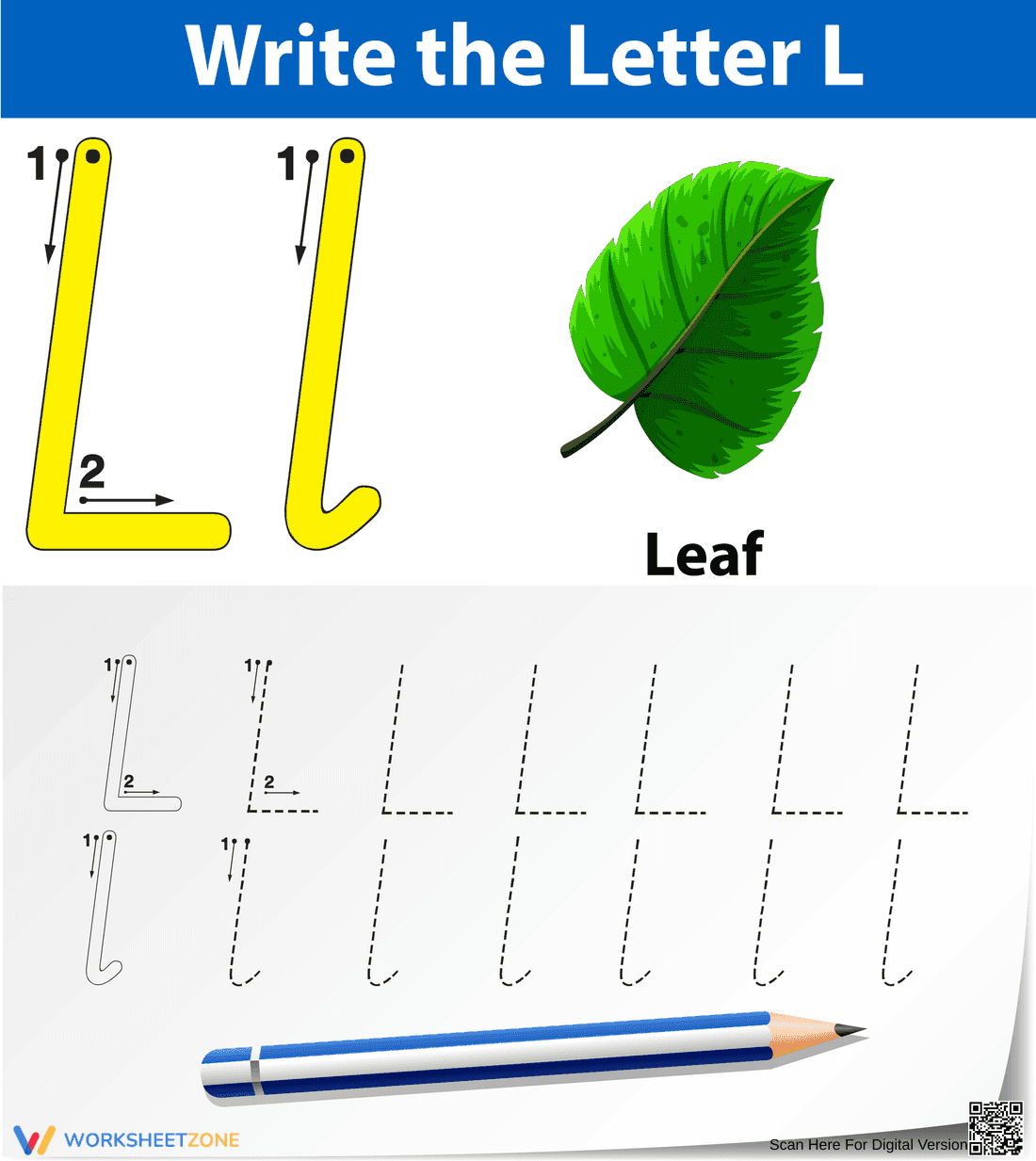
This Grade K-1 Letter L tracing worksheet provides students with 14 structured opportunities to master uppercase letter formation in both print and cursive styles. By combining visual cues with repetitive motor practice, students build the muscle memory necessary for legible handwriting. This resource bridges the gap between letter recognition and active production.
At a Glance
- Grade: Kindergarten · Subject: Handwriting
- Standard:
CCSS.ELA-LITERACY.L.K.1.A— Print many upper- and lowercase letters accurately- Skill Focus: Letter L formation
- Format: 1 page · 14 problems · Answer key included · PDF
- Best For: Morning work or literacy centers
- Time: 10–15 minutes
This single-page PDF features two large instructional models with directional arrows to guide initial strokes. Below, students engage with 7 print 'L' tracing tasks and 7 cursive 'L' tracing tasks. The inclusion of a vibrant "Leaf" illustration reinforces phonemic awareness and vocabulary association, making the abstract letter form concrete for young learners.
Zero-Prep Workflow
- Print: Select the single-page PDF and print enough copies for your cohort (30 seconds).
- Distribute: Hand out sheets during morning arrival or literacy rotations (1 minute).
- Review: Circulate to check for proper pencil grip and stroke direction as students complete the 14 tasks (Ongoing).
Total teacher preparation time is under 2 minutes, making this an ideal solution for busy mornings or unexpected sub plans.
Standards Alignment
The primary focus is `CCSS.ELA-LITERACY.L.K.1.A`, which requires students to print many upper- and lowercase letters. While this sheet focuses specifically on the uppercase 'L', it provides the foundational motor control required for the broader standard. Both standard codes can be copied directly into lesson plans, IEP goals, or district curriculum mapping tools.
How to Use It
Use this worksheet as a quiet morning work activity to settle students as they enter the classroom. It also serves as an excellent formative assessment tool during small-group literacy centers; observe if students follow the numbered stroke guides (1 and 2) or if they revert to bottom-up drawing. Expected completion time ranges from 10 to 15 minutes depending on fine motor development.
Who It's For
This resource is designed for preschool, kindergarten, and first-grade students developing early literacy skills. It is particularly helpful for students requiring extra fine motor support or those being introduced to cursive forms. Pair this with a "Letter L" anchor chart or a read-aloud book featuring "L" vocabulary like "leaf" or "lion."
Effective handwriting instruction in early childhood is a predictor of later reading and writing success. According to Fisher & Frey (2014), the gradual release of responsibility begins with clear modeling, which this worksheet provides through numbered stroke arrows. By practicing the CCSS.ELA-LITERACY.L.K.1.A standard through 14 specific tracing tasks, students move from guided observation to independent motor execution. Research from the NAEP suggests that early mastery of letter formation allows cognitive resources to be redirected toward higher-level composition tasks in later grades. This worksheet's dual focus on print and cursive 'L' supports diverse curriculum requirements across different school districts. The inclusion of a vocabulary anchor like "Leaf" ensures that the phonemic connection is maintained during motor practice, a key component of the Science of Reading. This resource provides a structured, evidence-based approach to early handwriting development.


