


























Views
Downloads

Uppercase Letter L Worksheet | Essential Kindergarten Ready
Paste this activity's link or code into your existing LMS (Google Classroom, Canvas, Teams, Schoology, Moodle, etc.).
Students can open and work on the activity right away, with no student login required.
You'll still be able to track student progress and results from your teacher account.
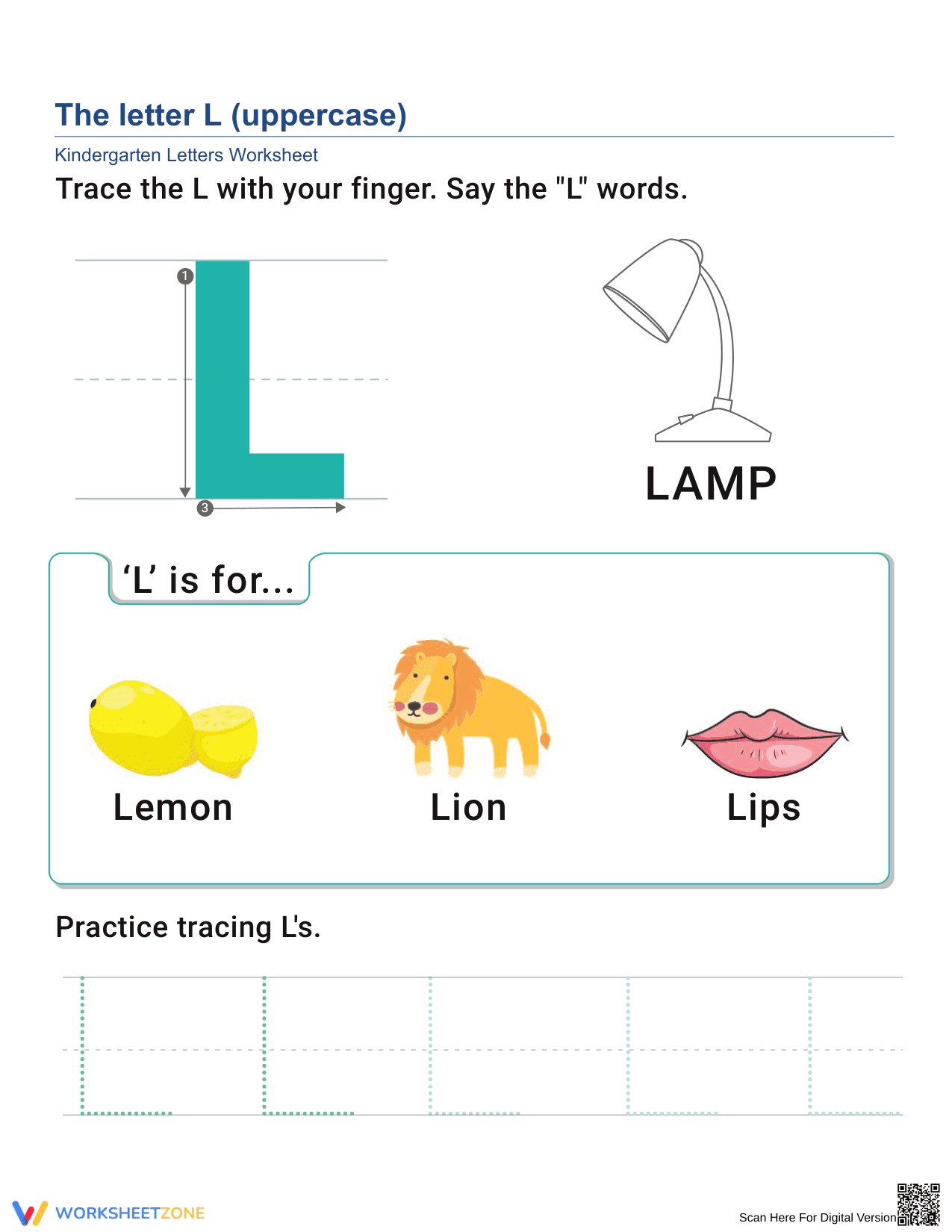
This Kindergarten uppercase Letter L worksheet helps early learners master letter formation and phonemic awareness through tactile tracing and visual word association. Students develop the fine motor skills necessary for handwriting while connecting the letter L to familiar objects like lions and lemons. This resource ensures a solid foundation for early literacy.
At a Glance
- Grade: Kindergarten · Subject: ELA Alphabet
- Standard:
CCSS.ELA-LITERACY.RF.K.1.D— Recognize and name all upper- and lowercase letters of the alphabet- Skill Focus: Uppercase L formation
- Format: 1 page · 9 tasks · No-prep · PDF
- Best For: Morning work or literacy centers
- Time: 10–15 minutes
The worksheet features a large-format finger-tracing guide with directional arrows to ensure correct stroke order. Below the tactile guide, a vocabulary box highlights four L words—lamp, lemon, lion, and lips—with clear illustrations. The final section provides four dedicated tracing boxes on primary-ruled lines for independent handwriting practice, allowing students to transition from guided to independent work.
The zero-prep workflow is designed for maximum efficiency in busy classrooms. First, print the single-page PDF in under 30 seconds. Second, distribute to students during small group rotations or as a whole-class warm-up. Third, review the letter sound and vocabulary words together to reinforce phonemic connections. Total teacher preparation time is under 2 minutes, making this an ideal resource for sub plans.
This resource aligns with `CCSS.ELA-LITERACY.RF.K.1.D`, which requires students to recognize and name all uppercase letters. It also supports `CCSS.ELA-LITERACY.L.K.1.A` by encouraging the print of many upper- and lowercase letters. Both standard codes can be copied directly into lesson plans, IEP goals, or district curriculum mapping tools to ensure compliance with state and national frameworks.
Use this worksheet during the instructional phase of a handwriting lesson by modeling the finger trace on an interactive whiteboard. For formative assessment, observe students during the independent tracing section to check for proper pencil grip and top-to-bottom stroke direction. Expected completion time is 10 to 15 minutes, fitting perfectly into a standard literacy block.
This activity is ideal for preschool and kindergarten students beginning their literacy journey. It provides necessary scaffolding for students with fine motor delays through the large-scale tracing guide. Pair this with a letter L alphabet song or a physical object hunt in the classroom for a multi-sensory experience that supports diverse learners and English Language Learners.
According to the RAND AIRS 2024 report, early letter recognition is one of the strongest predictors of later reading success. This worksheet targets CCSS.ELA-LITERACY.RF.K.1.D by integrating visual, tactile, and auditory cues to solidify the uppercase L in a student's long-term memory. Research from Fisher & Frey (2014) emphasizes that gradual release models, starting with guided tactile tracing before moving to independent pencil work, significantly improve handwriting fluency in early childhood settings. By providing clear visual anchors like the Lion and Lemon, this resource ensures that students build a robust phonological foundation alongside mechanical writing skills. This structured approach to alphabet instruction is essential for meeting foundational literacy benchmarks and preparing students for more complex phonetic blending tasks in subsequent grades. The inclusion of 9 specific tasks provides enough repetition to ensure mastery without overwhelming young learners.


